
Data annotation is the act of labeling or tagging raw data—like images, text, audio, or video—with specific information so that machine learning and AI systems can understand, learn from, and make accurate predictions using that data.
Managing AI and machine learning projects today often feels like wrestling chaos: models break, predictions fail, and “smart” products underperform. I have seen this firsthand as development teams rush to deploy solutions but overlook one key piece—good data annotation.
The real issue is not just about collecting data. It’s about making that data clear, labeled, and suitable for AI to learn. Miss this step, and no amount of clever coding will save your project from error or bias.
In this guide, I will explain what data annotation is, why it matters, the main annotation types, who does the work, best tools, common pitfalls, and how you can get started or improve your current process.
Why Is Data Annotation Critical for AI and Machine Learning?
Data annotation is the backbone of AI model training. Without clear, labeled data, even the most advanced machine learning algorithms cannot learn or make sense of the world.
In my experience, successful machine learning projects all start with well-annotated data. Machine learning (ML) models use this labeled data as “ground truth” to recognize patterns, learn relationships, and make decisions. This is especially important in supervised learning, where the model learns by example.
When teams skip proper annotation or use low-quality data, their AI systems can become biased, make wrong predictions, or fail completely. I have seen this happen in fields ranging from healthcare to robotics. A single labeling error can make an AI system unsafe or useless.
The impact of good annotation reaches across all AI sectors—computer vision (image analysis), natural language processing (text tasks), robotics (object grasping), and beyond. In 2026, as more industries use AI, the demand for precise annotation continues to grow.
What Are the Main Types of Data Annotation? (With Visual Examples)
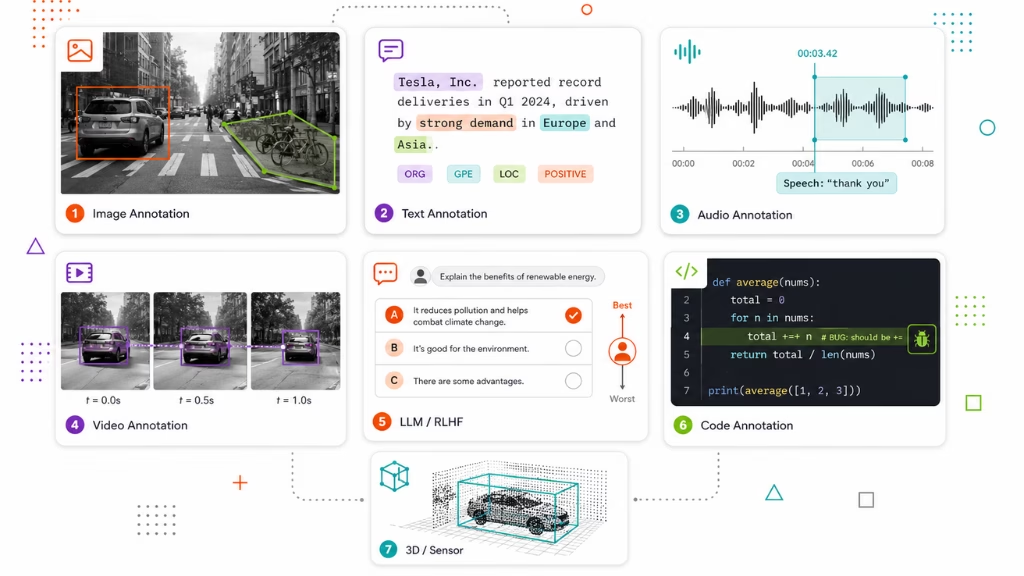
| Type | Description | Common Use Case | Visual Example |
| Image Annotation | Labeling images with bounding boxes, points, segmentations | Self-driving cars, medical imaging | Rectangle on road sign, outline of tumor |
| Text Annotation | Tagging text spans, entities, or sentiment | Chatbots, sentiment analysis | “Apple” tagged as company or fruit |
| Audio Annotation | Marking speech, sounds, or transcribing | Speech recognition, call QA | Time-stamp on word or laugh |
| Video Annotation | Tracking objects across frames, labeling video segments | Security, sports analytics | Player outlined in each frame |
| LLM/RLHF | Human feedback on model outputs, ranking replies | Large language models, fairness checks | Scoring helpfulness of responses |
| Code Annotation | Tagging code comments, functions, or errors | Code review, AI coding helper | Comment identifying bug |
| Other Emerging | New or hybrid data: sensor, 3D, AR/VR streams | Robotics, XR applications | 3D bounding volumes |
Each type requires its own guidelines and visual approach. For example, image annotation may involve drawing polygons for tumors, while text annotation may require highlighting named entities like “Barack Obama” or classifying email sentiment.
Audio and video projects often need time-stamped or frame-specific labels, which can be tedious and need specialized tools. LLM/RLHF annotation is newer: here, humans might rate how safe or helpful a chatbot’s answer is or write corrections for AI-generated text.
In my POV, picking the wrong annotation type or approach for your dataset can waste resources and erode trust in your AI solution.
How Does the Data Annotation Process Work? (Step-by-Step Workflow)
- Collect Raw Data
Teams gather images, text, audio, or video that represent real-world scenarios. - Define Annotation Guidelines
Clear instructions help annotators know what labels mean and how to apply them. - Distribute Tasks
Data is split into assignments. Annotators, often working remotely, pick up their batches. - Label the Data
Annotators tag or mark the data using annotation tools. - Validation and Quality Assurance (QA)
A second person, often called a validator or QA lead, checks labeled data for accuracy and consistency. - Feedback and Rework
If errors are found, data is re-annotated or further reviewed. - Export and Integrate
Once quality is confirmed, the labeled data is exported in a format ready for AI model training.
This cycle may repeat several times, especially for complex projects. In my experience, each role matters: a missed QA step allows errors to reach production, while confusion over guidelines can lead to wasted hours.
Human-in-the-loop steps, where people make the final call, are critical even as teams automate parts of the process. The mistake I see often is over-automating without real QA, leading to silent failures.
Tradeoffs involve time, cost, and quality. Rushed jobs might be cheap but can sink the performance of expensive AI models.
Who Performs Data Annotation? Roles, Skills, and Pathways
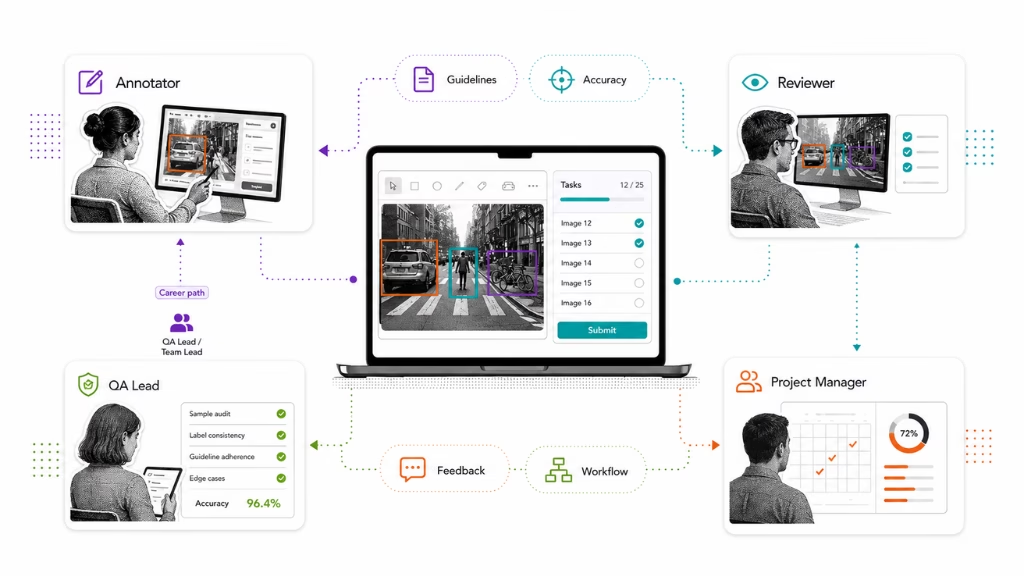
There is a diverse workforce behind every labeled dataset. Each project uses specific roles and skills. Clear role definition helps teams avoid confusion and cut down on costly mistakes.
- Annotator (Labeler): Applies labels or marks according to guidelines.
- Validator/Reviewer: Checks labels for accuracy and consistency.
- QA Lead: Designs quality control processes and audits large samples.
- Project Manager: Runs scheduling, communication, and workflow tracking.
In my experience, the best annotators have a mix of attention to detail, ability to follow instructions, basic tech skills, and—when needed—domain knowledge (for example, understanding medical images).
A “day in the life” often includes logging into an annotation platform, reviewing guidelines, completing tasks, and responding to QC feedback. Many work from home or through crowdsourcing platforms. Others are part of in-house or outsourcing teams, scaling up or down depending on project load.
Getting started often means taking online skills tests, practicing on sample data, and learning new platforms. The career path can move from annotator to team lead or QA roles, which pay more and carry extra responsibility. According to recent worker testimony on DataAnnotation.tech and Reddit, flexibility and global access are major draws, but clear instructions and real feedback are essential to avoid burnout or errors.
What Are the Best Data Annotation Tools, Software, and Platforms? (2026 Edition)
| Platform | Supported Types | Key Features | Typical Use Case |
| SuperAnnotate | Image, Video, Text, LLM | Advanced QA, automation, team workflow | Enterprise AI pipelines |
| CVAT | Image, Video | Open source, strong handling, plugin support | Research, in-house projects |
| DataAnnotation.tech | Image, Text, Audio | Crowd annotation, job matching, QA loops | Freelance, remote annotators |
| Label Studio | Image, Text, Audio, Video | Flexible config, cloud/self-hosted | Mixed-format projects |
| Custom/In-House | Any (with development) | Full control, privacy-first | Regulated industries, IP-sensitive companies |
Key tool features to look for:
- Type support (image/text/audio/video/LLM)
- Built-in QA and consensus functions
- Scalability (can it handle your dataset size?)
- Data security and privacy compliance
- Integration with your ML stack
Depending on your sector, security may be your priority (for example, healthcare). For huge image projects, batch processing and automation are vital. In my experience, reviewing tool features and doing a pilot run prevents most expensive mistakes later.
How Is Data Annotation Quality Controlled? Best Practices & Accuracy
Data annotation quality determines whether your AI model performs well or fails. While quality standards may differ by project, some best practices apply everywhere.
In my experience, these are critical:
- Accuracy: Labels must match the true object or concept in data.
- Consistency: Different annotators should apply labels the same way.
- Reliability: Data should stand up to future re-checks.
Quality control methods include:
- Consensus checks: Multiple annotators label the same data; disagreements flag uncertainty.
- Double labeling: Two or more passes by different reviewers.
- Inter-annotator agreement metrics: Measure how often labelers agree; high disagreement means unclear guidelines or poor training.
- Clear annotation guidelines: Avoids confusion and vague labels.
- Regular QA audits and spot checks: Catch systematic errors early.
See this sample QA metric table:
| Metric | What It Shows | Typical Target Value |
| Annotation accuracy | % correct labels | >95% |
| Inter-annotator agreement | Annotator consistency | >85% |
| Error rate | % of wrong labels | <5% |
| Rework rate | % of labels needing redo | <10% |
A better approach is to invest time upfront in annotator training and burnout prevention. High turnover or rushed work always leads to accuracy dips. The mistake I see often is skipping guideline reviews, which causes expensive rework later.
What Are the Real-World Applications of Data Annotation?
Data annotation powers most business-ready AI in 2026. Each industry faces unique data, so annotation shapes both model results and business impact.
| Industry | Use Case | Annotation Type | Example |
| Healthcare | Medical image diagnostics, EHRs | Image, Text | Tumor boundary outline |
| Autonomous | Object detection in driving videos | Image, Video | Car, pedestrian tracking |
| Retail | Product categorization, review sentiment | Text, Image | “Red shirt” match |
| Security | Face recognition, activity detection | Image, Video | Suspicious individual |
| NLP (Chatbots) | Intent detection, spam filtering | Text, Audio, LLM/RLHF | Email labeled “spam” |
| Finance | Document parsing, fraud spotting | Text, Image | Highlighting ID fields |
| Robotics | Scene segmentation, grasp identification | Image, Sensor/3D | Handle labeled in image |
| LLM Development | Ranking and correcting model outputs | Text, LLM/RLHF | Human scoring of response |
Mini-case: In a prospective study at two Indian eye hospitals, retinal images from 3,049 patients were graded by trained clinicians, with disagreements reviewed by a panel of three retinal specialists. Using these quality-controlled labels, the AI system achieved 88.9%–92.1% sensitivity and 92.2%–95.2% specificity for detecting moderate or worse diabetic retinopathy—showing why expert annotation and QA are essential in medical AI.
How Do You Get Started in Data Annotation? Jobs, Earnings, and Career Growth
Starting a career in data annotation is accessible to many, but earning and growth depend on skills, reputation, and platform choice.
- Find a Legitimate Platform or Employer
Trusted options include DataAnnotation.tech, company recruiting pages, or vetted crowdsourcing platforms. - Pass Onboarding Tests
Most teams require sample tasks and a basic understanding of guidelines before you can access real jobs. - Learn the Tools
Platform tutorials, practice tasks, and peer chat help you ramp up quickly. - Complete Assignments and Respond to Feedback
Always review errors; asking clarifying questions prevents repeats. - Advance to Team Lead or QA Roles
Reliable annotators get more responsibility, higher pay, or steady contracts.
According to recent research, average global pay for annotators ranges from $2–$8 per hour in entry roles, and $15–$30+ per hour for QA leads and specialists. Rates differ by region and project skill demand.
Risks are real: low-pay “microtasks,” scams, and unclear data privacy are common. The real issue is to verify reputation and avoid platforms that ask for upfront payments or personal data beyond job needs.
Upskilling paths include learning annotation tools, reviewing hard datasets, and earning certifications on major platforms. I have seen many annotators grow into project management or specialist roles with time and diligence.
Worker testimonials highlight flexibility and income potential but warn about repetitive tasks and screen fatigue. New regulations in 2026 improve worker protections in some regions, but global standards still vary.
What Are the Key Challenges, Risks, and Ethics in Data Annotation? (2026 Insights)
No annotation project is risk-free. Teams and annotators must know the key challenges and how to address them.
In my experience, the main issues include:
- Data privacy: Sensitive information can leak if stored or shared incorrectly.
- Bias: Human errors or cultural background can skew labels or exclude certain groups.
- Legal and labor risk: International wage laws and new AI regulations (for example, the 2026 EU/US rules) impact how work is structured and paid.
- Burnout and Repetition: Long hours on repetitive tasks hurt performance and morale.
- Automation risk: Some simple annotation work may be automated, impacting job security.
Regulatory changes since 2025 now require clearer data consent, better worker contracts, and regular bias audits in many regions.
Here is a snapshot of key risk considerations:
| Challenge | Impact Area | 2026 Mitigations |
| Data leakage | Annotator/end-user privacy | Strong encryption, access control |
| Bias | Model quality/fairness | Diverse annotator pools, guidelines |
| Exploitative pay | Workforce, legal | Platform reviews, wage compliance |
| Repetitive stress | Health, quality | Scheduled breaks, task rotation |
| Automation | Jobs/future prospects | Upskilling, hybrid human+AI work |
A better approach is to build transparency and clear feedback into every project. In my POV, it’s smarter to plan for these risks than react when problems surface.
Conclusion
Data annotation remains the cornerstone in bringing AI and machine learning to real business problems. I have seen projects succeed or fail based on how seriously teams invest in labeling, QA, and ethical review.
Looking ahead, annotation is evolving fast—large language model (LLM) annotation and RLHF are common, automation is growing, and regulations demand more transparency and worker protections.
A better approach for any team is to stay up-to-date, invest in learning, and put ethical, accurate annotation at the core of your workflow. If you are considering tools, a new career, or want to improve your current system, focus on quality, not just quantity.
AI-assisted systems will only thrive when real experts—annotators, QA leads, and project managers—are part of the process. Teams that get this right will shape the future of reliable, ethical AI.
FAQs
What is data annotation in machine learning?
Data annotation in machine learning means labeling or tagging raw data so that AI systems can learn, make predictions, and work in real-world scenarios.
Why is data annotation important for AI models?
AI models need labeled data to recognize patterns, avoid bias, and deliver accurate results. Without data annotation, most AI would not function well.
What are the main types of data annotation?
The main types are image annotation, text annotation, audio annotation, video annotation, and LLM/RLHF annotation for feedback on language models.
How do I become a data annotator?
To become a data annotator, find a trusted platform, pass onboarding tests, learn the tools, and complete assignments with accuracy.
What tools and platforms are used for data annotation?
Popular tools include SuperAnnotate, CVAT, DataAnnotation.tech, and Label Studio. Choice depends on data type, volume, and project needs.
What skills are needed for data annotation jobs?
Attention to detail, following guidelines, basic computer skills, and sometimes subject knowledge or language ability are key skills for data annotation.
How is data quality controlled in annotation projects?
Quality is managed by double-checking labels, using QA metrics, running audits, and applying clear guidelines. Teams often use consensus and inter-annotator agreement.
How much can I earn as a data annotator?
Average earnings vary by project and region, usually from $2 to $8 per hour for entry roles, and up to $15–$30+ for specialized or QA positions.
What challenges or risks exist in data annotation work?
Risks include exposure to sensitive data, bias, scams, repetitive tasks, and sometimes low pay or uncertain contracts, depending on the platform.
Is data annotation a legitimate way to earn money?
Yes, data annotation is a legitimate income source if you use reputable platforms or employers and avoid upfront payment scams.
How do annotation roles differ (annotator, validator, team lead)?
Annotators label data, validators check accuracy, and team leads or QA oversee quality and manage workflow processes in annotation teams.
What are best practices for accurate data annotation?
Best practices: Use clear guidelines, double-check work, take scheduled breaks, ask for feedback, and review errors to improve over time.
This page was last edited on 28 July 2026, at 3:28 pm

Start a conversation with our team to solve complex challenges and move forward with confidence.