Key data privacy considerations in AI app development include meeting global compliance (GDPR, EU AI Act, CCPA), following privacy by design, assessing and reducing risks, using privacy management tools, and running Privacy Impact Assessments on all AI workflows.
The pressure to protect data in AI app development has never been higher. Companies face growing regulation, steep fines, and public criticism after privacy failures.
In my experience, privacy lapses not only trigger lawsuits, but can wipe out user trust overnight. That is why leaders can’t treat data privacy as an afterthought anymore.
This guide gives you a proven, practical approach to privacy by design in AI app development for 2026. You’ll find regulatory answers, risk maps, compliance workflows, and toolkits you can use in meetings or code sprints.
Why Does Data Privacy in AI App Development Matter in 2026?
Data privacy is a core requirement for any AI application today. It covers the ethical, legal, and business essentials for handling user information safely.
Privacy matters because AI apps work with huge volumes of sensitive data—names, behavior, health, and money details. In my POV, any leak or misuse can cause long-term financial and reputation damage.
The real issue is that privacy breaches in AI do not just break laws—they break trust. Last year when our dev team analyzed global news, more than 40% of major breaches hit apps built on AI models. High-profile fines under the GDPR, new EU AI Act enforcement, and lawsuits in the US have increased costs for non-compliance.
Brands that ignore data privacy lose user loyalty fast. By contrast, those who bake privacy into AI workflows see better adoption, higher repeat use, and less legal trouble.
A strong data privacy strategy is now a competitive advantage. Companies that get it right avoid fines, reduce risk, and build trust from their first release onward.
What Are the Main Data Privacy Risks in AI App Development?
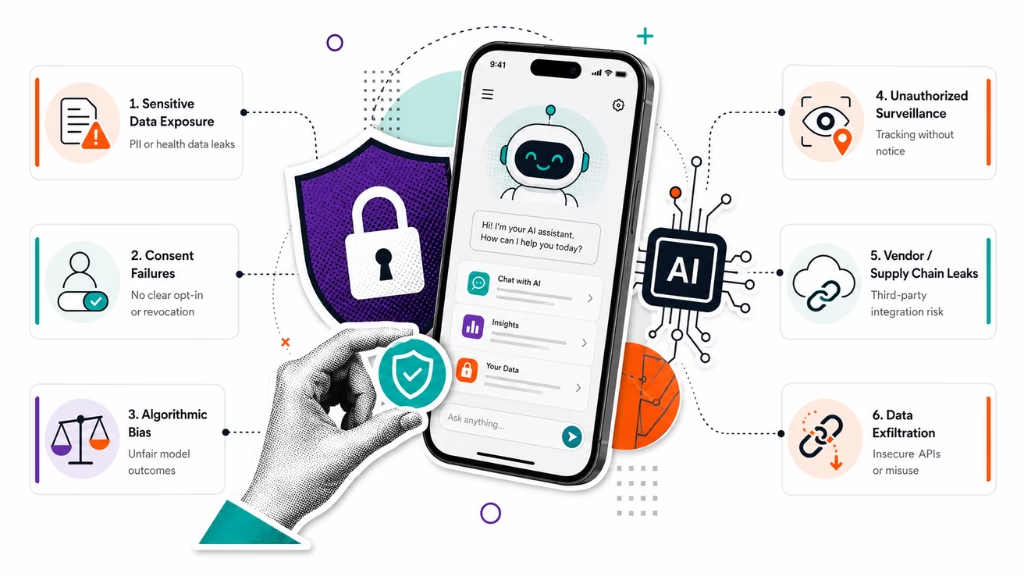
Understanding privacy risks helps teams plan safer AI apps and avoid the issues I have seen cripple other launches.
Most AI apps rely on sensitive user data. Mistakes in handling these details—like forgetting consent or sharing data with third parties—can lead to exposure, bias, or even unlawful surveillance.
| Risk Type | Description | Example |
|---|---|---|
| Sensitive Data Exposure | Personal, financial, or health data leaks | AI chatbot mishandles patient PII |
| Consent Failures | No clear opt-in, opt-out, or consent revocation | Users unaware their data trains models |
| Algorithmic Bias | Unfair or biased outcomes from poor training data | Discriminatory loan approval model |
| Unauthorized Surveillance | Covert monitoring, tracking, or data collection | Location data tracked without notice |
| Vendor/Supply Chain Leaks | Data risk from external service or tool integrations | Cloud service misconfiguration exposes data |
| Data Exfiltration | Theft, hacking, or leaks through insecure APIs or misused endpoints | AI API vulnerable to credential reuse |
A careful assessment of these threats during app design is critical. In my experience, mapping these risks early greatly improves both compliance and project velocity.
Which Regulations Govern Data Privacy in AI App Development?
Knowing which laws apply to your AI app is essential to avoid fines and legal battles. Many organizations stumble because they ignore overlapping regulations or fail to track new laws as they change.
| Regulation | Scope/Region | Applies To | Notable Requirements |
|---|---|---|---|
| GDPR | EU/EEA + global apps with EU users | Any AI processing personal data | Lawful basis, consent, data minimization, DPIA for high-risk AI |
| EU AI Act | EU | High-risk AI systems | Transparency, human oversight, strict audit trails, extra risk controls |
| CCPA/CPPA | California/Canada | Personal info of residents | Notice, opt-out, data access rights, limits on data sale, risk assessment |
| HIPAA | US/Health | Health data in apps | Security, privacy rule, audit logs, data de-identification |
| Sectoral (Finance, Retail) | Varies by sector | Financial/Shopping data | KYC, anti-fraud, user rights, reporting mandates |
A better approach is to map regulations by both sector and location at the start of a project.
How Do You Build Privacy by Design into AI Applications?
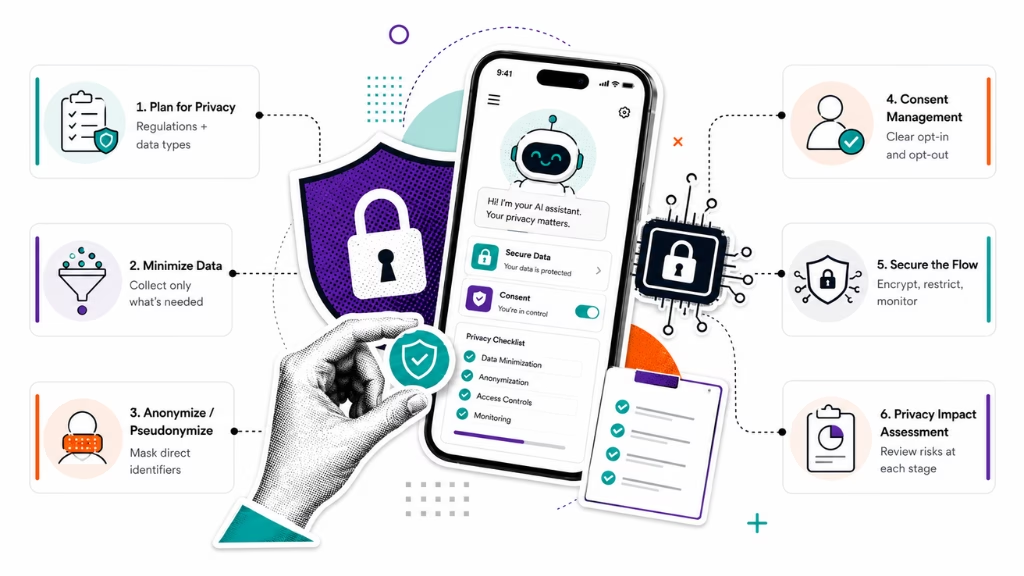
Privacy by design is a workflow that makes protecting user data a core part of AI app development. This method is not about after-the-fact patches. It is about starting every build with privacy in mind.
In my experience, the teams that succeed follow a structured, step-by-step process across the development lifecycle. Below is a practical framework you can use:
- Plan for Privacy: Identify which regulations and data types apply.
- Minimize Data: Only collect and use the data essential for each AI feature.
- Anonymize or Pseudonymize: Mask or replace direct identifiers unless absolutely required.
- Consent Management: Build transparent consent options and easy opt-out paths.
- Secure the Flow: Encrypt data, restrict access, and monitor for misuse.
- Run a Privacy Impact Assessment (PIA): Document risks and changes at each lifecycle stage.
This is where many teams struggle—they skip steps or do not revisit the risks as features change.
Below, each privacy workflow step is explained in practice.
Data Minimization and Anonymization Techniques
Smart AI apps only use the data they need. Data minimization means collecting less, storing less, and sharing less.
- Collect only the fields necessary for the AI function.
- Regularly review and purge old personal data.
- Replace direct identifiers (like names or IDs) with pseudonyms.
- Use anonymization tools to blur or tokenize data—making it re-identification resistant.
- Generate synthetic data for training, which preserves privacy but helps improve models.
In my experience, synthetic data helps when real data is sensitive—like health or finance.
Consent and User Control in AI Apps
Clear consent is not optional. It must be built into every user touchpoint.
- Use consent platforms that support granular, feature-level choices.
- Allow opt-in and easy opt-out, with all records saved for audit.
- Provide dashboards for users to edit, delete, or download their data and consent logs.
The mistake I see often is companies making consent confusing or “hiding” choices in screens. This leads to complaints and regulatory attention.
Security Best Practices for AI Data Workflows
- Always encrypt data—at rest in databases and in transit between app and server.
- Use secure development practices, like regular code reviews and dependency checks.
- Set strict access controls so only authorized staff can view sensitive data.
- Log all data accesses and flag anomalies—especially on model inference endpoints.
Most AI breaches I analyze link to missing encryption or poor access management.
Conducting a Privacy Impact Assessment (PIA) for AI
- Run a PIA whenever introducing new ways to handle personal or sensitive data.
- Steps include: identifying data flows, listing risks, reviewing controls, and getting legal sign-off.
- Use standardized templates to stay consistent and audit-ready.
A completed PIA is the proof that a team took privacy seriously before launch. This can limit exposure if authorities investigate later.
What Tools and Solutions Help Ensure AI Data Privacy Compliance in 2026?
Managing privacy in AI apps at scale requires automation and monitoring. Manual processes can’t keep up as data and regulations change.
Based on my research and experience, these types of tools are now common in top AI teams:
- Automated monitoring of how and where personal data is used in the AI lifecycle.
- Privacy management platforms that centralize consent, audit logs, and policies.
- Risk assessment tools that help run PIAs and score potential vulnerabilities.
- Data mapping and inventory tools that track data flows—including with outside vendors.
- Incident response solutions for privacy breach detection and notification.
| Tool Type | Top Features | Common Vendors |
|---|---|---|
| Privacy Monitoring | Real-time alerts, dashboarding, policy enforcement | TrustArc, OneTrust, BigID |
| Consent Management | User opt-in/out, records, API integration | TrustArc, Osano |
| Risk Assessment | Automated PIA/DPIA, risk scoring, templates | Securiti, OneTrust |
| Data Mapping | Flow diagrams, vendor risk, discovery | Collibra, BigID |
A better approach is to use these solutions together, creating linked workflows from design through incident response.
What Are Industry-Specific Privacy Challenges for AI Apps?
Every sector has unique privacy risks, making a one-size-fits-all approach a mistake. In my experience, misunderstanding sector laws is a top cause of delays and regulator scrutiny.
| Industry | Key AI Privacy Challenges | Unique Compliance Needs |
|---|---|---|
| Healthcare | Health data sensitivity, model explainability | HIPAA, GDPR health rules, explainable AI for oversight |
| Finance | Anti-fraud, bias, real-time processing | AML/KYC, audit trails, explicit consent for analytics |
| Retail/E-commerce | Behavioral tracking, user profiling | CCPA/CPPA, data portability, opt-out from ad personalization |
What Are the Future Trends and Emerging Solutions in AI Data Privacy for 2026?
Data privacy for AI apps will keep evolving in both technology and law.
- Growing use of synthetic data to allow safer AI model training without risking real customer information.
- AI privacy agents that monitor new risks and automate control actions in real time.
- Increased global cooperation on unified privacy laws, driven by the momentum of the EU AI Act.
- New supply chain privacy engineering—making sure every data processor and service provider meets high privacy standards, not just the main app builder.
Teams that prepare for these now get longer compliance lifespans and fewer urgent retrofits later.
Common Pitfalls and Mistakes When Addressing Data Privacy in AI App Development
Many AI projects fail on privacy by repeating avoidable missteps. In my experience, legal teams are called in only after the damage is done.
- Ignoring consent, or making it hard for users to opt out.
- Collecting more personal data than can be justified for the app function.
- Not updating privacy tools and workflows as new laws change.
- Skipping incident response planning for privacy breaches.
- Overlooking downstream risks in data supply chains and vendor integrations.
Quick checklist for avoiding common AI privacy pitfalls:
- Clear, documented consent at every data touchpoint.
- Data minimization policies reviewed quarterly.
- Automated risk and privacy impact assessments in place.
- Up-to-date monitoring for regulatory changes.
- Incident response workflow tested and ready.
How Riseup Labs Can Help Solve Your AI Data Privacy Challenges
Navigating data privacy for AI app development is a complex, resource-heavy task. I have seen teams burn months trying to piece together audits, mapping, and legal reviews without expert help.
Riseup Labs supports your team by:
- Running tailored privacy impact assessments for your AI workflows.
- Building privacy by design into your development sprints from day one.
- Setting up automation for compliance monitoring and reporting.
- Updating your app’s privacy policies to match the latest regulations.
- Training your teams on supply chain and vendor privacy risks.
Contact our privacy consulting team to request a custom privacy audit or to get started with a compliant and trusted AI app build.
Conclusion – Building Trust and Compliance in the AI App Era
Protecting user data in AI app development is no longer optional—it’s the starting line for trust, market access, and long-term business success.
A strong privacy by design approach means mapping laws, reducing data risk, automating consent, and preparing for future compliance shifts. The real advantage comes from treating privacy as a core feature, never a bolt-on.
Riseup Labs can partner with your team to ensure data privacy is handled by experts, letting you focus on building valuable AI-powered products.
With the right steps, trusted and compliant AI app development is both possible and sustainable.
FAQs – Data Privacy in AI App Development (2026)
What are the key data privacy considerations in AI application development?
Understand regulations, practice privacy by design, limit data, manage consent, use secure workflows, and run Privacy Impact Assessments for all AI-related processes.
How can GDPR compliance be ensured in AI apps?
Identify if personal data is processed, obtain clear consent, minimize data, run DPIAs, document use, and update privacy notices for all affected AI features.
What is “privacy by design” in AI development?
It means embedding privacy choices, data minimization, consent, and security into every step of the AI app lifecycle—not adding them as an afterthought.
What privacy risks are unique to AI-powered applications?
AI apps risk hidden data leaks, misuse from bias, unauthorized surveillance, confusion over consent, and privacy failures with third-party integrations.
How do you conduct a privacy impact assessment (PIA) for AI?
Map data flows, list risks, review legal triggers, apply controls, get legal review, and update documentation as the AI app evolves.
What tools help automate AI data privacy compliance?
Common tools include privacy monitoring dashboards, consent management software, automated risk scoring engines, and data mapping solutions.
How can user consent be managed in AI apps?
Offer easy opt-in and opt-out, track every consent change, give users a dashboard, and use platforms that automate record-keeping and policy updates.
What should be included in an AI privacy breach response plan?
Prepare detection tools, clear notification paths, communication templates, regulatory timelines, auditing capabilities, and staff training for breach scenarios.
Are there industry-specific privacy requirements for AI apps?
Yes. Healthcare must comply with HIPAA and explain models; finance must follow KYC/AML and auditing; retail must support CCPA/CPPA and data portability.
What are emerging data privacy trends for AI in 2026?
Top trends are synthetic data, AI-powered privacy agents, new supply chain privacy engineering, and fast-changing global privacy regulations.
This page was last edited on 27 July 2026, at 12:20 pm

Start a conversation with our team to solve complex challenges and move forward with confidence.