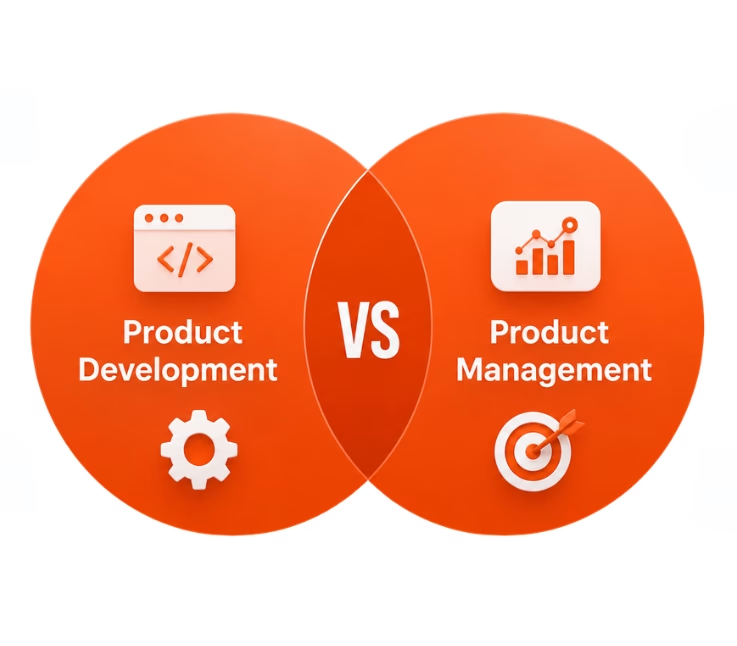
Product management sets the product’s strategy, vision, and direction. Product development takes that direction and executes it—designing, building, testing, and launching the product. Both must work hand-in-hand for product success, but their core focus and day-to-day responsibilities are distinct.
Not long ago, I consulted for a SaaS startup that prided itself on moving fast. Yet, despite a talented engineering team and ambitious product ideas, deadlines slipped and features missed the mark. The root problem? Nobody could say for certain who owned the strategy—and who was supposed to execute it.
This scenario is common. Many organizations believe product development and product management are interchangeable terms or overlapping jobs. That misconception leads to blurred responsibilities, duplicate effort, turf wars, and wasted potential. Engineers end up guessing at priorities. Product managers get bogged down in firefighting rather than shaping the roadmap. Team morale dips, and customer needs go unmet.
Distinguishing between these two roles isn’t just an academic exercise. It shapes how quickly your organization innovates, how well you compete, and how efficiently you scale—regardless of whether you’re in a scrappy startup or a global enterprise. The lines between product development and product management define everything from hiring and structure to the delivery process itself.
In this guide, I’ll break down the real differences between product development and product management, dissect the roles, processes, and team structures, and share practical insights for aligning both functions.
By the end, you’ll know how these disciplines complement each other, how the boundaries shift by company stage, and how to make smarter moves—whether you’re hiring, building your team, or planning your own career path.
What Is Product Management?
Product management is the discipline of guiding a product from idea to market fit, focusing on its vision, strategy, and measurable success. Product managers (PMs) act as cross-functional leaders: aligning teams, translating customer needs into actionable plans, and keeping the product on track toward business objectives.
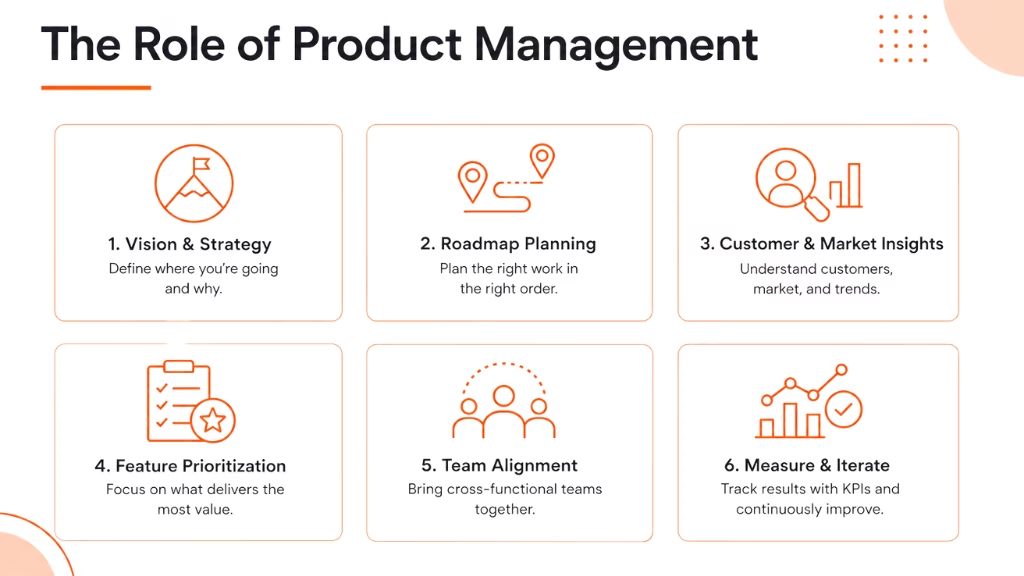
Core Responsibilities:
- Craft a clear product vision and a long-range strategy
- Own and communicate the product roadmap
- Conduct ongoing market research and synthesize user feedback
- Prioritize features based on impact and feasibility
- Coordinate between engineering, design, marketing, and sales
- Track and analyze key performance indicators (KPIs), adjusting course as evidence dictates
Typical Deliverables:
- Product roadmaps
- Business cases
- Product Requirement Documents (PRDs)
- Feature prioritization lists
- Success metrics and reporting dashboards
Essential Skills:
- Strong analytical thinking and problem framing
- Skilled communication and facilitation
- Empathy for the customer’s context and pain points
- Decisiveness, often in conditions of ambiguity
- Ability to rally and align diverse stakeholders
In practice, a product manager’s day revolves around decision-making. It might start with analyzing user data or market trends, move to a sync with engineering about feature progress, and end with negotiating trade-offs with leadership. Many PMs cite context-switching and influencing without direct authority as everyday challenges—and also the most rewarding parts of the role.
What Is Product Development?
Product development is where the product vision becomes reality. These are the engineers, designers, and testers who turn plans into working solutions—iterating until the product solves a real problem for customers.
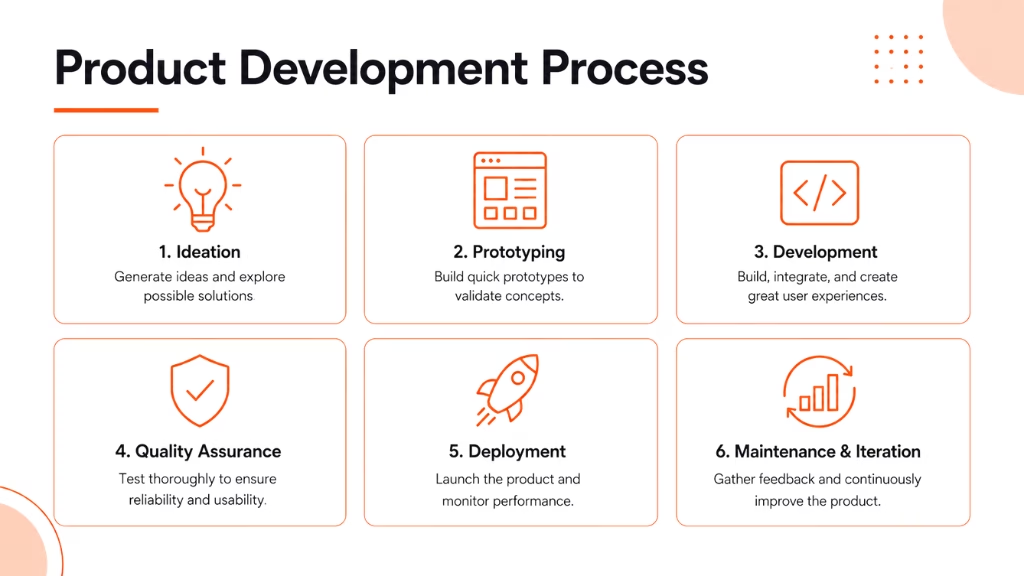
End-to-End Process:
- Ideation: Collaborate on possible solutions and technical approaches
- Prototyping: Build quick, testable models to validate concepts
- Development: Write code, create UI/UX, and integrate systems
- Quality Assurance: Conduct tests to ensure reliability and usability
- Deployment: Launch, monitor, and maintain the product in production
Key Roles:
- Software engineers and developers
- UX/UI designers
- Quality assurance (QA) specialists
- System architects
- (Occasionally) Technical product owners
Primary Deliverables:
- Minimum Viable Products (MVPs)
- Prototypes, alphas, and beta releases
- Technical documentation
- Shipping and maintaining released product versions
Essential Skills:
- Deep technical expertise (coding, architecture, UI/UX, system integration)
- Iterative problem-solving and debugging
- Collaboration with both peers and non-technical teams
- Commitment to product quality and user experience
Most development teams rely on clear inputs from PMs. In reality, one of the most common pitfalls is incomplete or evolving requirements, causing rework and delays. The best teams keep channels open, inviting PMs and users into early reviews and ensuring development work stays tied to the product strategy.
Product Development vs Product Management: What Are the Key Differences?
While both are essential to delivering a successful product, the heart of product management is “what and why,” whereas product development’s territory is “how and when.” These are not just semantics—ownership and accountability flow from this split.
| Product Management | Product Development | |
| Primary Focus | Product strategy, market fit, outcomes | Technical execution, delivery cycles |
| Key Roles | Product manager, product owner | Engineers, designers, QA |
| Main Outputs | Vision, roadmap, user requirements | Working product, prototypes, tech docs |
| Reporting Line | Business, general manager | CTO, VP Engineering |
| Success Metrics | Adoption, retention, revenue impact | Release frequency, product reliability |
| Typical Skills | Strategic thinking, communication, research | Coding, design, QA, system integration |
Think of the PM as the architect and the development team as the builders. Product management sketches the blueprint, defines why the building should exist, and decides what success looks like. Development determines how to bring the vision to life, what materials to use, and ensures structural integrity all the way to completion.
How Do Product Development and Product Management Work Together?
The most effective teams form a feedback loop—sharing insights from customers, technical constraints, and product performance. This is what propels rapid learning and adaptation.
Key Collaboration Points:
- Discovery: PMs bring priorities and user insights, development assesses feasibility and options
- Sprint Planning: PM sets priorities, dev team estimates and commits to achievable goals
- Development Cycle: Iterative reviews to clarify requirements, unblock issues, and adjust execution
- Launch and QA: PMs and devs jointly validate features, iron out bugs, and hone release plans
Popular Collaboration Models:
- Agile Squads: Cross-functional teams (PM, engineering, design) working in sprints toward shared milestones
- Lean Startup Teams: Small groups rapidly prototype, test, and refine concepts, with direct PM-dev alignment
- Dual-Track Agile: PMs handle “discovery” (user research, solution validation), development focuses on “delivery” (building and shipping)
A useful rule of thumb: Whenever friction or rework emerges, check if PMs and developers are operating in silos. The better approach is shared rituals. Joint backlog grooming, demos, and regular retrospectives help catch misalignments early.
Team Structures by Company Size: Startup, Scaleup, and Enterprise
How teams divide these roles evolves as companies mature—not just based on headcount, but also on product complexity and market pressure.
Startup:
- Early-stage teams often wear multiple hats. A founder may serve as product manager and write code.
- Close collaboration, fast decision cycles, and little process overhead.
Scaleup / Mid-Size:
- Product management and development start to specialize.
- Dedicated PMs handle roadmap and growth. Development splits into specialist roles (QA, DevOps, tech leads).
- Better-defined handoffs and accountability.
Enterprise:
- Highly specialized roles across multiple product lines and scrum teams.
- Strong boundaries and standardized processes.
- Collaboration becomes as much an exercise in coordination as in building or planning.
| Company Type | Product Management | Product Development |
| Startup | Founder/Hybrid acting as PM | Generalist engineers/designers |
| Scaleup | Full-time PMs, growing product teams | Tech leads, QA, specialists added |
| Enterprise | Specialized PMs (Growth, Platform) | Multiple squads, architects, dedicated QA |
In practice, overlap in early-stage teams can speed up execution, but as the product and organization scale, blurred roles result in missed opportunities or burnout. Defining responsibilities early and revisiting them regularly prevents these pitfalls.
Essential Tools & Software for Each Function
Both product management and product development depend on the right tools to keep teams aligned and moving efficiently.
Popular Product Management Tools:
- Roadmapping & Prioritization: Aha!, Productboard, Trello
- Customer Insights: Typeform, UserTesting
- Analytics: Amplitude, Mixpanel
- Collaboration & Docs: Notion, Slack
Product Development Tools:
- Issue Tracking: Jira, GitHub Projects, Linear
- Design & Prototyping: Figma, Sketch
- Continuous Integration/Deployment: Jenkins, GitLab CI/CD
- Testing/QA: Selenium, TestRail
What matters most here is choosing tools that fit your stage. Startups might look for all-in-one platforms to avoid complexity, while enterprises invest in integrations and scalability. For most teams, transparent project tracking and easy access to context move the needle more than the latest feature set.
Transitioning From Product Development to Product Management
A shift from a development to a management track is a popular—and rewarding—career move for engineers and designers seeking to broaden their impact. But the path isn’t as simple as mastering a new toolset.
How to Make the Transition:
- Gain exposure to customer research and product planning; join roadmap discussions.
- Build confidence in facilitating meetings and presenting trade-offs to diverse audiences.
- Volunteer for “mini-PM” experiences, like spec writing or backlog refinement.
- Seek mentors or consider formal learning (Pragmatic Institute, Product School).
- Start taking responsibility for outcomes, not just outputs.
Overlap in Skills:
- Technical literacy (a huge asset for PMs)
- Analytical thinking
- Strong teamwork
Key Mindset Shifts:
- From solution-building to problem-framing
- Expanding focus beyond code to market needs and strategy
- Taking ownership for the product’s overall success
A quote that often resonates with aspiring PMs:
“Transitioning from developer to PM means shifting the question from ‘How do we build this?’ to ‘Why—and for whom—should we build it?’” (Senior PM, SaaS company)
Industry Examples: How These Roles Play Out in the Real World
Let’s look at how organizations in different sectors align product management and development:
- Startup SaaS: A founder interviews customers, scribbles mockups, and codes initial versions personally. Fluid roles allow for ultra-fast learning loops, but as the team grows, that flexibility risks burnout and confusion unless responsibilities are clarified.
- Enterprise Software: Product managers take charge of strategy, competitive analysis, and cross-functional alignment. Large development teams run parallel sprints with specialist roles—success relies on process discipline and clear handoffs.
- Consumer Hardware: Product management oversees feature definition and customer research, while development handles technical specs and manufacturing. Stage-gate frameworks ensure teams meet strict quality and regulatory standards.
Industry data from the 2023 Product Management Trends report (Product Management Festival) reveal that over 60% of PMs in tech companies cite lack of role clarity as a challenge affecting both speed and morale.
One mistake I often see: scaling teams without evolving team structures. The companies that succeed prioritize constant communication between PM and engineering leads, embedding shared KPIs from the start.
Common Misconceptions: Clearing Up the Confusion
Misunderstandings about these disciplines still trip up hiring, process design, and collaboration.
- Myth: Product managers are just project managers with a fancy title.
Reality: While both coordinate work, PMs are accountable for product vision, market outcomes, and business impact—not just delivery on time. - Myth: Product development equals coding only.
Reality: Development includes all technical activities—prototyping, design, QA, and deployment. - Myth: Product managers vanish after feature specs are handed off.
Reality: The best PMs guide the product’s journey from conception through iteration and refinement. - Myth: Anyone can always do both jobs effectively.
Reality: Role overlap is necessary in small startups, but specialization becomes essential as products grow in scale and complexity.
Product Development vs Product Management: FAQs
What’s the main difference between product management and product development?
Product management defines the product’s vision and strategy. Product development brings that vision to life by designing, building, and launching the product.
Who creates and maintains the product roadmap?
The product manager is typically responsible for the product roadmap, collaborating with development and stakeholders to align priorities and timelines.
What activities does a product development team handle?
They design, build, test, and release products. This includes prototyping, coding, quality assurance, and ongoing maintenance.
Can one person do both product management and development?
In some startups, yes. But as teams grow, separating the roles helps maintain focus and accountability.
How do PMs and dev teams work together in practice?
They collaborate throughout the product lifecycle: sharing discovery, planning sprints, reviewing progress, and iterating based on feedback.
What skills are crucial for PMs compared to developers?
PMs need strategic thinking, stakeholder management, and market awareness. Developers rely on technical ability, prototyping, and problem-solving.
Is product management considered part of product development?
No, but they are closely linked. Product management leads strategy; product development owns execution. Success requires both working together.
Do hardware and software companies structure these roles differently?
Yes. Hardware tends to need longer planning cycles and more handoffs. Software teams usually favor rapid, iterative collaboration.
Next Steps
Distinguishing product development from product management is foundational to building product teams that deliver real value and outperform the competition. Organizations should proactively clarify responsibilities, tailor structure to their current and future needs, and arm teams with the right tools.
For professionals, understanding where strategy meets execution empowers better career choices and more targeted skill building. If you want to move faster and smarter—whether as a leader or individual contributor—start with clear role definitions. Build better partnerships between PM and developer, and revisit these boundaries regularly as your business grows.
This page was last edited on 25 June 2026, at 11:20 am

Start a conversation with our team to solve complex challenges and move forward with confidence.