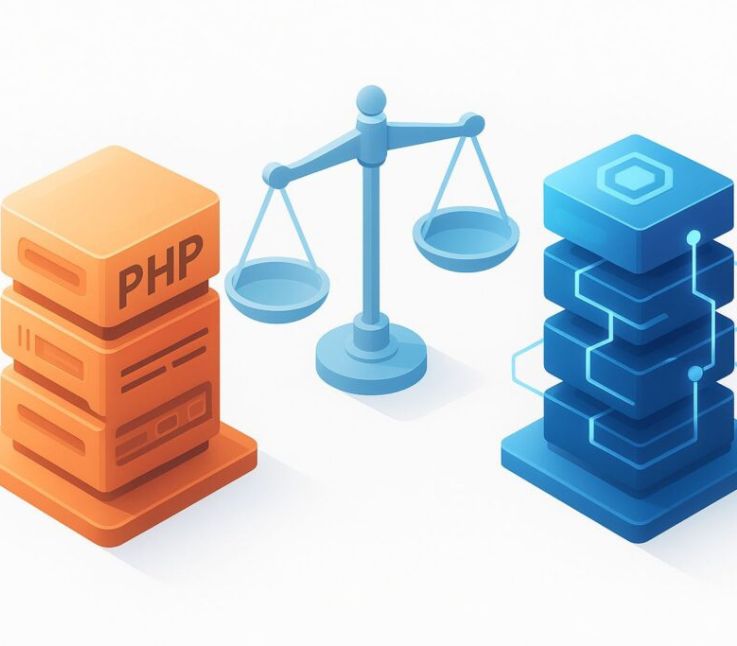
Choosing between php vs node.js is one of the most important decisions in backend web development, directly impacting your application’s performance, scalability, and future growth. While both technologies are widely used and reliable, they serve different purposes and excel in different scenarios—making the choice less straightforward than it seems. This guide provides a clear, side-by-side comparison, real-world use cases, and expert insights to help you evaluate each option. By the end, you’ll know exactly which technology aligns best with your project goals.
Quick Feature Comparison: PHP vs Node.js (2025)
| Feature | PHP | Node.js |
|---|---|---|
| Definition | Scripting language for server-side logic | JavaScript runtime for backend development |
| Initial Release | 1995 (Rasmus Lerdorf) | 2009 (Ryan Dahl) |
| Best For | CMS, e-commerce, rapid prototyping | APIs, real-time apps, microservices |
| Main Pros | Mature ecosystem, easy hosting, strong CMS support | High concurrency, async, modern tooling |
| Tech Stack | LAMP (Linux, Apache, MySQL, PHP) | MEAN/MERN (MongoDB, Express, Angular/React, Node.js) |
| Recent Updates | PHP 8.1: Fibers, JIT, type improvements | Node 20+: ES modules, diagnostic tooling improvements |
What Is PHP and Where Does It Shine?
PHP is an open-source server-side scripting language that powers a vast portion of the web, renowned for its simplicity, mature ecosystem, and seamless integration with content management systems.
- PHP Origins & Ecosystem: Introduced in 1995 by Rasmus Lerdorf, PHP was designed for web development and quickly became central to the LAMP stack. Its rich package management (Composer, PEAR) and large selection of frameworks—such as Laravel, Symfony, and CodeIgniter—enable rapid development and maintainability.
- Primary Use Cases: PHP is the backbone of major content management systems (WordPress, Drupal), e-commerce platforms (Magento, WooCommerce), and countless internal business tools. These applications rely on efficient rendering of server-side HTML, user authentication, and flexible API backends.
- Community & Support: With decades of widespread use, PHP enjoys a robust community, institutional support (PHP Foundation), and comprehensive documentation.
Where PHP Excels:
- Quick setup for CMS-driven websites and blogs
- Cost-effective hosting and strong compatibility with shared servers
- Broad developer base, making hiring and support easy
What Is Node.js and Where Does It Excel?
Node.js is an event-driven, non-blocking JavaScript runtime environment built on Chrome’s V8 engine, well-suited for high-concurrency, real-time, and microservices-driven applications.
- Node.js Architecture: Released in 2009 by Ryan Dahl, Node.js uses an asynchronous, event-driven model. It handles numerous simultaneous connections with minimal resource usage, making it ideal for data-intensive or real-time applications.
- Modern Use Cases: Node.js is the engine behind scalable APIs, collaborative tools (like chat and gaming), streaming services, and single-page applications. Major companies—including Netflix and PayPal—leverage Node.js for real-time user experience and efficient backend operations.
- Ecosystem & Tooling: The npm package manager, with over a million modules, and frameworks like Express, NestJS, and Koa, empower developers to build robust systems fast. The OpenJS Foundation drives ongoing development and best practices.
Where Node.js Excels:
- Real-time apps (chat, streaming, gaming)
- Highly scalable APIs and microservices
- Efficient full-stack JavaScript workflows
What Are the Core Similarities Between PHP and Node.js?
Both PHP and Node.js are foundational tools for backend web development, offering open-source, cross-platform solutions supported by vast communities.
Shared Capabilities:
- Enable building and deploying server-side web applications and APIs
- Open-source licensing and strong community contributions
- Cross-platform support for Linux, Windows, and macOS environments
- Comprehensive package management (Composer for PHP, npm for Node.js)
- Seamless connectivity to common databases (MySQL, PostgreSQL, MongoDB)
- Hosting options available from entry-level to enterprise scale
At a Glance:
| Capability | PHP | Node.js |
|---|---|---|
| Open Source | Yes | Yes |
| Cross-Platform | Yes | Yes |
| API Support | Yes | Yes |
| Package Management | Composer | npm |
| Community Size | Large | Large |
How Do PHP and Node.js Differ? (Feature-by-Feature Breakdown)

While both technologies can serve similar business needs, PHP and Node.js differ in execution model, performance, scalability, tooling, and security considerations.
| Feature | PHP | Node.js |
|---|---|---|
| Language Type | Scripting (PHP) | JavaScript runtime (Node.js) |
| Execution Model | Synchronous (one request at a time per thread) | Asynchronous, non-blocking (handles many at once) |
| Performance | Improved with PHP 8.1’s JIT and Fibers; fast for content-heavy apps | Excels at I/O-bound, concurrent workloads; performance leader in real-time/async scenarios |
| Scalability | Traditionally monolithic; new support for async with Fibers | Built for microservices and horizontal scaling |
| Ecosystem | Composer, Packagist, mature frameworks (Laravel, Symfony) | npm, >1M packages, modern frameworks (Express, NestJS) |
| Security | Strong, but legacy issues persist (SQLi, XSS) | Vulnerable to NoSQLi, XSS; strong with best practices |
| Learning Curve | Simple for beginners; huge documentation base | Easy for JS devs; async patterns can be a hurdle |
| DevOps/Hosting | Ubiquitous shared/VPS hosting, great Docker support | Often needs custom hosting, thrives in containerized/cloud/serverless setups |
| Cost (TCO) | Generally lower hosting/dev cost for small-scale | Scales efficiently at larger loads; modern cloud support |
Detailed Considerations:
- Performance Benchmarks: According to TechEmpower Framework Benchmarks (2024), Node.js often outpaces PHP in raw request handling—especially for real-time and concurrent tasks. PHP 8.1’s Just-In-Time (JIT) improvements significantly narrow this gap for standard workloads.
- Scalability: Node.js naturally supports microservices and can be clustered for scale-out, while PHP’s monolithic roots are mitigated by new async features (Fibers) and containerization.
- Ecosystem & Tooling: While both have mature package managers, npm’s scale and modern tooling support broader, evolving development practices.
- Security: PHP’s legacy security challenges are mitigated by modern frameworks and adherence to PHP-FIG standards. Node.js’s central risks are often around dependency management and emerging NoSQL vectors, with robust best-practice libraries available.
When Should You Use PHP? (Best Use Cases, Pros & Cons)
PHP remains the top choice for content-driven sites, fast prototyping, and applications that require stable, low-cost environments.
Best Use Cases:
- Content management systems (WordPress, Drupal, Joomla)
- E-commerce platforms (Magento, WooCommerce)
- Blogs, landing pages, and business websites
- Backend APIs for legacy systems or rapid MVPs
Pros of PHP:
- Easy to learn and onboard new developers
- Huge array of frameworks and ready-made solutions
- Affordable, widely available hosting
- Strong community and enterprise support
- Comprehensive documentation and learning resources
Cons of PHP:
- Less suited for real-time or highly concurrent apps
- Asynchronous capabilities lag behind Node.js
- Monolithic architecture can limit scalability for some use cases
Quick Reference Table: PHP Best Fits
| Ideal For | Example |
|---|---|
| CMS & Blogs | WordPress, Drupal, Joomla |
| E-commerce | Magento, WooCommerce |
| Prototyping | Internal tools, MVPs |
| Affordable Hosting | Shared/VPS hosting |
| Stable Legacy Integrations | ERP connectors |
When Should You Use Node.js? (Best Use Cases, Pros & Cons)
Node.js is designed for high-concurrency, event-driven, and real-time applications, especially where quick data flows and modern architecture are critical.
Best Use Cases:
- Real-time applications: chat, gaming, collaborative editing
- API servers for SPAs and mobile apps
- Microservices-based architectures
- Large-scale streaming services (e.g., Netflix, PayPal)
- Applications requiring seamless frontend-backend JavaScript flow
Pros of Node.js:
- Handles many concurrent connections efficiently (non-blocking I/O)
- Ideal for microservices, modern CI/CD, and DevOps workflows
- Massive, evolving npm ecosystem
- Enables use of the same language (JavaScript) across full stack
- Well-suited to containerization, serverless, and cloud deployments
Cons of Node.js:
- “Callback hell” with deeply nested asynchronous code (can be mitigated with modern patterns)
- Single-threaded event loop can limit performance for CPU-heavy tasks
- Dependency vulnerabilities; must stay current with updates
Quick Reference Table: Node.js Best Fits
| Ideal For | Example |
|---|---|
| Real-time Apps | Chat servers, games |
| Streaming | Video/audio (Netflix, Spotify) |
| API-driven Microservices | Modular business layers |
| Modern DevOps/Serverless | AWS Lambda, Dockerized APIs |
| Collaborative Tools | Online editors, live dashboards |
Performance & Scalability: Which One Handles Growth Better?
Node.js leads in raw concurrency and scalability for real-time and microservice workloads, while PHP now offers improved performance and scale with modern advances.
- Node.js: Excels at handling thousands of simultaneous connections due to its event-driven, non-blocking nature. Scaling horizontally is straightforward with Node.js’s cluster module, and platforms like Kubernetes are widely adopted.
- PHP: PHP 8.1’s Fibers and Just-In-Time (JIT) compilation have significantly improved request throughput and reduced latency—particularly for traditional dynamic web pages and APIs. PHP can scale vertically and is now more cloud- and Docker-friendly.
- Benchmarks: According to recent TechEmpower (2024) tests, Node.js typically outperforms PHP in high I/O/concurrent scenarios, while PHP holds its own for content-rendered applications.
- Scaling Models:
- Node.js: Prefer horizontal scaling (across CPUs/servers) and containerized deployments.
- PHP: Traditionally vertical, now also supports horizontal scaling with orchestration and container platforms.
Summary Table: Performance & Scalability
| Factor | PHP | Node.js |
|---|---|---|
| Single Request | Fast (esp. with JIT) | Fast |
| High Concurrency | Improved with Fibers, but not as efficient as Node.js | Excellent (event-driven I/O) |
| Scaling | Vertical; horizontal w/containers | Horizontal (clusters/cloud) |
Security Comparison: Which Is More Secure and Why?
Both PHP and Node.js offer robust security capabilities today, but each has unique risks and defenses that should guide your decision.
- PHP Security: Historically vulnerable due to poor input validation and outdated codebases (common threats: SQL injection, XSS). Modern PHP frameworks enforce safe practices and PHP-FIG standards, reducing these risks. Regular updates and mature libraries bolster protection.
- Node.js Security: Faces more NoSQL injection and dependency risks due to rapid package growth and ecosystem size. Non-blocking architecture can make DDoS mitigation more complex. However, active community oversight and tools (like npm audit) help surface vulnerabilities quickly.
- Common Defenses:
- Validate and sanitize all user inputs
- Employ up-to-date frameworks and security libraries
- Monitor dependencies with Composer Audit (PHP), npm audit (Node.js)
- Adhere to OWASP Top Ten recommendations
Security at a Glance:
- Both support HTTPS, JWT authentication, and modern encryption
- Frequent code updates and community vigilance are essential
- Legacy PHP codebases may require extra scrutiny
Learning Curve & Developer Experience: Which Is Easier to Learn?
PHP is generally easier for total beginners, while Node.js is intuitive for developers familiar with JavaScript and modern frontend tooling.
- PHP: With simple syntax, abundant educational resources, and a gentle learning curve, PHP is a top choice for those new to backend web development. A basic “Hello, world!” app requires only a few lines and can run on most web servers out of the box.
- Node.js: Best for developers already versed in JavaScript or full-stack workflows. Mastering asynchronous concepts (callbacks, promises, async/await) is essential and can lengthen onboarding for newcomers without a JavaScript background.
- Developer Backgrounds:
- PHP: Entry-level, CMS-oriented, freelance, and legacy enterprise developers
- Node.js: JavaScript-focused, modern web/app startups, microservices and DevOps teams
Learning Curve Table: PHP vs Node.js
| Area | PHP | Node.js |
|---|---|---|
| Syntax | Simple, forgiving | JavaScript, async patterns |
| Onboarding | Fast for beginners | Fast if JS-experienced |
| Docs/Community | Extensive, legacy support | Massive, modern focus |
| Transition | From HTML/CSS easy | From frontend JS seamless |
Migration & Integration: Switching or Combining PHP & Node.js
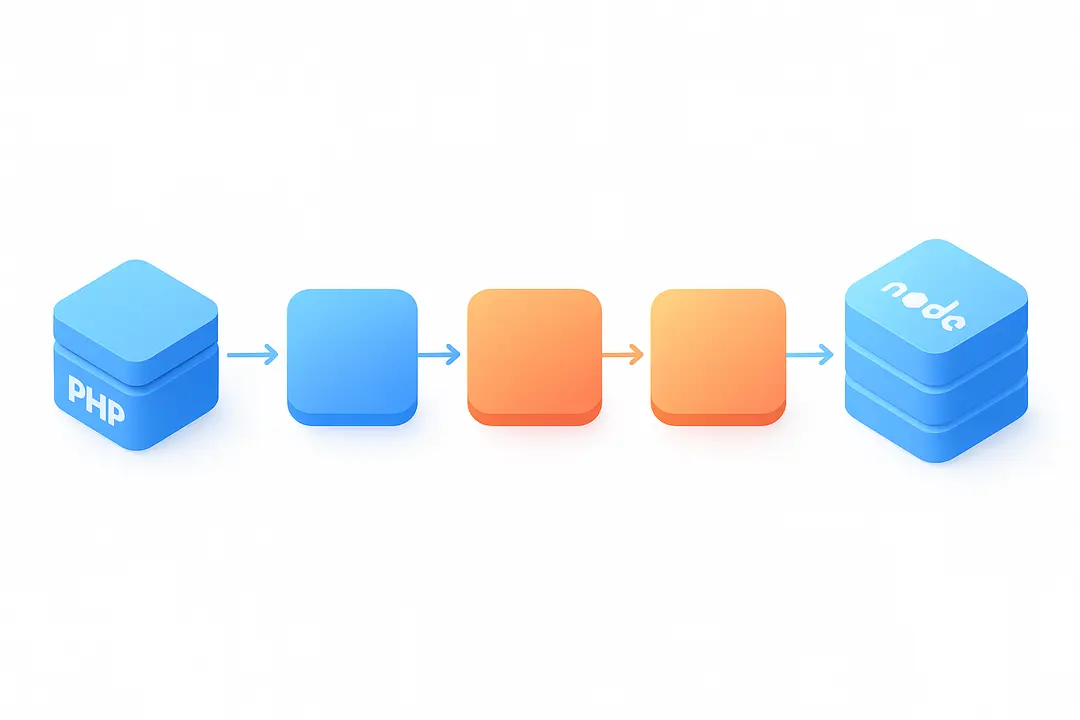
Migrating from PHP to Node.js, or running both in a hybrid stack, is common when modernizing legacy systems or expanding capabilities.
Typical Migration Reasons:
- Need for real-time or event-driven capabilities not available in a PHP stack
- Modernizing monoliths to microservices
- Consolidating frontend and backend codebases into JavaScript
Migration Roadmap:
- Define Scope: Identify key features, business logic, and data layers to migrate.
- Assess Data Migration Needs: Plan for secure movement of databases (MySQL to MongoDB, etc.).
- API Layering: Gradually replace PHP endpoints with Node.js APIs—run both stacks side-by-side during cutover.
- Refactor Incrementally: Move non-critical modules first (e.g., notifications, chat).
- Hybrid Integration: Run PHP for CMS, Node.js for API/microservices—connect via REST or API gateway.
Common Pitfalls:
- Insufficient regression testing during phased migration
- Underestimating legacy dependency rewrites
- Ignoring team training and workflow changes
Best Practice: Start with a pilot module and gradually expand, using robust CI/CD and containerization to minimize risk.
Decision Framework: How to Choose PHP or Node.js for Your Project
Selecting the right backend depends on several factors: application type, real-time needs, team skillset, and scalability requirements.
Project Technology Flowchart
- Is your application real-time, collaborative, or heavily event-driven?
Yes → Node.js - Do you need CMS or e-commerce integration, or quick MVP launch?
Yes → PHP - Is your team already fluent in JavaScript?
Yes → Node.js - Are you building scalable microservices deployed on containers/cloud?
Yes → Node.js - Do you have legacy systems or need rapid, low-cost prototyping?
Yes → PHP - Is tight integration with modern DevOps (Docker, serverless) required?
Both fit, but Node.js offers more granular tools
Decision Matrix
| Requirement | Best Fit | Why |
|---|---|---|
| Real-time Processing | Node.js | Async, event-driven, high concurrency |
| Content Management | PHP | CMS, templating, rapid setup |
| Massive API Scale | Node.js | Clustered microservices, lightweight APIs |
| Legacy Integration | PHP | Mature, backward-compatible libraries |
| Full JS Workflow | Node.js | Shared code, single language stack |
| Rapid Prototyping | PHP | Simple, ready-made solutions |
Quick Reference Table: PHP vs Node.js (2025 Feature Comparison)
| Feature | PHP | Node.js |
|---|---|---|
| Definition | Server-side scripting language | JavaScript runtime |
| Year Released | 1995 | 2009 |
| Language Type | Synchronous, interpreted | Asynchronous, V8-compiled |
| Performance | Strong (PHP 8.1+ JIT, Fibers) | Excellent for concurrency, I/O-bound |
| Best Use Case | CMS, e-commerce, blogs | Real-time, APIs, microservices |
| Ease of Scaling | Improved, but traditionally vertical | Designed for horizontal scaling |
| Hosting Cost | Low, ubiquitous | Moderate to scalable |
| Security | Good (with frameworks) | Good (with dependency checks) |
| Learning Curve | Gentle, great docs | Easy for JS devs, async can challenge |
| Ecosystem/Tools | Composer, Laravel, Symfony | npm, Express, NestJS |
FAQ: People Also Ask About PHP vs Node.js
What is the main difference in php vs node.js for backend development?
The main difference in php vs node.js is that PHP is a server-side scripting language built for synchronous execution, while Node.js is a JavaScript runtime designed for asynchronous, event-driven applications. This makes Node.js more suitable for scalable, real-time systems.
In a php vs node js performance comparison, which is faster?
In a php vs node js performance comparison, Node.js generally performs better for concurrent and I/O-heavy workloads due to its non-blocking architecture. PHP has improved significantly with newer versions but is still better suited for traditional request-response applications.
When should you choose Node.js over PHP in node js vs php backend development?
In node js vs php backend development, Node.js is ideal for real-time apps, APIs, and scalable systems. It’s especially useful when working with full-stack JavaScript or handling multiple simultaneous connections efficiently.
Is Node.js better than PHP for real-time applications?
Yes, when evaluating php vs node.js, Node.js is better for real-time applications because of its event-driven, non-blocking model. It excels in chat apps, live updates, and streaming platforms.
Which is easier to learn in php vs node.js for beginners?
In php vs node.js, PHP is often easier for beginners due to its simple syntax and straightforward setup. However, Node.js becomes easier if you already know JavaScript and understand asynchronous programming concepts.
What are the pros and cons of php vs node.js?
When comparing php vs node.js, PHP is great for CMS, e-commerce, and quick deployments, while Node.js offers high scalability and performance. However, Node.js can be complex for CPU-heavy tasks, and PHP may lack modern async capabilities.
How does scalability differ in php vs node.js?
In php vs node.js, Node.js offers superior scalability with its event-driven architecture and support for microservices. PHP can scale using modern tools like containers, but traditionally follows a more monolithic structure.
Is PHP outdated compared to Node.js?
In the debate of php vs node.js, PHP is not outdated. It remains widely used for CMS and web platforms, while Node.js is favored for modern, scalable, and real-time applications.
Can Node.js fully replace PHP in backend development?
In node js vs php backend development, Node.js can handle most modern applications, but PHP still dominates in CMS-based systems, legacy applications, and rapid web development scenarios.
Which is more secure: php vs node.js?
Security in php vs node.js depends on implementation. Both can be secure when best practices are followed. Node.js requires careful dependency management, while PHP security depends on keeping frameworks and code updated.
Which is better for APIs in php vs node.js?
In php vs node.js, Node.js is often preferred for building APIs due to its speed and ability to handle multiple requests efficiently. This makes it a strong choice in modern software development architectures.
How does community and ecosystem compare in php vs node.js?
When comparing php vs node.js, both have large communities. PHP has a mature ecosystem with platforms like WordPress, while Node.js has a fast-growing ecosystem with modern tools and libraries.
Conclusion: The Right Backend for Your Next Project
Choosing between PHP and Node.js in 2025 comes down to your application’s unique demands, your team’s experience, and how you plan to scale. PHP continues to be the go-to for CMS, e-commerce, and projects needing fast, stable, and cost-effective deployment. Node.js leads for real-time, scalable, and microservices-driven solutions—especially when high concurrency and modern DevOps practices matter most. For some, a hybrid approach delivers the best of both worlds. For detailed frameworks, case-by-case advice, or migration planning, consider downloading our full comparison sheet or contacting a backend specialist today.
Key Takeaways
- PHP and Node.js both deliver robust backend solutions, but each excels in different scenarios.
- PHP is unbeatable for CMS, e-commerce, and projects requiring quick setup and affordable hosting.
- Node.js shines in real-time, microservices, and high-concurrency environments with modern toolchains.
- Security, performance, and scalability are strong with both—when using current best practices.
- The right choice depends on your use case, team skills, and long-term scaling needs.
This page was last edited on 9 July 2026, at 11:09 am

Start a conversation with our team to solve complex challenges and move forward with confidence.