

Choosing the right AI software development pricing model is one of the most important decisions for any business investing in artificial intelligence. With AI adoption accelerating across industries, the landscape of AI pricing strategies has become increasingly complex—often leading to surprise costs and misaligned contracts.
This comprehensive guide provides business and technology leaders with a clear, actionable framework for understanding and selecting AI software development pricing models. Inside, you’ll find detailed model breakdowns, comparison tools, real-world cost ranges, vendor insights, and step-by-step advice to align your next AI project’s budget, risk, and ROI—no guesswork required.
What Are the Main Pricing Models for AI Software Development?
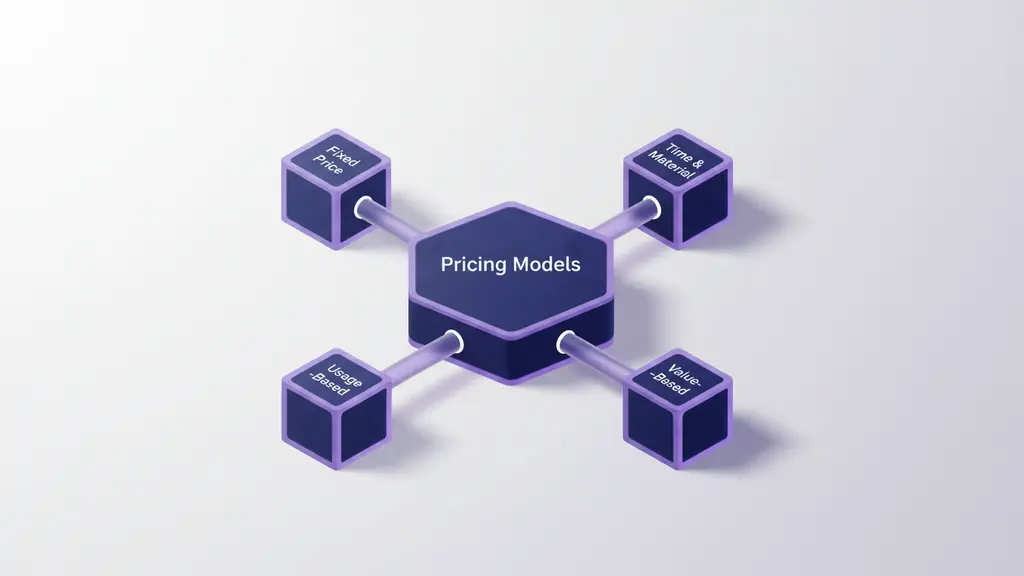
The main AI software development pricing models include Fixed Price, Time & Material (T&M), Usage-Based, Value-Based, Subscription, License Fee, Outcome-Based, and Hybrid approaches. Each model supports different project needs, risk tolerances, and business goals.
Here’s how these core models compare:
- Fixed Price: Predetermined project scope and cost—ideal for clearly defined requirements.
- Time & Material (T&M): Pay based on actual hours or resources consumed—best for evolving or exploratory AI projects.
- Usage-Based: Charges based on actual consumption (e.g., API calls, computation)—common for AI SaaS and scalable products.
- Value-Based: Price tied to realized business value or outcomes—suited for high-impact, custom AI solutions.
- Subscription: Recurring monthly/annual fees for continued access—frequent in AI SaaS or platform offerings.
- License Fee: One-time or term-based software licenses—common with on-prem or enterprise AI tools.
- Outcome-Based: Payment depends on achieving defined, measurable results—aligns incentives, but requires robust metrics.
- Hybrid: Combination of two or more models to balance risk, flexibility, and scalability.
AI projects use different pricing approaches to accommodate project complexity, budget flexibility, time constraints, and expected ROI. Next, compare them side-by-side.

AI Software Pricing Models
| Model | Cost Predictability | Flexibility | Best For | Key Risks | Example Scenario |
|---|---|---|---|---|---|
| Fixed Price | High | Low | Defined scopes/MVPs | Scope creep, rigidity | Chatbot MVP deployment |
| T&M | Low–Medium | High | R&D, evolving specs | Overruns, less budget control | Custom computer vision R&D |
| Usage-Based | Variable | Very High | Scalable/variable usage | Unexpected spikes in usage | AI-powered API (image analysis) |
| Value-Based | Medium–Low | Medium | High-ROI, business gains | Hard to measure value precisely | Predictive maintenance AI |
| Subscription | High | Medium | Ongoing SaaS use | Rising OPEX, vendor lock-in | NLP platform for customer support |
| License Fee | High (upfront) | Low | On-premise, regulated | Large initial investment | Internal fraud detection system |
| Outcome-Based | Low | Medium | Shared-risk projects | Disputes on outcome measurement | AI that reduces costs by X% |
| Hybrid | Medium–Varies | High | Large/complex projects | Complexity, overhead | Fixed fee + usage, e.g., chatbot SaaS |
Deep Dive: How Does Each AI Pricing Model Work (With Pros, Cons, and Use Cases)?
Fixed Price Model
A Fixed Price model sets a predetermined fee for a clearly defined project scope, with agreed milestones and deliverables.
- How it Works: Project requirements, timeline, and outcomes are locked in advance. Vendors quote a total price, sometimes divided across milestones.
- Best for: MVPs, pilots, or projects with well-defined, stable requirements.
- Pros: Predictable costs, easy budgeting, clear deliverables.
- Cons: Inflexible—scope changes can trigger renegotiation or added expense.
- Example: Building a rule-based AI chatbot with a set number of features for a fixed cost.
Time & Material (T&M) Model
The T&M approach bills customers for the actual hours worked or resources consumed, usually on a weekly or monthly basis.
- How it Works: Invoices are issued based on hourly or daily rates for developers and specialists, plus materials (e.g., compute resources).
- Best for: Projects with uncertain or changing requirements, ongoing R&D, or innovative AI solutions.
- Pros: High flexibility to adapt scope and features, especially when building AI iteratively.
- Cons: Difficult to predict final cost, potential for budget overruns without strong project management.
- Example: Developing a custom AI recommendation engine where user preferences evolve during development.
Usage-Based Model
The Usage-Based model charges according to how much of an AI service is consumed—typically measured by API calls, tokens, compute hours, or data processed.
- How it Works: Charges are calculated per usage unit, such as each API call, minute of processing, or dataset analyzed.
- Best for: AI SaaS products or platforms where usage can scale up or down (e.g., computer vision in retail analytics).
- Pros: Scalable pricing, aligns cost with value delivered, easy to start small.
- Cons: Costs can be unpredictable if usage spikes; difficult to budget for high-volume scenarios.
- Example: Using AWS Rekognition to analyze images, billed per image processed.

Value-Based Model
Value-Based pricing ties the cost of the AI project to the anticipated or realized business value it delivers, such as savings, revenue uplift, or efficiency gains.
- How it Works: Price is negotiated based on expected business impact, with payment reflecting perceived value, not just hours worked or resources used.
- Best for: High-ROI custom AI solutions where business impact can be measured (e.g., reducing fraud loss).
- Pros: Strong alignment of incentives between vendor and client; potential for outsized returns.
- Cons: Difficult to define and measure the true value in advance; negotiations can be complex.
- Example: Predictive maintenance AI priced as a share of annual downtime savings.
Subscription Model
Subscription pricing involves recurring (monthly or annual) payments for continued access to an AI tool, service, or platform.
- How it Works: Customers pay a regular fee to use the platform, with usage limits and support tiers often included.
- Best for: SaaS AI products, NLP platforms, or services requiring ongoing updates and support.
- Pros: Predictable OPEX, regular updates, easier budgeting.
- Cons: Cumulative costs can exceed fixed projects over time; risks of vendor lock-in.
- Example: Paying a monthly fee for an AI customer service automation tool.
License Fee Model
This model grants the client rights to use AI software under a one-time or term-based license—often with distinct pricing for different usage levels.
- How it Works: The client pays an upfront (or renewal) fee for perpetual or time-limited use of the software, sometimes with extra support or maintenance charges.
- Best for: Large enterprises, on-premise deployments, or environments needing strict data control.
- Pros: Full control, IP ownership options, potentially lower long-term costs.
- Cons: Large upfront investment, separate costs for updates/upgrades.
- Example: Licensing an AI fraud detection engine for use within a bank’s internal systems.
Outcome-Based Model
Outcome-Based pricing makes payment contingent on achieving pre-agreed results—like revenue uplift, cost reduction, or improved accuracy.
- How it Works: Terms define quantifiable metrics (e.g., 20% reduction in processing costs); payment is linked to success against those KPIs.
- Best for: Projects where outcomes can be objectively measured and shared risk is appropriate.
- Pros: Shared risk/reward, vendor highly motivated to deliver results.
- Cons: Complex negotiations, may not suit all project types, challenges in attributing success.
- Example: Paying for an AI-powered claims processing solution only if it reduces manual review rates by an agreed percentage.
Hybrid Approaches
Hybrid pricing models combine two or more approaches to align cost, flexibility, and risk sharing.
- How it Works: These models might use fixed pricing for core development, with usage-based or outcome-based elements layered in for future scalability.
- Best for: Large, multi-phase AI projects, custom SaaS solutions, or new ventures with evolving needs.
- Pros: Custom-fit contracts, balance of predictability and agility.
- Cons: More complex structuring and negotiation.
- Example: AI chatbot platform with a fixed fee for setup, then usage-based billing for ongoing transactions.
What Are the Main Factors Influencing AI Development Costs?
AI development costs are driven by multiple factors—including project scope, data challenges, infrastructure needs, team expertise, compliance, and ongoing support.
Key cost drivers for custom AI solutions:
- Scope & Project Complexity: More complex objectives, user interfaces, or integrations increase time and cost.
- Data Sourcing & Preparation: Acquiring, labeling, and cleaning quality data is often the largest line item in AI budgets.
- Infrastructure & Cloud Usage: Compute-intensive AI, such as deep learning, drives up cloud (e.g., GPU/TPU) or on-premises hardware costs.
- Team Composition & Expertise: Senior ML engineers and data scientists command higher rates; cross-functional teams increase costs.
- Regulatory/Compliance Costs: Addressing data privacy laws (like GDPR/CCPA) can require additional design and audit steps.
- Ongoing Maintenance & Support: Retraining models, patching, and extending AI systems add to total cost of ownership.
Checklist for AI project cost estimation:
- Define requirements & anticipated complexity
- Assess available data quality and sources
- Outline infrastructure needs and preferred environments
- Map required team skills and availability
- Identify compliance or security requirements
- Plan for post-launch maintenance/upgrades
How Do You Choose the Right Pricing Model for Your AI Project?

Choosing the right AI software development pricing model requires assessing your project’s scope, risk tolerance, timeline, and business goals. A step-by-step framework helps ensure alignment between budget, flexibility, and expected outcomes.
Stepwise model selection checklist:
- Define Project Scope and Clarity:
Is your AI project well-defined, or are requirements likely to change? - Assess Flexibility Needs:
Do you need the freedom to iterate and experiment? - Evaluate Budget Predictability:
Do you require a fixed budget, or can you accommodate variability? - Estimate Expected Usage and Scaling:
Will usage be steady or fluctuate over time? - Consider Outcome Importance:
Can business value or KPIs be clearly measured? - Review Internal Capabilities:
Does your team have AI expertise to manage or co-develop? - Factor in Compliance and Security:
Are there strict regulatory or IP control needs?
Decision Framework (Described Flowchart):
- If requirements are clear and scope is stable:
→ Choose Fixed Price. - If requirements are evolving or R&D-driven:
→ Opt for T&M. - If high/variable usage is expected:
→ Usage-Based or Hybrid. - If your project’s business value can be quantified:
→ Consider Value-Based or Outcome-Based. - If ongoing improvement and access are key:
→ Subscription models suit best. - If strict control or internal deployment is needed:
→ License Fee structure. - If balancing risk/predictability is necessary:
→ Use a Hybrid blend.
Rules of thumb:
For SaaS/startups, start with simple or usage-based models.
For enterprise/internal tools, lean towards license/maintenance contracts.
For high-ROI innovation projects, negotiate shared-risk structures.
Example:
A healthcare SaaS rolling out a patient triage chatbot might use a hybrid model: fixed price for initial delivery, usage-based monthly billing for ongoing AI-powered interactions.
Typical AI Development Cost Ranges: Real-World Benchmarks
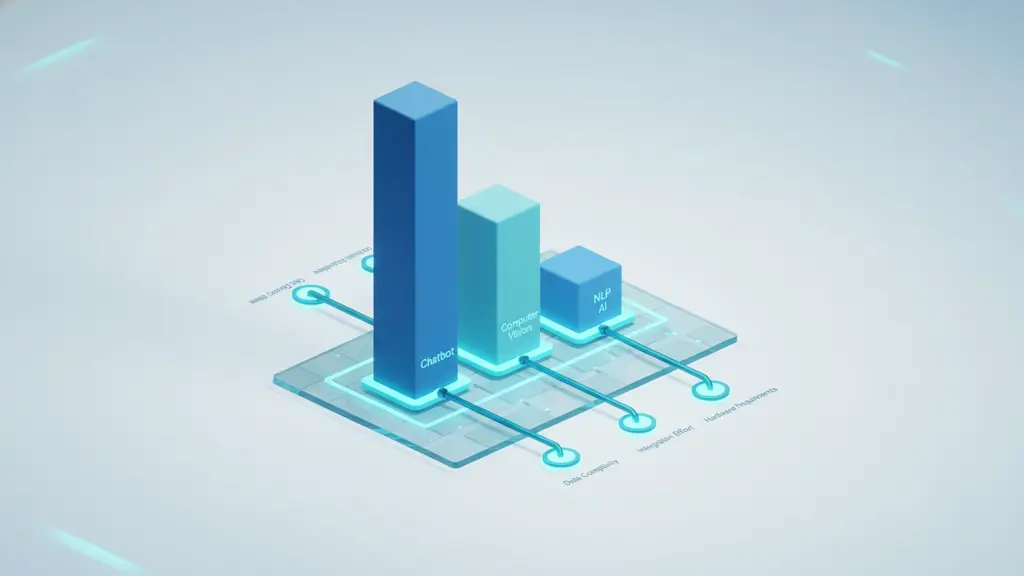
AI project costs can vary wildly by industry, solution type, and region. Below are reference ranges to anchor expectations for budgeting and comparing vendor proposals.
| AI Solution Type | Low-End Estimate | High-End Estimate | Influencing Factors |
|---|---|---|---|
| Chatbot (MVP) | $20,000 | $75,000 | Features, integrations, NLP |
| Computer Vision Module | $35,000 | $150,000+ | Data preparation, accuracy |
| Predictive Analytics | $30,000 | $200,000+ | Data volume, complexity |
| NLP Platform | $50,000 | $300,000+ | Language support, customization |
| AI SaaS Product (Basic) | $100,000 | $500,000+ | Platform build, scaling |
These ranges reflect recent industry benchmarks and may vary by vendor, location, and requirements.
Cost influencers by industry:
- Healthcare: Additional costs for HIPAA compliance and data regulation.
- Finance: Higher complexity for fraud analytics, security requirements.
- Retail: Variable based on data integration and customer analytics needs.
Regional and salary impact:
US/EU rates are typically 25–40% higher than Asia-Pacific for senior AI specialists.
Outsourcing can reduce costs but may add communication or compliance challenges.
Global Vendor Pricing & Outsourcing Insights for AI Development
| Region | Avg. Hourly Rate (AI Dev) | Advantages | Considerations |
|---|---|---|---|
| North America | $100–$250+ | Deep expertise, strong compliance | High cost, competitive hiring |
| Western Europe | $90–$200 | Quality, regulatory awareness | Higher rates, time zone alignment |
| Eastern Europe | $50–$120 | Technical strength, cost-effective | Language/cultural factors |
| Asia-Pacific | $35–$100 | Large talent pool, affordability | IP protection, varying quality |
| Latin America | $40–$90 | Time zone fit (US), growing skills | Smaller specialist pool |
Outsourcing models:
- Direct—hire individual freelancers or teams directly (lower cost, higher management overhead).
- Vendor/Partner—contract established firms (higher rate, robust delivery, mature processes).
Procurement/contracting tips:
- Specify IP ownership terms
- Address data security and regulatory requirements
- Use clear SLA milestones and payment triggers
- Negotiate ramp-up or pilot phases before full commitment
Negotiation levers:
- Ask for phased pricing (pilot, scale)
- Request bundled support or maintenance
- Use global benchmarks to justify target ranges
How to Negotiate and Budget for AI Software Development
Smart negotiation and disciplined budgeting can make the difference between AI success and costly overruns. Approach vendor discussions with clarity and strategic questions.
Top negotiation questions:
- What pricing model(s) do you recommend for this project—and why?
- How are unexpected changes or additional requirements handled?
- What is included—and excluded—in the proposal (e.g., support, retraining)?
- What compliance, maintenance, or upgrade costs should we anticipate?
- Who owns the IP rights and data outputs?
Tips for budgeting AI development:
- Plan for pilot phases: Negotiate smaller commitments for prototypes or proofs-of-concept.
- Tie payments to milestones: Link compensation to clear deliverables or acceptance criteria.
- Clarify post-launch costs: Budget for retraining, cloud costs, and compliance updates.
- Leave room for iteration: Especially important with T&M and usage-based models.
- Document negotiation outcomes: Set expectations in writing, including change order processes.
Best Practices:
- Use a “budget buffer” of at least 15–20% for unforeseen AI challenges.
- Reassess costs and needs after each project milestone.
- Prioritize models with predictable maintenance/support line-items.
Frequently Asked Questions (FAQ) About AI Software Pricing Models
What are the main AI software development pricing models?
The principal models are Fixed Price, Time & Material, Usage-Based, Value-Based, Subscription, License Fee, Outcome-Based, and Hybrid. Each supports different project sizes, risk appetites, and business outcomes.
How much does custom AI development cost?
Custom AI solution pricing typically ranges from $20,000 to $500,000 or more, depending on complexity, data scope, integration needs, and region.
What factors impact AI project pricing?
Key AI development cost drivers include project complexity, data availability/preparation, required expertise, infrastructure demands, compliance, and ongoing maintenance.
How do I choose the right pricing model for my AI project?
Assess your project’s clarity, flexibility needs, budget constraints, desired outcomes, and internal capabilities. Use a decision framework to align the pricing model to your objectives and risks.
What is the difference between usage-based and fixed-price models?
Usage-based pricing charges according to consumption (e.g., API calls, compute hours). Fixed price provides a set cost for a defined project scope, regardless of usage or effort.
How can I estimate the budget for an AI solution?
Start with project requirements, map data and infrastructure needs, outline team skills, factor in compliance and ongoing support, then benchmark similar projects’ costs.
What are typical ongoing costs after AI software is launched?
Operational expenses may include cloud usage, model retraining, data updates, bug fixes, and adapting to evolving regulatory or user needs.
Can I negotiate pricing with an AI development company?
Yes. Most AI vendors are open to negotiation—particularly on payment milestones, pilot phases, support levels, and hybrid model tailoring.
Are hybrid pricing models suitable for AI projects?
Hybrid models are increasingly common and well-suited to large or evolving AI solutions. They offer a balanced approach to risk, flexibility, and cost control.
What steps can help maximize ROI on AI software investments?
Choose the right pricing model, define KPIs up front, validate business value, plan for maintenance, and revisit contract terms as usage and needs evolve.
Conclusion
Understanding and selecting the right AI software development pricing model is crucial to controlling costs, reducing risk, and maximizing strategic value. With a clear framework, model benchmarks, and a stepwise selection guide, you’ll have the confidence to negotiate smarter contracts and plan sustainable AI investments.
Ready to take the next step? Use our model selection checklist or contact an AI development advisor for a tailored cost assessment today.
Key Takeaways
- Pricing model choice directly impacts AI project cost, risk, and ROI.
- Each model—Fixed, T&M, Usage-Based, and Hybrid—suits different needs.
- AI development costs are driven by scope, data, infrastructure, and expertise.
- Global vendor rates and outsourcing can affect project budgets significantly.
- Smart negotiation and clear budgeting processes help maximize AI value.
This page was last edited on 9 July 2026, at 11:09 am

Start a conversation with our team to solve complex challenges and move forward with confidence.