Machine learning outsourcing lets businesses tap into top-tier AI talent, drive innovation, and achieve results faster than ever before.
As organizations race to unlock the potential of machine learning (ML), many face a bottleneck: a global shortage of skilled ML professionals, spiraling costs, and fast-changing technology. Attempting to build in-house ML capabilities often leads to delays, missed opportunities, or overstretched teams.
The good news? Outsourcing ML projects enables access to expert partners, proven processes, and more flexible scaling—if done right. This guide delivers an actionable playbook for business leaders: frameworks, checklists, market data, and real-world scenarios to ensure your next ML outsourcing project is a success.
Key Takeaways Table: Benefits, Risks, and Quick Facts
Below is a quick comparison of ML outsourcing versus in-house development, highlighting top benefits, risks, and essential factors.
| Feature | Outsourcing ML | In-House ML |
| Cost | Lower upfront, predictable | High hiring/training costs |
| Expertise | Access to global talent | Limited by hiring pool |
| Speed to Market | Faster ramp-up | Slower (setup/learning) |
| Scalability | Flexible per project | Challenging, resource-bound |
| Control | Shared decision making | Full internal control |
| Risks | Data/IP security, miscomm | Talent retention, siloing |
Top Benefits:
- Access to specialized skills on demand
- Faster project delivery and innovation
- Reduced operational costs and risk
Top Risks:
- Data privacy or IP exposure
- Communication or alignment gaps
- Loss of control over core processes
What Is Machine Learning Outsourcing?
Machine learning outsourcing is the practice of hiring external vendors—agencies, consultants, or freelancers—to deliver ML development, implementation, and maintenance, instead of relying solely on internal teams.
Key Concepts:
- ML Outsourcing Vendors: Specialists who offer ML and AI services, from building models to deployment and ongoing support.
- Common Outsourced Tasks:
- Model development and training
- Data preprocessing and annotation
- MLOps (machine learning operations)
- Deployment and integration
- Application support and maintenance
Glossary Box:
- MLOps: Combining machine learning development with IT operations for seamless model deployment and management.
- Vendors: External companies or professionals offering ML expertise and execution.
- Data Science: The field underpinning ML model creation and analysis.
ML outsourcing lets organizations quickly access best-in-class expertise and advanced tools without the heavy investment of recruiting or training internal teams.
How Does Machine Learning Outsourcing Work?
Machine learning outsourcing follows a step-by-step process, designed to ensure efficient delivery and ongoing support of your ML projects.
Process Overview:
- Requirements Definition:
Scope the project, define goals, deliverables, and KPIs. - Vendor Selection:
Identify, assess, and select the right ML outsourcing providers based on expertise, track record, and fit. - Onboarding:
Share data, documentation, and grant necessary system access—align expectations and responsibilities. - Project Execution & Delivery:
Vendor conducts model development, testing, and deployment via agile or milestone-based workflows. - Support & Maintenance:
Ensure ongoing performance, monitoring, and updates as needed.
Key Roles:
- Client: Sets goals, provides data, oversees progress.
- Vendor: Leads the technical execution, reports results, and troubleshoots issues.
- Project Manager: Coordinates communication, timelines, and ensures alignment across both sides.
Why Outsource Machine Learning?
Outsourcing machine learning offers significant advantages, including lower costs, faster innovation, and access to specialized expertise.
Top Benefits of ML Outsourcing:
- Cost Efficiency:
– Reduces hiring, training, and infrastructure expenditures.
– Fixed or predictable costs via clear pricing models. - Access to Specialized Talent:
– Leverage deep expertise not always available in-house.
– Engage experts in cutting-edge ML, AI, and data science. - Faster Time to Market:
– Vendors offer ready-to-deploy teams and established workflows.
– Accelerate pilot and production timelines by bypassing hiring bottlenecks. - Scalability & Flexibility:
– Adjust resources to project needs—scale up or down without team churn. - Focus on Core Business:
– Free up internal teams to focus on strategic growth, not technical overhead.
Case Evidence:
According to industry analyses (Deloitte, McKinsey), companies can reduce AI/ML project implementation time by 30–50% and cut operational costs by up to 40% by choosing the right outsourcing partner.
What Are the Key Risks and Challenges in ML Outsourcing?
![What Are the Key Risks and Challenges in ML Outsourcing? [Mitigation Strategies]](https://riseuplabs.com/wp-content/uploads/2026/02/what-are-the-key-risks-and-challenges-in-ml-outsourcing-mitigation-strategies.webp)
While ML outsourcing brings clear rewards, it also introduces risks such as data security gaps, communication breakdowns, and potential loss of control over crucial assets.
Major Risks:
- Data Security and Privacy:
Sensitive data shared with external partners may be at risk without tight controls. - Loss of Process Control:
Vendors may use opaque methods (“black box” risk), limiting visibility for your team. - Communication & Alignment:
Misunderstandings can develop due to language, culture, or time-zone differences.
| Risk | Potential Impact | Mitigation Strategy |
| Data Security | Data breaches | NDAs, data encryption, audits |
| Loss of Control | Reduced oversight | Clear KPIs, progress reporting |
| Communication Gaps | Project delays | Regular meetings, defined contacts |
Risk Mitigation Tactics:
- Due Diligence: Vet vendors’ security protocols and reputation.
- Contracts: Use robust NDAs, clear IP assignments, and compliance clauses.
- Communication Plan: Set regular update meetings and clear escalation paths.
- Defined KPIs: Track deliverables and project health via visible metrics.
By addressing these areas proactively, you can reduce the probability and impact of common ML outsourcing challenges.
In-house vs. Outsourced Machine Learning: How Do They Compare?
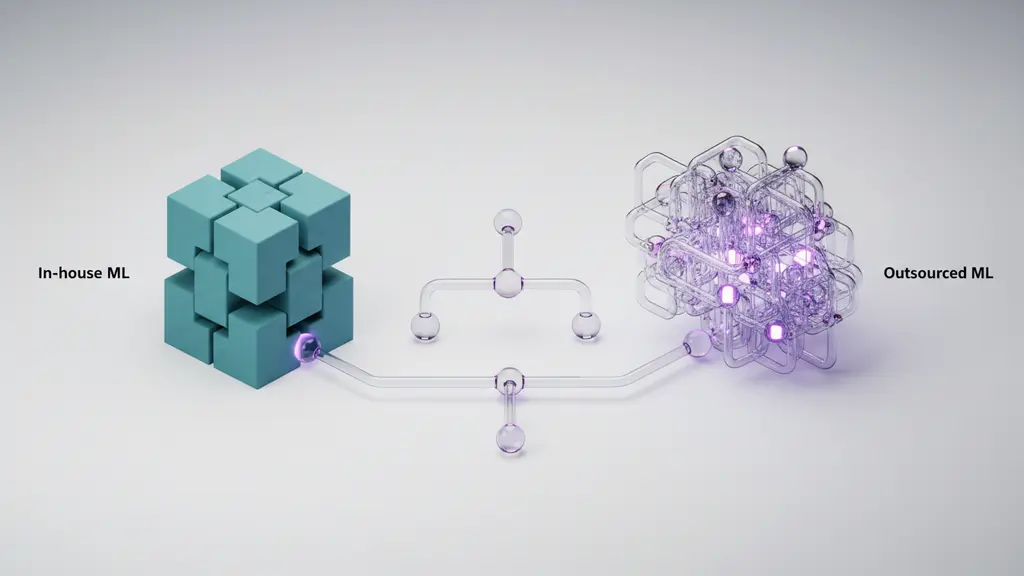
Deciding between in-house development and outsourcing ML work depends on your business goals, resources, and project complexity.
Comparison Table:
| Feature | In-House | ML Outsourcing |
| Initial Cost | High (hiring, infra) | Lower upfront (predictable spend) |
| Time to Launch | Slower (hiring, ramp-up) | Faster (ready talent/process) |
| Talent Pool | Limited by geography/budget | Global, deep expertise |
| Scalability | Resource-constrained | Scale freely with project needs |
| Control | Direct ownership | Shared, contractual control |
| IP Management | Fully internal | Requires clear contract terms |
When to Outsource:
- Need rapid prototyping or proof-of-concept.
- Lack internal ML/AI/DevOps expertise.
- Require surge capacity for high-priority initiatives.
When In-House Makes Sense:
- Ongoing, core ML is business-critical IP.
- Strict regulatory or data governance mandates.
How to Choose the Right ML Outsourcing Vendor?
Selecting the best ML outsourcing partner is a strategic process—poor choices carry cost, security, and timeline risks.
Stepwise Vendor Selection Framework:
- Define Needs:
Clarify business goals, required skills, deliverables, success metrics. - Market Mapping:
Research agencies, managed services, freelancers—focus on relevant track records. - Shortlist Providers:
Filter by technical strength, sector experience, references, case studies. - Interview & Deep Dive:
Assess communication, project ethos, and technical approach. - Pilot/Proof-of-Concept:
Run a small test project; review collaboration, results, and problem-solving. - Score & Evaluate:
Use weighted criteria—price, expertise, cultural fit, security measures. - Contract Negotiation:
Lock down scope, SLAs, pricing, IP, and security.
Vendor Evaluation Checklist (Sample):
- Demonstrated experience in similar ML projects/industry
- Clear project management and communication plan
- Strong data security/compliance credentials
- Transparent pricing and contract terms
- Willing to pilot or provide references
What Do ML Outsourcing Contracts, Pricing Models, and Costs Look Like?
Understanding contract and pricing structures upfront helps prevent surprises and supports better budgeting during your ML outsourcing journey.
Common Pricing Models:
| Model | Description | When It Fits |
| Time & Materials (T&M) | Hourly/daily billing—flexible scope | Evolving or ambiguous projects |
| Fixed Price | Predefined deliverables, set amount | Well-scoped, low-risk projects |
| Subscription/Retainer | Ongoing access, fixed monthly fee | Continuous support/maintenance |
Cost Benchmarks:
- Small project: $10,000–$50,000 USD
- Mid-sized project: $50,000–$250,000 USD
- Enterprise/complex: $250,000+ USD
Costs vary by scope, data, and vendor region; always compare market rates.
What a Strong ML Outsourcing Contract Should Include:
- Clear deliverables, milestones, and timelines
- IP ownership and confidentiality clauses
- Service Level Agreements (SLAs) for uptime, support, and incident response
- Data privacy, compliance (GDPR, HIPAA) obligations
- Change control processes
Negotiation Best Practices:
- Seek transparency on change requests
- Clarify termination/audit rights
- Build in performance-based payment triggers
Example Use Cases: ML Outsourcing Success Stories by Industry
Outsourcing machine learning drives value across sectors, from healthcare to finance and manufacturing.
Industry Use Case Snapshots:
| Industry | Use Case Example | ROI/Impact |
| Manufacturing | Predictive maintenance with ML models | Reduced downtime, higher yield |
| Healthcare | Patient risk stratification | Improved care, compliance |
| Finance | Fraud detection systems | Faster identification, savings |
| Marketing | Customer segmentation, targeting | Higher conversion, efficiency |
Example:
- A global manufacturer outsourced predictive analytics to reduce production line failures—result: 30% reduction in downtime within 12 months.
- A healthcare SaaS firm partnered with ML consultants for HIPAA-compliant patient risk tools—outcome: enhanced predictive accuracy while maintaining data security standards.
How to Ensure Compliance, Data Security, and Explainable AI in Outsourced ML?
Ensuring regulatory compliance, robust data security, and transparent AI is vital when working with external vendors.
Key Compliance Standards:
- GDPR: Data handling rules for EU citizens
- HIPAA: Privacy of healthcare data (US)
- Industry Best Practices: SOC 2, ISO 27001 (information security)
Best Practices for Data Security:
- Strict NDAs and contractual data protection
- Data minimization, anonymization, and secure transmission methods
- Vendor security certifications and regular audits
Explainable AI:
- Use frameworks and tools that allow ML decision-making to be inspected and understood.
- Build contractual obligations for transparency—vendors should supply documentation and, when possible, interpretable models.
Expert Tips:
– Always include compliance checks in vendor assessments.
– Demand clear audit trails and traceability for ML processes.
Can You Scale or Transition from Outsourced to In-house ML?
Businesses often start with outsourcing but may later wish to build or grow their own ML teams. A thoughtful transition plan keeps options open and prevents dependency.
ML Outsourcing Transition Pathways:
- Start with Outsourcing:
Harness vendor expertise to build MVPs or accelerate innovation. - Plan Knowledge Transfer:
Include documentation, code handover, and staff upskilling provisions in contracts. - Hybrid Models:
Blend internal and external teams for project continuity and skills ramp-up. - Move In-House:
Gradually hire and onboard permanent staff, using what’s learned from outsourcing to inform hiring, processes, and tooling.
Best Practices:
- Negotiate knowledge transfer as part of the original agreement.
- Use hybrid approaches (outsourced core + internal integrators) to avoid single-vendor lock-in.
- Document project pipelines, code repositories, and key decisions for future independence.
Frequently Asked Questions (FAQs) about Machine Learning Outsourcing
What is machine learning outsourcing?
Machine learning outsourcing is the practice of hiring external vendors or consultants to manage ML development, deployment, and maintenance, freeing up internal teams to focus on core business activities.
What are the main benefits of outsourcing machine learning projects?
Key benefits include faster time to market, access to global talent, cost savings, and flexible scaling of resources based on project needs.
How do I choose the right ML outsourcing vendor?
Choose by clearly defining project requirements, researching vendor experience, assessing expertise, conducting interviews or pilots, and evaluating data security protocols. Always check references and include clear contract terms.
What risks should I consider when outsourcing machine learning?
Risks involve data security, intellectual property protection, communication gaps, and potential loss of project control. Mitigation includes robust contracts, regular updates, and clear KPIs.
How does the cost of outsourcing ML compare to building in-house?
Outsourcing is often less expensive upfront due to the absence of hiring and infrastructure costs. In-house development has higher fixed costs and slower ramp-up but may suit long-term, core capabilities.
What industries benefit most from ML outsourcing?
Industries seeing strong returns from ML outsourcing include manufacturing, healthcare, finance, and marketing—especially where analytical needs and data volumes are high.
How do ML outsourcing contracts and pricing models work?
Common models include time & materials, fixed price, and subscription. A good contract should specify scope, deliverables, payment terms, IP ownership, SLAs, and compliance obligations.
What is the difference between offshore and nearshore ML outsourcing?
Offshore refers to vendors in distant countries (often with lower costs), while nearshore vendors are in neighboring or culturally similar regions, often providing easier communication and oversight.
How can I ensure data security and compliance when outsourcing ML?
Ensure vendors comply with relevant standards (GDPR, HIPAA), specify non-disclosure and data protection measures in contracts, and request evidence of regular security audits or certifications.
Can I transition from outsourcing to an in-house ML team?
Yes—plan for knowledge transfer and documentation during the outsourcing phase, start onboarding in-house talent, and consider hybrid models for a smooth transition.
Conclusion
Embracing machine learning outsourcing is a strategic opportunity for organizations seeking growth, speed, and innovation in the AI era. This guide equips you with concrete frameworks to select the right partners, optimize costs, manage risk, and ensure long-term independence.
Ready to take the next step? Use our vendor evaluation checklist, consult with an expert, or start building your RFP for machine learning outsourcing today—position your company for data-driven success in 2026 and beyond.
Key Takeaways
- ML outsourcing unlocks specialized expertise, faster delivery, and cost savings.
- Careful vendor selection and contract frameworks minimize risk.
- Industry-specific use cases prove that outsourcing drives real ROI.
- Compliance, security, and explainable AI should be core to every ML outsourcing deal.
- Hybrid and transition strategies future-proof your ML investments and safeguard knowledge.
This page was last edited on 9 July 2026, at 11:09 am

Start a conversation with our team to solve complex challenges and move forward with confidence.