
Outsourcing DevOps is rapidly becoming the norm for modern organizations facing talent scarcity, escalating cloud complexity, and the constant pressure to innovate securely and efficiently.
Many CTOs and product leaders wrestle with rising costs, skill gaps, and the limits of traditional in-house models—especially as automation, cloud-native platforms, and compliance needs evolve through 2024 and 2025.
This article delivers a clear, expert-backed solution: a practical, step-by-step playbook for how to outsource DevOps, choose the right outsourcing model, mitigate risks, and accelerate projects with confidence.
By following this comprehensive guide, you’ll understand the business drivers, sidestep costly pitfalls, and implement a strategy that maximizes agility, quality, and ROI for your engineering teams.
What Is DevOps Outsourcing?
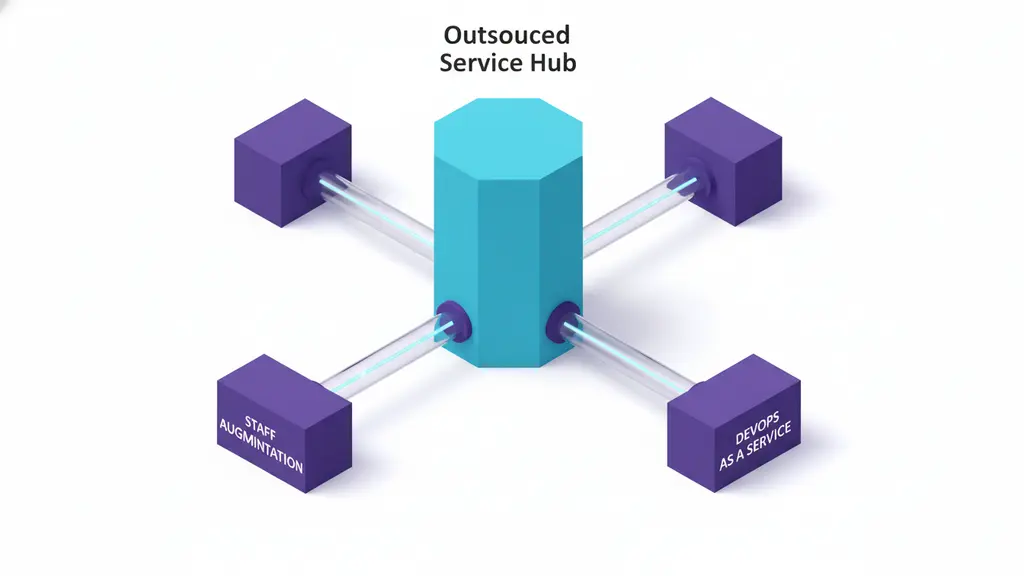
DevOps outsourcing is the practice of delegating DevOps engineering tasks—such as CI/CD, infrastructure automation, security, and monitoring—to specialized third-party providers.
Unlike managing DevOps functions entirely in-house, outsourcing leverages external expertise through models like staff augmentation, managed services, or DevOps as a Service (DaaS). Providers deliver capabilities ranging from process optimization to 24/7 operations, tailored to your business needs.
DevOps Outsourcing: Key Components
- Staff Augmentation: Supplement your team with external DevOps engineers or specialists.
- Managed DevOps Services: Entrust a provider to run, monitor, and continuously improve your end-to-end DevOps pipeline.
- DevOps as a Service (DaaS): Subscription-based, cloud-centric offerings that deliver toolchains and automation via secure platforms.
Outsourcing DevOps does not replace essential in-house roles such as software developers, QA engineers, or product owners. Instead, it enables organizations to accelerate delivery, scale operations, and meet compliance requirements by partnering with proven experts.
Can DevOps Be Outsourced—and Should You?
Yes, DevOps can be effectively outsourced, especially when organizations face resource constraints, growth surges, or need continuous expertise in specialized areas. Outsourcing suits companies ranging from scaling startups to established mid-market firms aiming to optimize DevOps workflows or migrate to cloud-native environments.
When to Outsource DevOps
Best Fit:
- Rapidly scaling startups or SaaS companies
- Businesses expanding into new markets or tech stacks
- Teams with skill gaps in automation, security, or compliance
Best Tasks to Outsource:
- Building and maintaining CI/CD pipelines
- Cloud infrastructure automation (AWS, Azure, GCP)
- Continuous monitoring, alerting, and incident response
- Compliance management (PCI DSS, GDPR, HIPAA)
Best Kept In-House:
- Core application development
- Business-specific QA or domain expertise
- Proprietary data science or sensitive R&D
Task Matrix: Outsource vs In-House
| DevOps Task | Outsource | In-House |
| CI/CD Pipeline Automation | ✓ | |
| Cloud Infrastructure Setup | ✓ | |
| Security Monitoring | ✓ | |
| Compliance Implementation | ✓ | |
| Application Code Changes | ✓ | |
| Business Logic QA | ✓ |
Companies should consider outsourcing DevOps when the need for speed, resilience, or compliance outweighs the ability (or cost) of building deep in-house expertise.
What Are the Benefits of Outsourcing DevOps in 2024?

Outsourcing DevOps delivers clear business value by providing access to specialized talent, reducing operational costs, and enabling rapid scaling.
Key Benefits of DevOps Outsourcing
- Expertise On-Demand: Access certified DevOps engineers with deep experience in modern tools, cloud services, and security.
- Cost Efficiency: Shift from high upfront CAPEX (hiring, infrastructure) to predictable OPEX (managed service fees or subscriptions).
- 24/7 Availability & Scalability: Ensure round-the-clock monitoring and seamless scaling without growing internal headcount.
- Faster Time-to-Market: Accelerate deployments and product launches through streamlined automation.
- Enhanced Security & Compliance: Leverage providers’ experience meeting PCI DSS, SOC2, GDPR, and other compliance frameworks.
Organizations adopting managed DevOps services often see improved deployment frequency, reduced mean time to recovery (MTTR), and increased change success rates, according to recent reports from the DevOps Institute and Forrester.
What Are the Risks and Challenges in DevOps Outsourcing?
While DevOps outsourcing offers substantial benefits, it also presents unique risks that decision-makers must address proactively.
Main Challenges in DevOps Outsourcing
- Communication Barriers: Managing workflows across different time zones and ensuring cultural alignment can impact collaboration and delivery.
- Security & Data Governance: Granting vendors system access necessitates rigorous access controls and audit trails to prevent data leaks.
- Compliance Complexity: Navigating multiple regulatory environments (GDPR, HIPAA) requires careful due diligence, especially with cross-border providers.
- Vendor Lock-In: Long-term reliance on a single provider without a clear exit or transition plan can create business risk.
- Hidden Costs: Transition, onboarding, and tool licensing fees can erode expected cost savings if not carefully managed.
Risk Category | Description | Mitigation
| Risk Category | Description | Mitigation |
| Communication | Time zone and language mismatches | Set overlapping hours |
| Security | Potential for unauthorized access or breaches | Strict IAM & audits |
| Compliance | Data residency and audit trail requirements | Contractual clauses |
| Vendor Lock-In | Difficulty switching providers post-integration | Exit strategies |
| Hidden Costs | Unexpected transition, tooling, or training expenses | Upfront cost planning |
Proactively identifying and mitigating these risks is essential for a successful DevOps outsourcing strategy.
What Are the Different DevOps Outsourcing Models?
DevOps outsourcing is delivered through several distinct models, each with its own strengths and best-fit scenarios.
Main DevOps Outsourcing Models
| Model | Description | Responsibility | Pros | Cons |
| Staff Augmentation | Supplement internal teams with contracted DevOps professionals | Client-heavy | Flexibility, control | Management overhead |
| Managed Services | Outsource entire DevOps workflows to a provider | Provider-heavy | End-to-end automation | Less direct oversight |
| DevOps as a Service | Cloud-based, toolchain-focused subscription (DaaS) | Shared/mixed | Fast setup, scalability | Limited customization |
Staff Augmentation:
Brings in DevOps experts as part of your team, ideal for scaling capacity or infilling specific skills.
Managed Services:
Transfers operational responsibility and outcomes (SLA-driven) to a trusted provider—best for organizations seeking holistic improvement with minimal in-house management.
DevOps as a Service (DaaS):
Delivers pre-configured toolchains and automation, typically via cloud, accelerating adoption for companies wanting “DevOps in a box.”
Selecting the right model involves balancing your need for speed, control, and integration depth.
The 7R Framework: Step-by-Step Guide to Outsourcing DevOps

To successfully outsource DevOps, organizations need a proven, structured roadmap. The proprietary 7R Framework offers a clear, end-to-end process that reduces risk and maximizes outcomes.
7R Framework: Outsourcing DevOps in 7 Steps
- Readiness: Define your DevOps outsourcing goals.
- Research: Identify and shortlist providers.
- Risk: Assess vendor risk and compliance alignment.
- Request: Run RFP and due diligence.
- Run: Execute a pilot project or trial engagement.
- Review: Formalize contract, SLA, and onboarding.
- Refine: Monitor, optimize, and scale the engagement.
Step 1: Readiness—Define Your DevOps Outsourcing Goals
Start by assessing your current DevOps maturity, identifying pain points (e.g., pipeline slowdowns, compliance backlogs), and mapping out strategic and technical objectives such as speed, cost optimization, or 24/7 uptime.
- Document stakeholder priorities.
- Define expected outcomes and success metrics.
- Use a RACI (Responsible, Accountable, Consulted, Informed) matrix to clarify roles.
Step 2: Research—Identify and Shortlist Providers
Find reputable DevOps outsourcing vendors through analyst reports (such as Forrester Wave, Gartner), peer referrals, or review platforms.
- Evaluate expertise, certifications (AWS, Azure, Kubernetes), case studies, and tech stack compatibility.
- Check compliance readiness (GDPR, PCI DSS), language skills, and support coverage.
Step 3: Risk—Assess Vendor Risk and Compliance Alignment
Vet each vendor’s security posture, data protection practices, and past SLA performance.
- Require documented security policies and audit results (SOC2, ISO 27001).
- Ensure legal reviews of NDAs, data residency clauses, and regulatory fit for your geography.
Step 4: Request—Engage in RFP and Due Diligence
Create a structured RFP (Request for Proposal) specifying your needs, desired deliverables, and evaluation criteria.
- Review vendor responses using a scoring matrix.
- Ask for case studies, customer references, and sample SLAs.
- Consider inviting shortlisted vendors to propose a pilot or proof-of-concept.
Step 5: Run—Pilot Project or Trial Engagement
Test your top vendor with a scoped, time-bound pilot project.
- Set clear KPIs (deployment frequency increase, incident resolution speed).
- Establish reporting and collaboration formats.
- Capture learnings and gather feedback from stakeholders.
Step 6: Review—Formalize Contract, SLA, and Onboarding
Negotiate final terms, including scope, SLAs, change management, and exit provisions.
- Set up shared dashboards and integration points.
- Transfer necessary documentation and knowledge.
- Onboard external teams with a clear handover and communication protocol.
Step 7: Refine—Monitor, Optimize, and Scale Engagement
Establish ongoing performance reviews, QBRs (Quarterly Business Reviews), and continuous feedback processes.
- Monitor agreed KPIs and adapt contracts as needs change.
- Plan for scaling up, pivoting, or switching providers when necessary.
How Do You Choose the Right DevOps Outsourcing Provider?
Choosing the right DevOps partner requires a rigorous, data-driven evaluation process focused on expertise, communication, security, and cultural fit.
Top Vendor Selection Criteria
- Technical Expertise: Verify certifications (AWS, Azure, Kubernetes), toolchain experience, and documented process maturity.
- Reference Validation: Conduct interviews with existing clients, request case studies and quantifiable project outcomes.
- Security & Compliance: Scrutinize security certifications and audit reports; ask about incident history and compliance success.
- Scoring Template: Use a vendor evaluation matrix that scores providers by technical fit, communication, pricing, SLAs, and references.
- Communication & Culture: Assess language proficiency, collaboration style, and time zone overlap during interviews.
- Red Flags: Vague documentation, reluctance to provide references, or limited transparency on costs/processes.
An effective selection process reduces risk and ensures the partner can scale with your technical and business goals.
How Much Does DevOps Outsourcing Cost? In-House vs. Outsourced Analysis
DevOps outsourcing costs vary widely based on the model, region, provider expertise, and scope—but typically save money over recruiting, hiring, and retaining in-house talent.
DevOps Outsourcing Cost Models
- Hourly/FTE: Pay per resource hour or assign dedicated engineers (common with staff augmentation).
- Fixed Price: Project-based fee for a defined scope (common for pilot projects or migrations).
- Subscription/Managed Service: Recurring monthly/annual fee for ongoing services (DaaS or managed models).
| Cost Driver | In-House | Outsourced |
| Salary/Benefits | High (annual) | None |
| Recruitment/Onboarding | High (upfront) | Low (vendor) |
| Tools/Platform | Full responsibility | Shared/Split |
| Training & Certifications | Ongoing | Typically included |
| Flexibility | Low | High |
| Scalability | Hiring delays | Immediate |
| Estimated Monthly Spend (*) | $12,000+ per FTE | $6,000–$15,000 total |
(*) Costs are indicative and will vary by region, model, and provider.
Tips for Cost Optimization
- Carefully scope pilot projects before scaling.
- Identify all potential transition, tooling, or integration costs.
- Compare multiple vendors and negotiate flexible terms.
How Do You Measure Success in DevOps Outsourcing? [KPIs & Reporting]
To ensure sustained value, organizations must track performance using meaningful DevOps KPIs and regular reporting.
Core DevOps Outsourcing KPIs
| KPI | Description |
| Deployment Frequency | Number of successful releases per time period |
| Change Failure Rate | Percent of releases causing incidents |
| Mean Time to Recovery | Time to restore service after incident |
| Incident Response Time | Time to acknowledge and resolve issues |
| SLA Adherence | % uptime/availability vs agreed targets |
| Collaboration Metrics | Response time, ticket closure, meeting cadence |
Best Practices
- Set and review KPIs in contracts and QBRs.
- Require dashboard or automated reporting from providers.
- Adjust goals as your organization matures and scales.
DevOps Outsourcing at a Glance
| Step/Model | Description | Pros | Cons | KPIs | Cost Range |
| 7R Process Step | Structured roadmap for success | De-risks outsourcing | Requires discipline | Step completion, impact | N/A |
| Staff Augmentation | Vendor-provided engineers | Flexibility, control | More oversight needed | Time to value, velocity | $6K–$12K/mo* |
| Managed Services | End-to-end DevOps ownership | Results, automation | Less direct control | SLA metrics, uptime | $8K–$15K/mo* |
| DaaS | Subscription cloud toolchains | Fast adoption | Customization limits | Usage, deployments | $2K–$8K/mo* |
| Cost Comparison | In-house vs outsourced | OPEX savings possible | Transition costs | Cost/performance ratio | See above |
(* Sample cost ranges; actuals vary by provider, region, and scope.)
Common Questions About Outsourcing DevOps
Can DevOps be outsourced successfully?
Yes. Many organizations outsource DevOps to access specialized skills, achieve faster time-to-market, and run 24/7 operations—especially when scaling rapidly or facing skill shortages.
What are the key steps to outsource DevOps?
The recommended steps are: define goals, research vendors, assess risks, issue RFPs, run a pilot project, finalize contracts/onboarding, then continuously monitor and optimize.
How do you choose a DevOps outsourcing partner?
Look for technical certifications, proven project outcomes, strong communication skills, positive client references, and region-appropriate compliance expertise.
What are typical DevOps outsourcing models?
The three main models are staff augmentation (hiring individual experts), managed services (outsourcing entire processes), and DevOps as a Service (subscription-based cloud platforms).
How much does outsourcing DevOps cost?
DevOps outsourcing can range from a few thousand dollars per month (for targeted services) to $15,000+ per month for comprehensive, managed teams—often less than building equivalent in-house capacity.
What are the common risks in DevOps outsourcing?
Risks include communication barriers, security and compliance challenges, hidden costs, and potential vendor lock-in. Proactive planning and clear contracts can mitigate most risks.
How do you ensure security and compliance?
Require providers to have up-to-date certifications (SOC2, ISO 27001), rigorous access controls, and experience meeting GDPR, PCI DSS, or HIPAA standards relevant to your business.
What’s the difference between managed services and staff augmentation for DevOps?
Managed services providers own outcomes and deliverables via SLAs, while staff augmentation adds external experts to your team, maintaining client-side management.
How is success measured?
Success is measured by deployment frequency, change failure rates, recovery time, and adherence to KPIs/SLA. Regular reporting and QBRs ensure accountability.
Should startups outsource DevOps?
Yes—startups with limited in-house capacity often benefit from outsourcing to accelerate product launches, bridge skill gaps, and focus internal resources on core innovation.
Conclusion
Outsourcing DevOps is one of the most effective ways for modern organizations to accelerate growth, boost resilience, and stay competitive in a rapidly evolving cloud landscape. By following the proven 7R Framework—defining your goals, selecting the right model and partner, mitigating risk, and building measurable partnerships—you can harness the power of external expertise while retaining strategic direction.
Every organization’s needs differ. Use the insights, checklists, and actionable steps in this playbook to tailor your approach, de-risk your outsourcing journey, and drive measurable success—all while optimizing costs.
Ready to take the next step? Download the full DevOps Outsourcing Checklist, schedule a consultation with our experts, or subscribe for ongoing DevOps strategy updates.
Key Takeaways
- Outsourcing DevOps enables businesses to access specialized skills, operational efficiency, and scalability, especially in a cloud-driven world.
- The proprietary 7R Framework offers a clear, actionable process to mitigate risk and maximize outsourcing ROI.
- Comparing models—staff augmentation, managed services, DaaS—ensures alignment to business goals and technical needs.
- Success relies on rigorous provider selection, clear contracts, and KPI-driven management.
- Proactive security, compliance, and cost controls are critical to long-term value and risk avoidance.
This page was last edited on 30 January 2026, at 5:46 pm

Start a conversation with our team to solve complex challenges and move forward with confidence.