
- Who This Is For
- Framework for Hiring AI Developers (2026)
- Which AI Developer Do You Need and For What?
- What Skills to Look for When Hiring an AI Developer
- In-House vs Remote AI Developers: Which One Should You Choose?
- How to Source, Vet, and Onboard AI Developers
- What AI Developers Cost Across Regions
- Where to Go From Here
- 30-Day AI Hiring Checklist
If you need to hire AI developers, the hardest part isn’t sourcing talent; it’s avoiding the wrong hire.
Most teams don’t realize they made a bad AI hire until months later. The demo worked. The interviews sounded strong. Then the system hits real data, real users, real costs, and nothing holds up. Progress slows, confidence drops, and no one can explain why.
This guide exists for teams that don’t have time for that mistake. It breaks down how to hire AI developers based on outcomes, execution ability, and real production constraints, not titles, buzzwords, or inflated resumes.
If AI hiring matters to your roadmap, this is how to do it deliberately instead of guessing.
TL;DR
- Start with the problem, not the title: Decide what needs to exist in production in the next 90 days before hiring anyone.
- Hire the right role: ML Engineers build and ship, Research Scientists explore unsolved problems, MLOps Engineers stabilize and scale production systems.
- Test execution, not talk: Use a short, realistic take-home task (3–4 hours) that reflects actual work, not trivia or theory.
- Source where real work happens: Look at open-source contributions, technical communities, and hands-on platforms—not just resumes or LinkedIn.
- Choose in-house vs remote intentionally: In-house for long-term ownership, remote for speed and specialized execution. Many teams need both.
- Onboarding matters: A clear 30–60–90-day plan is required, especially for remote hires, or even strong candidates will fail.
- Pay for impact: Compensation should reflect responsibility and production risk, not just location.

Who This Is For
This guide is written for people who have to make AI hiring work immediately, not “someday.”
If you’re under pressure to hire remote AI talent in the next 1 month and you don’t have room for trial-and-error, this is for you.
- CTO / Head of Engineering: You need AI capability added to your team without blowing up delivery timelines, rewriting half the codebase, or babysitting experiments that never ship.
- Founder / Product Lead: You’re planning an AI feature and need to decide what to build, who to hire, and how much it will really cost before committing.
- Talent Ops / Hiring Manager: You’re expected to source and evaluate AI specialists even when the signals are noisy, resumes are inflated, and internal reviewers disagree.
This guide is for teams that can’t afford a 3–6 month mistake, where a single bad hire means lost momentum, burned budget, and delayed product decisions.
If you need AI developers who can plug into your team, ship responsibly, and justify their decisions, keep reading.
Framework for Hiring AI Developers (2026)
Hiring AI developers in 2026 is not a linear process. The goal isn’t to “find someone who knows AI,” it’s to reduce risk while moving fast.
- According to Gartner, 80% of enterprise executives believe AI automation will transform their industry by 2030
- A survey by IBM found that one-third of organizations cite the lack of a trained workforce as a major barrier to building AI solutions.
Together, these signals show a widening gap between AI ambition and execution, making hiring AI developers the most effective way to build, ship, and scale real AI projects.
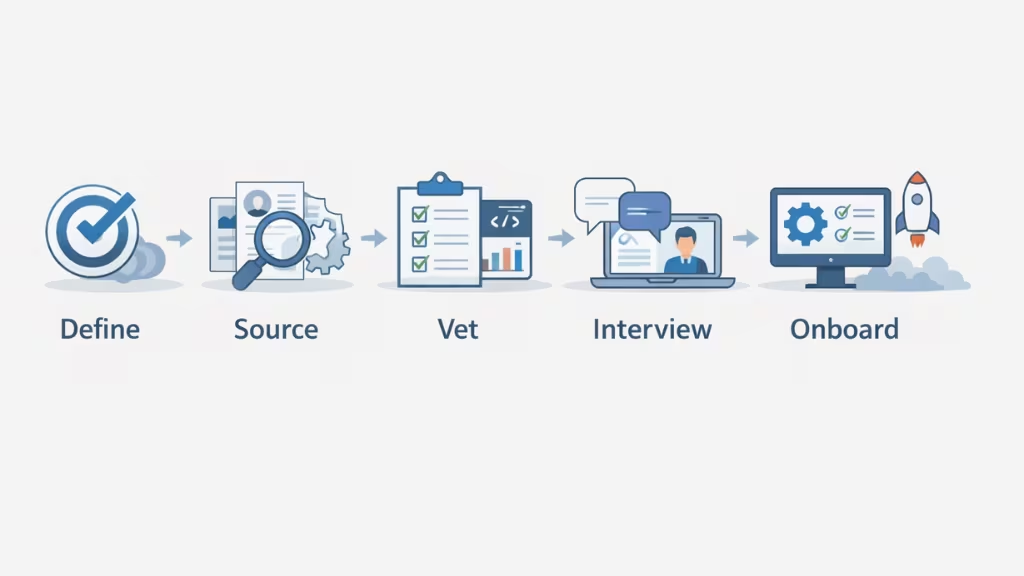
This framework breaks hiring into five decisions, each designed to prevent the most expensive failure modes: mis-scoped roles, demo-only hires, and production debt.
Before writing a job description, define the non-negotiable outcome this hire must deliver in the next 90 days.
Ask:
- What must exist in production after 3 months?
- What will break if this person fails?
- What decisions do we expect them to own vs escalate?
Examples:
- “Ship a reliable RAG-based internal support tool with usage metrics.”
- “Reduce manual ops work by 30% using AI-assisted workflows.”
- “Design AI architecture that won’t double inference costs in 6 months”
If you can’t define the outcome, you’re not ready to hire.
Avoid hiring a generic “AI engineer.” Match the outcome to a specific AI profile:
| Outcome | Profile You Need |
|---|---|
| AI features in a product | AI Product Engineer |
| Chatbots, copilots, automation | LLM / GenAI Engineer |
| Forecasting, recommendations | Applied ML Engineer |
| Reliability, scaling, audits | MLOps / AI Platform Engineer |
| System-wide decisions | AI Architect / Lead |
The table below summarizes the full hiring process, outlining what needs to happen, how long each stage should take, and who is accountable at every step.
| Stage | Focus | Key Actions | Timeline | Primary Owner |
|---|---|---|---|---|
| Stage 1: Define | Scope & alignment | Finalize role definition, success criteria, scorecard, and compensation band | ~1 week | Hiring Manager / CTO |
| Stage 2: Source | Pipeline creation | Actively source candidates through targeted platforms, referrals, and AI-specific networks | 1–2 weeks | Recruiter / Hiring Manager |
| Stage 3: Vet | Technical signal | Run technical screenings, scoped take-home tasks, or live problem-solving sessions | ~1 week | Engineering Team / AI Lead |
| Stage 4: Interview | Decision confidence | Conduct behavioral interviews, system design discussions, and final decision rounds | ~1 week | Hiring Manager & Leadership |
| Stage 5: Offer | Close the hire | Extend offer, align on terms, and complete legal or contractual steps | 3–5 days | HR / Founder |
| Stage 6: Onboard | Integration & impact | Execute the 30–60–90-day onboarding plan and establish ownership | First 90 days | Hiring Manager & Team |
Applied correctly, this framework helps you hire AI developers who can ship, own decisions, and deliver under real-world constraints.
Which AI Developer Do You Need and For What?
Before you write a job description, you need clarity on the business problem, not the tech stack.
For most businesses, AI hiring falls into three distinct roles.
The Three Core AI Roles (and When to Hire Them)
1. Machine Learning (ML) Engineer – The Builder
ML Engineers turn proven ideas into production-ready systems. They build data pipelines, train and adapt models, and deploy scalable APIs.
Hire them when: You need to ship a specific AI feature, the problem is understood, and success is measured by reliability, latency, and accuracy in production
2. AI Research Scientist – The Innovator
Research scientists work on novel approaches where existing methods fail. They explore new architectures, techniques, or algorithms.
Hire them when: There is no off-the-shelf solution; the work is exploratory by nature, progress is measured in experiments, not immediate deployment
3. MLOps Engineer – The Systems Architect
MLOps Engineers design and automate the infrastructure layer that keeps AI systems reliable over time.
Hire them when: You already have models in production, deployments are slow or brittle, monitoring, retraining, and governance are breaking down.
Real-World Hiring Scenarios
Example 1: B2B SaaS startup scaling an early RAG prototype into a production feature
A Series A SaaS startup is adding an AI document Q&A feature to its product. They have a working demo, but it’s slow and breaks under real use. The goal is to ship a stable, multi-tenant RAG system within 90 days. The right hire is a Machine Learning Engineer who can turn a rough prototype into a fast, reliable production system.
Example 2: Mid-sized e-commerce company struggling with fragmented, hard-to-maintain ML systems
An e-commerce company already runs several ML models for recommendations, forecasting, and fraud. The models work, but deployments are slow, monitoring is weak, and retraining is manual. The goal is to make AI systems easier to run and maintain. The right hire is an MLOps Engineer who can fix infrastructure, not models.
Example 3: Computer vision company solving a new problem
A robotics company is trying to detect small defects that current vision models keep missing. Pretrained models and public data don’t work. The goal is to find a better approach from scratch. The right hire is an AI Research Scientist who can test new ideas before anything goes to production.
If the problem is clear → hire an ML Engineer.
If the problem is unsolved → hire a Research Scientist.
If production is breaking → hire an MLOps Engineer.
Clarity on this distinction is what separates teams that ship AI from teams that endlessly “experiment” without impact.
What Skills to Look for When Hiring an AI Developer
AI developers are not just “model people.” They are engineers who work with code, data, and systems. The best ones can build something that runs in production and keeps working over time.
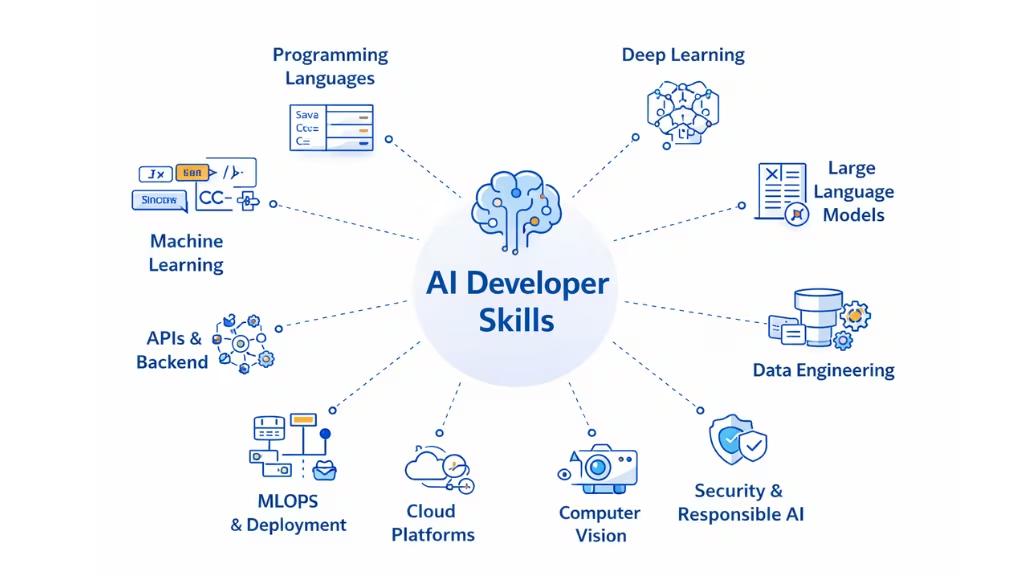
Here are the core skills and tools to look for.
1. Programming Languages
Python is the main language for AI work. A strong AI developer can write clean Python code and use it for data work, model work, and APIs. JavaScript or TypeScript is important when AI needs to be added to web products. Java and C++ matter for high-performance work, edge devices, or large enterprise systems. SQL is also a must because most real business data lives in databases.
2. Core Python Data Tools
AI developers should be comfortable using NumPy and Pandas for data cleaning and transformation. They should understand how to handle missing values, outliers, and messy data. They should also know how to work with files and formats like CSV, JSON, and Parquet.
3. Machine Learning Libraries
A good candidate should know scikit-learn for common ML tasks such as regression, classification, and clustering. They should have working experience with PyTorch or TensorFlow for deep learning.
4. Generative AI, LLMs, and NLP Tools
If your product uses chat, search, or writing features, LLM skills matter. Developers should know how to work with pre-trained models from Hugging Face and how to evaluate output quality. They should understand prompt design and basic prompt safety. They should also understand common NLP tasks like text classification, extraction, summarization, and question answering.
5. Retrieval-Augmented Generation (RAG) Skills
A strong candidate knows how to chunk documents, build embeddings, and retrieve the right context. They should know how vector search works and how to improve retrieval quality. Familiarity with vector databases like Pinecone, Weaviate, Milvus, or FAISS is a plus, but what matters most is whether they can build a reliable retrieval pipeline.
6. Computer Vision Tools
If your work involves images or video, computer vision skills are needed. A good AI developer should understand how to handle image data and use common libraries like OpenCV. They should have experience with deep learning models for vision tasks such as detection, classification, or segmentation. If the role is vision-heavy, experience with CNN-based workflows and modern vision models matters.
7. Data Engineering Basics
AI developers often need to move and process data, not just model it. They should understand basic ETL and data pipelines. They should be able to work with tools like Airflow or similar workflow systems when needed. They should also understand how to store and access data safely and consistently.
8. API and Backend Development
AI models often run behind APIs. A strong AI developer can build a service using FastAPI or Flask, handle inputs safely, and return stable outputs. They should know basic backend concepts like authentication, rate limits, and error handling. They should also understand how AI services connect to other systems.
9. Containers and Environment Management
Developers should know Docker and how to package a service so it runs the same way anywhere. They should understand dependency control and how to manage versions. Even if they are not DevOps experts, they should know why this matters.
10. Cloud Platforms
Many AI systems run in the cloud. Familiarity with AWS, GCP, or Azure is useful, especially for storage, compute, and deployment. A strong candidate can explain how they deployed models, where the data lived, and how the system scaled. They should also understand the basics of GPUs and when they are needed.
11. MLOps Tools and Practices
If you want AI in production, you need basic MLOps discipline. Developers should understand model versioning, repeatable training, and monitoring. Familiarity with MLflow is a strong signal for model tracking. For teams using pipelines, familiarity with tools like Kubeflow can help, but the core skill is knowing how to keep models reliable over time.
12. Monitoring, Logging, and Debugging
AI systems fail quietly. Strong developers know how to log inputs and outputs safely, measure performance, and spot problems early.
13. Testing and Code Quality
AI code should still be tested. A good AI developer writes unit tests, keeps code readable, and documents how to run and deploy the system.
14. Security and Responsible AI Basics
AI systems face risks like data leakage and prompt injection. Developers should understand basic safety practices, especially when building chat or RAG systems.
In-House vs Remote AI Developers: Which One Should You Choose?
Choosing between in-house and remote AI developers isn’t about preference; it’s about what you need right now and how fast you need results.
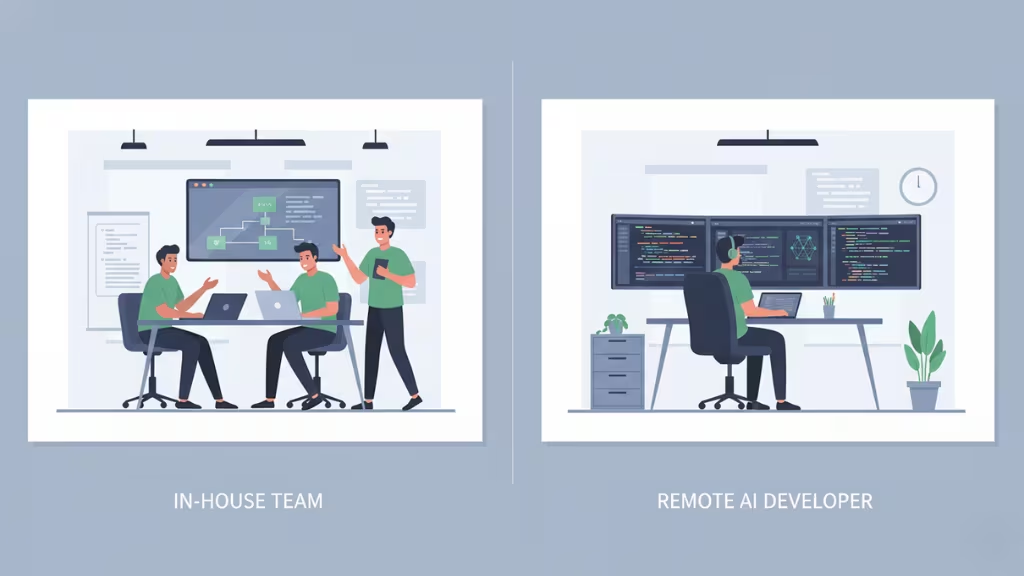
The table below breaks down where each model works best, including the real tradeoffs most teams discover too late.
| Factor | In-House AI Developers | Remote AI Developers |
|---|---|---|
| Best for | Long-term AI strategy and ownership | Fast execution and specialized expertise |
| Hiring speed | Slow (weeks to months) | Fast (days to weeks) |
| Upfront cost | High (salary, benefits, ramp-up) | Lower and more predictable |
| Flexibility | Low, hard to scale up or down | Large, scale as needed |
| Domain knowledge | Deep over time | Requires onboarding and documentation |
| AI specialization | Depends on the local talent pool | Easier access to niche skills (RAG, MLOps, GenAI) |
| Risk of mis-hire | High and expensive | Lower and easier to correct |
| Best use case | Core AI team and long-term roadmap | Shipping, validation, or closing skill gaps |
Most successful teams don’t choose one model forever; they combine both.
A common pattern looks like this:
- Start with remote AI developers to ship the first version fast
- Build confidence in the AI feature and its ROI
- Transition ownership to an in-house team over time
- Bring in remote specialists again when complexity spikes
This approach reduces risk while keeping momentum.
How to Source, Vet, and Onboard AI Developers
Hiring strong AI developers remotely requires more than posting a role and waiting. The best candidates are already working, already shipping, and already selective. If you want to attract them, your process needs to be intentional from day one.
Sourcing: Go Where Serious AI Builders Already Work
Technical communities are one of the strongest signals. Platforms like Kaggle and Hugging Face surface engineers who actively solve problems, publish experiments, and help others.
Open-source activity is another powerful filter. A candidate’s GitHub profile often says more than a resume ever will. Engineers contributing to widely used AI tools like PyTorch or LangChain are demonstrating real-world problem-solving, code quality, and collaboration habits in public.
When sourcing remotely, location also matters. Nearshore regions such as Latin America often provide strong time-zone overlap with U.S. teams, while Eastern Europe offers deep technical talent with strong computer science fundamentals. The key is to align geography with collaboration needs, not just cost.
Vetting: Test for Execution, Not Buzzwords
A bad AI hire can stall progress for months. That’s why vetting should focus on what candidates can build, not how well they talk about AI. Strong resumes and confident explanations don’t matter if the person can’t ship reliable, production-ready work.
The most effective way to evaluate AI developers is through a short, practical take-home assignment that mirrors real tasks they’ll face on the job. Keep it focused and time-boxed to 3–4 hours. Long or abstract exercises mostly test availability, not skill.
For example, a solid vetting task for an ML-focused role might look like this:
- Use a pre-trained model from Hugging Face for sentiment analysis.
- Expose the model through a simple REST API built with FastAPI.
- Containerize the application using Docker so it can be deployed easily.
- Include a clear README.md with setup and run instructions.
- Write basic unit tests to validate the API endpoint.
This kind of assignment reveals far more than trivia-based interviews. It shows whether a candidate understands modern ML libraries, basic API design, containerization, and core software engineering practices like testing and documentation.
A vetting process built around real execution doesn’t just filter out weak candidates; it builds confidence that the people you hire can actually deliver.
Onboarding: Turn a Hire Into Impact Quickly
Even strong AI hires fail when onboarding is unclear or rushed. Remote AI developers need context before they need tasks.
A structured onboarding plan should clarify what the developer owns, how success is measured, and where AI fits into the broader product or system. Early access to documentation, data pipelines, deployment processes, and decision-makers removes friction and builds confidence.
What AI Developers Cost Across Regions
When hiring AI developers, compensation should be driven by impact, responsibility, and execution risk, not just location. Paying too little leads to churn and poor outcomes. Overpaying for the wrong profile is just as costly.
Typical Annual Compensation Ranges
| Role | In-House (US/EU) | Remote (LATAM) | Remote (Eastern Europe) |
|---|---|---|---|
| Machine Learning Engineer | $140k–$190k | $45k–$80k | $60k–$100k |
| MLOps Engineer | $150k–$210k | $55k–$95k | $70k–$115k |
| AI Research Scientist | $160k–$230k | $60k–$100k | $75k–$120k |
Ranges reflect experienced, production-ready talent. In-house compensation does not include benefits, equity, or overhead.
In-House vs Remote: Cost Reality
In-house AI developers typically cost 30–50% more than base salary once you account for benefits, taxes, equity, and ramp-up time. They make sense when AI is a long-term core capability and deep context is required.
Remote AI developers offer faster access to specialized skills and more predictable costs. They work best when the scope is clear, and outcomes are defined upfront.
Common Compensation Mistakes
- Treating AI roles like standard software engineering positions
- Hiring senior talent but paying mid-level rates
- Optimizing for cost instead of delivery risk
- Ignoring ownership when setting pay bands
The smartest teams don’t aim to pay less; they aim to pay correctly for the impact they need.
Where to Go From Here
Hiring AI developers isn’t about finding the smartest person in the room. It’s about finding the right builder for the problem you’re trying to solve at the right time, with the right level of ownership.
If there’s one takeaway from this guide, it’s this: clarity beats speed.
Before you move forward, get clear on three things.
- First, what business outcome do you actually need in the next 90 days?
- Second, which AI role is best suited to deliver that outcome?
- And third, how will you evaluate real execution instead of surface-level expertise?
Once those are in place, hiring becomes much simpler. You can source more effectively, vet with confidence, and onboard in a way that leads to real impact instead of stalled experiments.
The next step isn’t to post a job. It’s to decide what success actually looks like and hire for that.
30-Day AI Hiring Checklist
☐ Define the single AI outcome that must exist in production within the next 90 days
☐ Decide which role is required (ML Engineer, Research Scientist, or MLOps Engineer)
☐ Write clear success criteria (uptime, latency, cost, accuracy, reliability)
☐ Set a realistic compensation band based on responsibility and risk
☐ Decide upfront whether the role is in-house, remote, or hybrid
☐ Identify 2–3 high-signal sourcing channels beyond job boards
☐ Review candidates based on shipped work, not titles or tool lists
☐ Shortlist only candidates who can clearly explain what they built and why
☐ Align all interviewers on what “good” looks like before vetting
☐ Create a short, role-specific take-home task (3–4 hours max)
☐ Evaluate code quality, structure, and production readiness
☐ Ask candidates to explain tradeoffs and failure modes
☐ Reject demo-only or theory-only profiles
☐ Make a hiring decision quickly once signals are clear
☐ Extend the offer without unnecessary delays
☐ Define 30–60–90 day ownership and success metrics
☐ Prepare access, documentation, and environments before day one
☐ Assign a single internal owner responsible for onboarding
☐ Identify a small but real production win for the first 30 days
FAQs: How to Hire AI Developers
What does an AI developer actually do?
An AI developer builds systems that use machine learning or AI models to solve real problems. This includes data preparation, model integration, API development, deployment, and ongoing maintenance. Most real work is engineering, not research.
Do I need an AI developer or a data scientist?
If you need something shipped into a product, you need an AI or ML engineer. Data scientists focus more on analysis and experiments. Many companies hire data scientists when they actually need engineers.
Can one AI developer do everything?
Rarely. Most AI roles specialize in building, researching, or operating systems. Expecting one person to cover ML, LLMs, infrastructure, and product is a common mistake.
What skills should I look for when hiring AI developers?
Strong Python skills, experience with ML libraries, ability to build APIs, comfort with data pipelines, and basic deployment knowledge. For modern roles, experience with LLMs, RAG systems, and monitoring matters.
Is experience with TensorFlow or PyTorch required?
At least one of them, yes. But knowing how and when to use models matters more than the framework itself.
How do I tell if someone actually knows AI or is bluffing?
Ask what they’ve shipped, how it failed, and what they changed. Use a short take-home task that mirrors real work. Bluffing collapses under execution.
Are take-home tests really necessary?
Yes. Short, practical tests (3–4 hours) are the most reliable signal. Interviews alone are not enough for AI roles.
Is it better to hire AI developers in-house or remotely?
In-house is better for long-term ownership. Remote is better for speed and specialized skills. Many teams use both.
Can remote AI developers work effectively?
Yes, if expectations, ownership, and onboarding are clear. Poor communication is the real risk, not location.
Where to hire LLM engineers or AI developers?
Look where real AI work is visible, not just resumes. High-signal sources include open-source projects on GitHub, technical communities like Kaggle and Hugging Face, and specialized AI talent networks. Remote markets such as Latin America and Eastern Europe also offer strong LLM and AI engineering talent with faster hiring timelines.
How long does it take to hire an AI developer?
With clarity, 3–5 weeks is realistic. Without clarity, it can drag on for months.
This page was last edited on 4 January 2026, at 9:27 am

Start a conversation with our team to solve complex challenges and move forward with confidence.