
If you’re asking what is nearshoring vs reshoring, you’re not alone. In the wake of global supply chain disruptions, rising geopolitical risk, and shifting cost structures, companies are reevaluating where production and sourcing should take place. The debate between nearshoring and reshoring has become central to modern supply chain strategy, as leaders prioritize resilience, speed, and long-term stability over purely low-cost manufacturing.
However, confusion persists. While both approaches aim to reduce risk and improve control, they differ significantly in cost implications, operational complexity, and strategic outcomes. This guide goes beyond simple definitions to provide a clear comparison of nearshoring vs reshoring, practical decision-making frameworks, and real-world examples. By the end, you’ll have a structured understanding of which strategy aligns best with your organization’s risk profile, financial goals, and competitive priorities.
Key Differences Table (At-a-Glance Summary)
| Factor | Nearshoring | Reshoring |
| Proximity | Regional (nearby countries) | Domestic (home country) |
| Control | Moderate to high | Highest |
| Cost | Lower than reshoring | Highest (domestic rates) |
| Speed | Faster than offshoring | Fastest |
| Risk | Reduced regional risk | Lowest geo/trade risk |
| Sustainability | Lower transport emissions | Maximum with automation |
What Is Nearshoring? Core Concepts, Benefits & Examples
Nearshoring means relocating business operations or production to a nearby country—typically one within the same region or time zone—to reduce supply chain complexity and risk. For U.S. companies, this often involves moving operations from Asia to Mexico or Canada under agreements like USMCA. In Europe, it often means moving production to Eastern European countries. Nearshoring is a strategy used to balance proximity with cost, aiming to improve supply chain resilience and responsiveness without the premium cost of domestic (reshoring) options.
What Are the Main Benefits of Nearshoring?
- Shorter delivery times: Regional proximity means goods and components arrive faster.
- Reduced logistics costs: Lower transportation expenses and fewer long-haul shipping risks.
- Improved oversight: Easier communication and quality control due to time zone alignment.
- Potential labor savings: Labor may remain less expensive than domestic production but with fewer logistical challenges than far-off offshoring.
- Regulatory alignment: Shared or complementary regulations (e.g., USMCA) streamline compliance and customs processes.
- Enhanced supply chain resilience: Reduces exposure to global disruptions and geopolitical risks.
What Challenges Come with Nearshoring?
- Limited skilled labor: Some nearshore regions may lack specialized talent or have labor shortages.
- Infrastructure constraints: Roads, ports, or utilities may not match those in established offshoring locations.
- Political or regulatory volatility: Shifts in local regulations, elections, or trade agreements may introduce new risks.
- Potentially higher costs: Compared to offshoring, nearshoring may have higher operational costs, even if still lower than reshoring.
- Reliability of local suppliers: Variability in supplier quality or consistency can impact operations.
What Are Real-World Examples of Nearshoring?
- Ford: Expanded automotive component production in Mexico to leverage USMCA benefits and proximity to U.S. assembly plants.
- U.S. electronics manufacturers: Shifted critical parts production to Mexico and Central America in response to pandemic-induced Asia supply bottlenecks.
- Consumer goods companies: Fast-moving consumer goods brands are increasingly using nearshoring to respond swiftly to regional market demands.
Nearshoring is particularly prevalent in sectors such as automotive, electronics, and consumer goods, where speed and regional adaptation are critical.
What Is Reshoring? Core Concepts, Benefits & Examples
Reshoring refers to bringing manufacturing or business operations back to the company’s home country—such as moving production from overseas locations to domestic facilities in the U.S. or Europe. This strategy is driven by the need for greater quality control, security, and supply chain transparency, and is often linked to “Made in USA” branding or similar national initiatives.
What Are the Benefits of Reshoring?
- Stronger quality control: Direct oversight enables consistent standards.
- Reduced supply chain risk: Fewer geopolitical, trade, or tariff threats.
- Job creation: Domestic investments can support local employment and deliver positive PR.
- Automation opportunities: Investment in domestic facilities often goes hand in hand with upgraded, efficient, automated processes.
- Brand value: “Made in USA” (or similar) can appeal to consumers and stakeholders seeking local production.
What Are the Challenges of Reshoring?
- Higher labor and production costs: Domestic workforces often command premium pay versus international alternatives.
- Workforce skill gaps: Some industries face shortages of skilled domestic labor, especially in manufacturing.
- Substantial investments: Up-front capital for new plants, equipment, or retraining can be significant.
- Longer ramp-up times: Building or modernizing domestic capacity can delay ROI.
- Regulatory hurdles: Navigating domestic compliance, permitting, and safety standards may add complexity.
Which Companies Have Implemented Reshoring?
- Stanley Black & Decker: Repatriated tool production to U.S. facilities, citing enhanced control and reliability.
- Electronics and PPE manufacturers: Many shifted operations back to the U.S. during COVID-19 to ensure supply chain resilience for critical items.
- Automotive: Select automakers have increased domestic part manufacturing to avoid overseas supply shocks.
According to the Kearney Reshoring Index, U.S. manufacturing reshoring activity increased significantly post-2020, contributing to new domestic jobs and greater supply chain reliability.
What is Nearshoring vs Reshoring? Key Differences at a Glance
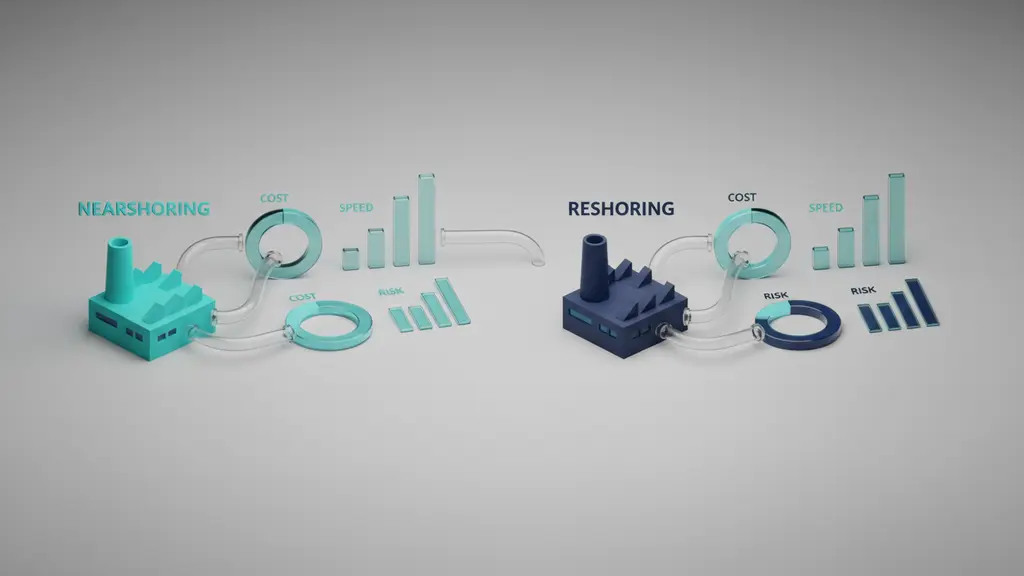
Comparison Table: Nearshoring vs Reshoring
| Criterion | Nearshoring | Reshoring |
| Location | Nearby countries/regions | Home country (e.g., USA, EU) |
| Proximity to Market | Close (regional) | Closest (domestic) |
| Operational Control | Moderate to High | Highest |
| Cost | Typically lower than reshoring; higher than offshoring | Typically highest (domestic labor, compliance) |
| Speed/Lead Time | Fast (short shipping, aligned time zones) | Fastest (no international transport) |
| Risk Profile | Reduced vs. offshoring; geopolitical risk regional | Lowest exposure to trade/political risk |
| Sustainability | Lower carbon footprint than offshoring | Lowest transport emissions; green potential via automation |
| Labor Availability | May face shortages or skill gaps regionally | Domestic skill gaps possible |
| Best for | Cost-sensitive, regionally focused, agile | Quality, security, government/PR focus |
Side-by-Side Pros and Cons: Quick Reference List
Nearshoring
- Pros:
- Lower logistics cost and lead time than offshoring
- Easier oversight and regional compliance
- Better supply chain resilience than distant sourcing
- Cons:
- Regional infrastructure or labor gaps
- Some political and regulatory risks remain
- Costs may still be higher than offshoring
Reshoring
- Pros:
- Complete supply chain control and security
- Boosts domestic job creation and brand value
- Potential for high automation and tech upgrades
- Cons:
- Highest labor and operational costs
- Domestic skill shortages possible
- Large initial investments needed
Choose nearshoring if you prioritize speed, lower logistics risk, and moderate cost.
Choose reshoring if quality, full control, and domestic branding are top goals.
How to Choose Between Nearshoring and Reshoring: Decision Matrix & Action Steps

What Factors Should Businesses Consider? [Decision Framework]
- Labor cost vs. labor availability: Weigh competitive labor costs against potential shortages in skilled workers.
- Speed-to-market: Assess how quickly you need products delivered; proximity supports agility.
- Quality control: Determine the level of oversight needed for critical products or components.
- Regulatory environment: Examine compliance demands, IP protection, and trade incentives in each location.
- Total Cost of Ownership (TCO): Factor in all direct and indirect costs—production, logistics, tariffs, risk mitigation.
- Risk Appetite: Assess tolerance for geopolitical instability, regional disruptions, and supply chain shocks.
- Sustainability: Consider carbon footprint, ESG pressures, and environmental goals.
Decision Matrix Example:
| Factor | Prioritize Nearshoring If… | Prioritize Reshoring If… |
| Labor Cost | Major concern | Accept higher cost for control |
| Lead Time/Speed | Need fast, regional delivery | Need fastest possible response |
| Quality/Control | Sufficient with regional teams | Requires direct oversight |
| Regulatory Stability | Favorable in selected regions | Highest importance |
| Automation Readiness | Limited in region | High readiness for automation |
| Sustainability/ESG | Logistics carbon is key factor | Domestic production is a mandate |
When Should a Company Choose Nearshoring vs Reshoring?
- Nearshoring is typically preferred by:
- Automotive manufacturers seeking proximity to assembly plants (e.g., US-Mexico under USMCA)
- Electronics companies balancing cost and speed
- Fast-moving consumer goods brands needing rapid market response
- Reshoring is often selected by:
- Critical infrastructure providers (e.g., energy, utilities)
- Healthcare and pharmaceutical manufacturers emphasizing control and security
- Defense companies or high-value equipment makers seeking strict quality oversight
Choose nearshoring if:
– Your sector values speed, cost optimization, and moderate oversight.
– You need agility in response to regional demand changes.
– You seek some risk reduction without the cost of full domestic operations.
Choose reshoring if:
– Quality, brand, or national security are top concerns.
– You’re positioned to invest in automation to offset labor costs.
– Regulatory certainty and domestic job creation align with your business strategy.
How Do Sustainability and Technology Influence the Choice?
- Automation: Modern robotics and smart factories make reshoring more cost-competitive, allowing companies to offset higher domestic labor rates with technology.
- Carbon footprint: Nearshoring reduces emissions associated with long-haul shipping, an increasingly important factor under government and investor ESG mandates.
- ESG Pressures: Both customers and stakeholders push for greener, more transparent supply chains, influencing localization decisions.
- Recent examples: Companies investing in advanced automation often choose reshoring, while those prioritizing transport emissions may favor nearshoring.
These factors are expected to drive continued localization and technology investment through 2025 and beyond.
Case Studies and Trends: Nearshoring and Reshoring in 2025–2026
Recent data demonstrates a marked shift toward both nearshoring and reshoring, fueled by the need for resilient and responsive supply chains.
- Kearney Reshoring Index: Shows a steady rise in U.S. manufacturing returning from abroad since 2020.
- Pandemic-driven shifts: COVID-19 exposed weaknesses in long-distance supply chains, prompting U.S. and EU manufacturers to move critical production back home or nearby.
- Regional highlights:
- U.S. companies increased investment in Mexican facilities for faster cross-border delivery.
- European manufacturers shifted sourcing from Asia to Eastern and Central Europe.
- Outcomes: Reported results include decreased lead times, improved supply chain visibility, and measurable cost savings in transportation and risk prevention.
These trends underscore the growing importance of localization strategies in global supply chains.
Frequently Asked Questions: Nearshoring vs Reshoring
1. What Is Nearshoring Vs Reshoring And What Are The Key Differences?
Nearshoring shifts operations to a nearby country to cut logistics costs and risk, while reshoring brings production back home for greater control and quality. These key nearshoring vs reshoring differences guide supply chain strategy.
2. What Are The Main Benefits Highlighted In A Nearshoring And Reshoring Comparison?
A strong nearshoring and reshoring comparison shows that nearshoring offers shorter lead times, lower transportation costs, and time zone alignment, while reshoring provides stronger quality control, national security benefits, and regulatory simplicity.
3. What Challenges Do Companies Face In The Nearshoring Vs Reshoring Decision?
Evaluating nearshoring vs reshoring differences reveals trade-offs. Nearshoring may still expose firms to cross-border risks, while reshoring often involves higher labor costs, domestic talent shortages, and significant capital investment in facilities and automation.
4. How Do You Choose Between Nearshoring And Reshoring?
To determine what is nearshoring vs reshoring in practical terms for your business, assess labor costs and availability, speed-to-market goals, compliance requirements, risk tolerance, sustainability targets, and long-term scalability. A structured decision matrix supports objective evaluation.
5. Can Nearshoring And Reshoring Improve Supply Chain Resilience?
Yes. In a comprehensive nearshoring and reshoring comparison, both strategies strengthen resilience by reducing dependency on distant suppliers and improving oversight. However, financial feasibility and operational readiness must be carefully analyzed.
6. Are There Cost Advantages In Nearshoring Vs Reshoring?
When comparing nearshoring vs reshoring differences, nearshoring generally provides lower labor and operating costs than reshoring. However, reshoring may offset higher labor costs through automation, tax incentives, and improved quality performance.
7. What Are Real-World Examples That Clarify What Is Nearshoring Vs Reshoring?
Examples help clarify what is nearshoring vs reshoring in action. Ford and electronics manufacturers have nearshored production to Mexico to shorten supply chains. Meanwhile, companies like Stanley Black & Decker have reshored key manufacturing lines to the U.S. to enhance control and reduce overseas risk.
8. How Did Global Disruptions Influence Nearshoring And Reshoring Comparison?
Recent disruptions accelerated both strategies. A modern nearshoring and reshoring comparison shows that companies shifted toward regionalized or domestic production to mitigate shipping delays, geopolitical uncertainty, and supplier concentration risks.
9. Which Industries Most Commonly Evaluate Nearshoring Vs Reshoring Differences?
Automotive, electronics, and consumer goods frequently adopt nearshoring for cost and proximity advantages. Reshoring is more common in defense, healthcare, critical infrastructure, and advanced manufacturing where security and compliance are paramount.
10. What Role Does Automation Play In Reshoring Strategies?
Automation is central when assessing nearshoring vs reshoring differences, particularly for reshoring. Robotics and advanced manufacturing technologies reduce reliance on high domestic labor costs, making reshoring more financially viable.
11. Is A Hybrid Model Possible Between Nearshoring And Reshoring?
Yes. Many companies use hybrid strategies informed by a nearshoring and reshoring comparison, placing cost-sensitive components in nearby countries while reshoring high-value or compliance-heavy production to domestic facilities.
Conclusion & Key Takeaways: Which Strategy is Right for You?
The choice between nearshoring and reshoring can define your company’s supply chain resilience, cost structure, and ability to adapt in a volatile global market. A clear understanding of each approach, from regional advantages to labor and technology considerations, is essential. Use robust frameworks, examine recent trends, and evaluate total cost and risk factors before choosing the strategy that best aligns with your business objectives.
For further guidance or a customized decision analysis, consider reaching out to supply chain strategy professionals or exploring additional resources on localization.
Key Takeaways
- Nearshoring places operations in nearby countries to optimize cost, speed, and resilience.
- Reshoring brings manufacturing back home for maximum quality control and security.
- Decision factors include cost, speed, labor availability, regulatory environment, and sustainability.
- Use industry scenarios and decision matrices to align strategy with business goals.
- Recent trends show strong movement toward localization in response to supply chain disruptions.
This page was last edited on 8 March 2026, at 9:50 am
Contact Us Now

Contact Us Now
Start a conversation with our team to solve complex challenges and move forward with confidence.


