
Understanding what is nearshoring vs onshoring has become a critical priority for organizations navigating cost pressures, regulatory complexity, and global uncertainty. As outsourcing strategies evolve, leaders must make deliberate decisions about where operations should be located to balance efficiency, control, and long term resilience.
Nearshoring and onshoring may sound similar, but they differ significantly in geography, cost structure, risk exposure, and operational oversight. Confusing the two can lead to misaligned investments and missed strategic opportunities. In a business landscape shaped by supply chain disruptions and shifting compliance standards, clarity is essential.
This guide provides a clear comparison of both models, outlining their advantages, trade-offs, and practical applications. You will gain a structured framework to evaluate which approach best supports your organization’s growth, risk tolerance, and competitive strategy.
What is Nearshoring? What is Onshoring? (Clear Definitions & Updated Examples)
Nearshoring is outsourcing business activities to organizations in neighboring or nearby countries, while onshoring means relocating those activities within the same country as your core business operations.
Nearshoring
Nearshoring refers to moving business processes or production to a nearby country, often within the same or a similar time zone. The strategy aims to achieve cost savings and operational efficiencies while maintaining geographic, cultural, and regulatory proximity.
Onshoring
Onshoring (sometimes called domestic outsourcing) is the practice of returning business processes, manufacturing, or services to the company’s home country. This approach emphasizes full compliance with domestic regulations, cultural alignment, and market proximity, though often at a higher cost.
Industry Synonyms:
- Nearshoring: “regional outsourcing,” “proximity outsourcing,” “nearshore outsourcing”
- Onshoring: “domestic sourcing,” “local outsourcing”
Real-World Examples (2024–2026):
- A major US auto parts company nearshores IT operations to Mexico, reducing costs while maintaining time zone alignment and better oversight.
- US-based tech firms continue onshoring customer support centers to smaller US cities to ensure data privacy compliance and superior customer experience.
Nearshoring vs Onshoring: What’s the Core Difference?
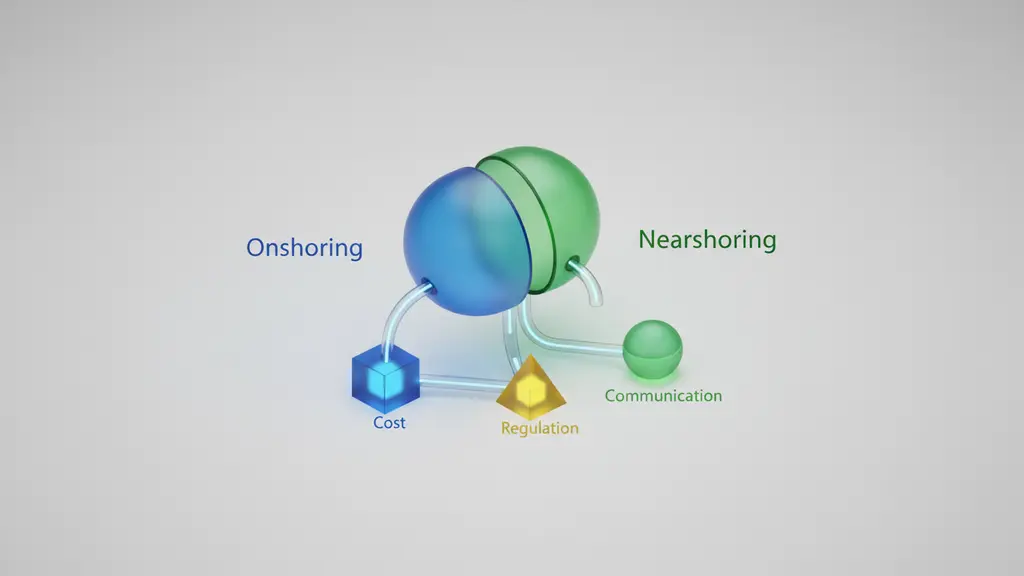
Nearshoring shifts work to nearby countries for cost and collaboration advantages, while onshoring keeps operations within the home country for maximum regulatory and cultural alignment.
Key Distinctions:
- Geography: Nearshoring happens across nearby national borders; onshoring stays within the same national border.
- Cost: Nearshoring typically offers lower labor costs than onshoring.
- Regulation: Onshoring ensures full compliance with local laws; nearshoring may require navigation of cross-border regulations.
- Time Zone & Culture: Nearshoring seeks alignment but may introduce minor cultural or communication differences; onshoring eliminates these differences.
| Aspect | Nearshoring | Onshoring |
| Location | Neighboring or nearby countries | Domestic, within home country |
| Cost | Lower than onshoring, higher than offshore | Highest |
| Compliance | Regional/legal similarities, some variance | Maximum, local only |
| Communication | Similar time zones, some language/culture | Total language/culture match |
| Example | US → Mexico, Germany → Poland | US → US, UK → UK |
In a nutshell:
Choose nearshoring for cost-efficiency with regional access, or onshoring for absolute control and compliance.
Comparison Table: Nearshoring vs Onshoring vs Offshoring
This comparison table provides a side-by-side view of the three most common outsourcing models for fast reference and stakeholder communication.
| Model | Geography | Typical Destinations | Cost | Supply Chain Risk | Communication (Time Zone/Culture) | Compliance Level | Common Industries |
| Onshoring | Home country | US → US, UK → UK | High | Low | Excellent | Maximum (local only) | Manufacturing, Finance, IT |
| Nearshoring | Neighboring/nearby country | US → Mexico, EU → Poland | Moderate | Moderate | Good (some cultural variance) | High (similar region) | IT, Supply Chain, Customer Support |
| Offshoring | Distant country | US → India, EU → China | Low | Variable | Challenged (timezone/language/culture) | Variable (global) | BPO, Tech Development, Manufacturing |
What Is Nearshoring vs Onshoring? Main Pros & Cons Explained

Nearshoring: Pros & Cons
Advantages:
- Lower labor and operational costs compared to onshoring
- Similar time zones, streamlining real-time collaboration
- Shorter travel distances for site visits and control
- Access to a growing regional talent pool
Limitations:
- Moderate regulatory risk compared to onshoring
- Potential for minor cultural or language misunderstandings
- Data security and IP protection may vary by country
Onshoring: Pros & Cons
Advantages:
- Full compliance with local regulations and standards
- Seamless cultural, language, and business alignment
- Strong IP, data privacy, and legal protections
- Easier integration with core business processes
Limitations:
- Highest labor and operational costs
- Limited access to specialized talent (versus global or regional search)
- Potential wage or labor market volatility
Recent Trend:
A 2024 Deloitte survey found that over 60% of mid-market US companies considered onshoring for compliance or risk mitigation, while nearshoring remains appealing for cost efficiency and resilient supply chain design.
Where Are Nearshoring and Onshoring Used? (Use Cases by Industry)
Nearshoring and onshoring models fit different industries based on cost, compliance, and talent needs.
IT & Software Development:
Nearshoring is preferred due to agile collaboration across similar time zones, competitive costs, and deep pools of regional tech talent.
Example: IBM leverages nearshoring to Latin America for scalable app support while maintaining quality.
Manufacturing:
Onshoring is favored for industries where strict compliance, quality control, or regulatory oversight trump cost (e.g., medical devices, aerospace).
Example: General Motors has increased US-based assembly for higher control and domestic market support.
Accounting & Finance:
Hybrid models—mix of onshoring (for sensitive, regulated work) and nearshoring (for standardized processes) to balance compliance with cost.
Example: Mid-sized US accounting firms nearshore routine processing to Mexico, keeping advisory work in-house.
Supply Chain & Logistics:
Nearshoring supports “just-in-time” models, speeding up delivery and reducing disruption risk.
Key trend: North American manufacturers increasingly nearshore to Mexico to de-risk global logistics.
Regional Trends:
US, Canada, and Western Europe are expanding nearshoring to Mexico, Eastern Europe, and North Africa.
Sectors like pharma and automotive also blend both models to match compliance and talent requirements.
What Key Factors Should Guide Your Outsourcing Model Choice?
Selecting between nearshoring and onshoring depends on several weighted business factors.
Key Decision Criteria:
- Total Cost:
Analyze not just wages, but full operating, tax, travel, and logistics expenses. - Time Zone & Working Hours:
Prioritize models that support real-time coordination or 24/7 operations as needed. - Regulatory and Data/Privacy Compliance:
Assess legal risk and compliance requirements for your industry and market. - Cultural & Communication Fit:
Consider language, business practices, and ease of collaboration. - Talent Pool Depth/Specialization:
Evaluate where the skills you need are most available, whether locally or regionally. - Scalability & Growth Flexibility:
Seek models that align with your plans for expansion or new markets. - Integration with Operations:
Factor in workflow, IT integrations, and management capacity.
How to Decide: Nearshoring or Onshoring? (Step-by-Step Decision Framework)

A systematic approach helps reduce risk and drive confident outsourcing decisions.
Stepwise Decision Matrix:
- Define Primary Goals:
Is your priority compliance/risk, cost, access to skills, or speed to market? - Score Each Model (1–5):
For each criterion above, rate nearshoring and onshoring according to your priorities. - Consider Industry-Specific Requirements:
Are there data or regulatory restrictions limiting cross-border outsourcing? - Assess Risk Appetite:
What degree of legal, IP, or supply chain risk can you tolerate? - Pilot or Hybrid Model:
Where possible, test a small project or combine models before full implementation. - Consult Stakeholders:
Engage with IT, legal, HR, and finance teams for holistic evaluation.
Expert Insight:
According to a recent Harvard Business Review discussion, “No single model fits every business; structured decision matrices reduce bias and optimize for unique organizational needs.”
What Are the Latest Trends in Outsourcing Models? (Emerging Models: Friendshoring, Reshoring, AI Impact)
The outsourcing landscape is evolving with new models and technologies reshaping how and where work is done.
Friendshoring:
Moving operations to allied countries with shared values and regulatory frameworks to minimize geopolitical risk and support stable trade relationships.
Reshoring:
Bringing previously offshored work back to the home country, often driven by regulatory changes or supply chain disruptions.
AI & Automation Impact (2024–2026):
AI is automating routine tasks, shifting the value proposition of traditional outsourcing models:
– Lower-level IT support is increasingly automated, while nearshoring is favored for higher-value, collaborative work.
– Manufacturers blend onshoring and nearshoring as automation reduces labor as a cost driver, making other factors—like supply chain resilience—even more critical.
Global Supply Chains:
COVID-19 and ongoing disruptions have driven renewed interest in regional models and diversification, making nearshoring and friendshoring increasingly popular for supply chain risk management.
FAQs: Nearshoring vs Onshoring (Direct Answers to Top User Questions)
1. What Is The Difference Between Nearshoring And Onshoring?
Nearshoring vs onshoring: Nearshoring involves moving business operations to nearby countries, offering cost and time zone benefits, while onshoring keeps operations within the home country, ensuring maximum compliance and cultural alignment.
2. What Are The Key Advantages Of Nearshoring?
Nearshoring vs onshoring: Nearshoring provides cost savings, closer collaboration with similar time zones, easier travel, and access to skilled talent in neighboring countries, with fewer risks compared to offshoring.
3. When Should A Company Consider Onshoring Over Nearshoring?
Companies should consider onshoring when nearshoring vs onshoring decisions are driven by the need for strict regulatory compliance, heightened data security, customer proximity, or strong cultural alignment.
4. How Does Nearshoring Compare With Offshoring?
Nearshoring vs onshoring: Nearshoring offers more operational control, faster communication, and often lower risk than offshoring, though it may come at a higher cost and offer less dramatic savings compared to distant outsourcing.
5. What Factors Influence The Choice Between Nearshoring And Onshoring?
When deciding between nearshoring vs onshoring, businesses must consider factors such as cost, regulatory compliance, access to talent, time zone and cultural alignment, risk levels, and operational integration.
6. What Industries Typically Use Nearshoring Or Onshoring?
Industries like IT, software development, manufacturing, supply chain, accounting, and finance commonly adopt nearshoring vs onshoring strategies, depending on their needs for cost, speed, and compliance.
7. How Do Regulatory Requirements Affect Onshoring Vs Nearshoring Decisions?
Nearshoring vs onshoring decisions are often influenced by regulatory requirements, such as data privacy, labor laws, and industry-specific compliance. Onshoring may be necessary where local regulations demand stricter oversight.
8. Does Nearshoring Minimize Cultural Or Communication Challenges?
While nearshoring vs onshoring helps reduce cultural or language barriers compared to offshoring, it may not eliminate them entirely. Communication is easier with nearshoring, but onshoring offers the most seamless interaction.
9. What Is An Example Of Nearshoring In Practice?
An example of nearshoring vs onshoring is a US-based tech company nearshoring its software development to Mexico. This allows for real-time collaboration and cost savings, while maintaining proximity for easier management and communication.
10. What Are The Main Risks Linked To Nearshoring And Onshoring?
Nearshoring vs onshoring risks include regulatory differences, data protection concerns, and minor cultural gaps for nearshoring. Onshoring risks primarily revolve around higher costs and potentially limited talent availability.
Key Takeaways
- Nearshoring offers cost and collaboration advantages by outsourcing to nearby countries.
- Onshoring ensures maximum compliance, seamless culture fit, and the highest costs.
- Use a structured matrix to match your outsourcing model to business priorities and risks.
- Industry needs vary—IT and supply chain often benefit from nearshoring; manufacturing and regulated sectors lean toward onshoring.
- Stay agile: emerging trends like friendshoring and AI are reshaping outsourcing strategies.
This page was last edited on 4 March 2026, at 10:22 am
Contact Us Now

Contact Us Now
Start a conversation with our team to solve complex challenges and move forward with confidence.


