Every year, countless software projects fail or stall—not because of poor code, but because teams lack clarity on process and structure. If you’ve ever asked what are the 7 phases of SDLC, you’re already recognizing that successful software delivery depends on more than technical skill. It requires a disciplined, repeatable framework that guides projects from concept to deployment and beyond.
The software development life cycle (SDLC) provides that structure. It defines a clear sequence of phases that reduce risk, improve collaboration, and ensure quality at every stage. In this guide, you’ll learn what are the 7 phases of SDLC, why each phase matters, and how modern practices such as AI integration, DevSecOps, and distributed teams fit into this proven methodology. By the end, you’ll have a practical understanding of how to apply the SDLC framework to deliver reliable, production-ready software.
What Is the Software Development Life Cycle (SDLC)?
The software development life cycle (SDLC) is a systematic process for planning, creating, testing, and maintaining software systems. It defines a clear sequence of stages—also known as phases—that guide teams from concept to deployment and beyond.
SDLC is often called the system development life cycle and applies across industries and software types. While models like Waterfall, Agile, and Iterative exist, the classic SDLC structure remains foundational. Using the SDLC ensures predictability, quality control, and alignment between technical and business goals.
What Are the 7 Phases of SDLC?
| Phase | Main Activities | Key Deliverables | Primary Roles Involved | Common Tools |
| 1. Planning | Define goals, scope, stakeholders | Project plan, charter | Project Manager, Sponsor | Jira, MS Project |
| 2. Analysis | Gather requirements, assess feasibility | SRS, user stories, use cases | Business Analyst, Stakeholders | Confluence, Requirement tools |
| 3. Design | Design architecture, UI/UX, security | Design docs, wireframes | Solution/Tech Architect, Designer | Figma, Lucidchart |
| 4. Development | Code and build the software | Codebase, builds | Developers, DevOps | IDEs, Git, CI/CD tools |
| 5. Testing | QA, user acceptance, security checks | Test cases, bug reports | QA Engineer, Security Tester | Selenium, JUnit, TestRail |
| 6. Deployment | Rollout to production/users | Release, deployment logs | DevOps, Release Manager | Jenkins, Docker, Ansible |
| 7. Maintenance | Ongoing support, bug fixes, updates | Patches, updated docs | Support Engineer, Ops | Monitoring tools, ticketing |
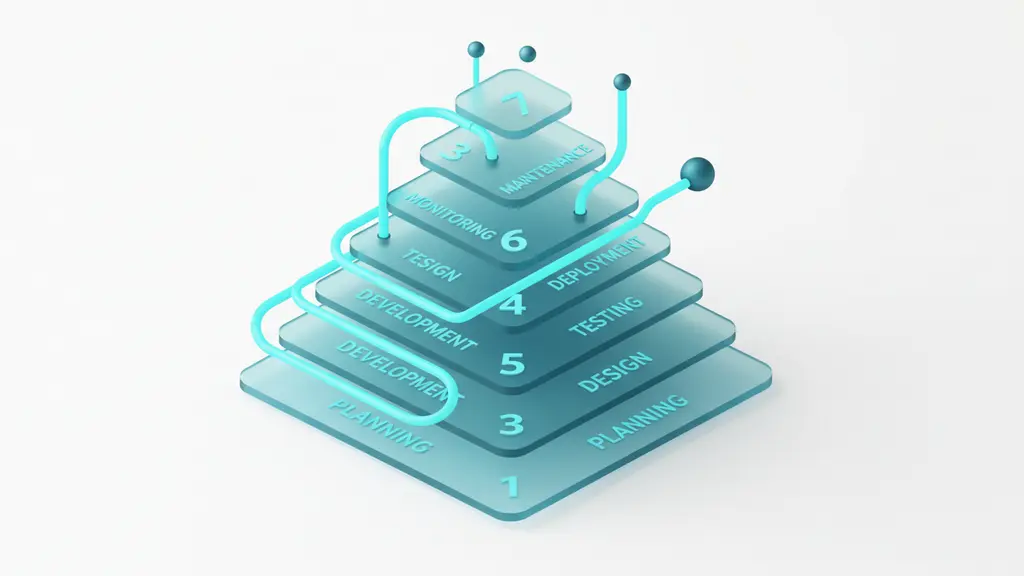
The 7 SDLC phases are: Planning, Analysis, Design, Development, Testing, Deployment, and Maintenance.
In-Depth Breakdown: Each of the 7 SDLC Phases Explained
Phase 1: Planning
The Planning phase aligns stakeholders on project goals, scope, resources, and risks before any technical work begins.
A strong planning phase reduces project failure by clarifying what needs to be built, why, and how to measure success.
Key activities:
- Establish objectives and requirements at a high level.
- Identify stakeholders and assign roles.
- Analyze risks, timelines, budgets, and regulatory constraints.
- Develop the initial project plan and feasibility study.
Example:
For a healthcare application, planning must account for compliance (like HIPAA), stakeholder input from clinicians, and up-front resource commitments.
Outputs:
- Project charter
- High-level timeline and budget
- Risk register
Tools:
- Jira, Microsoft Project, Smartsheet
Phase 2: Analysis (Feasibility/Requirements Gathering)
The Analysis phase documents user needs, detailed requirements, and assesses if the project is technically and financially feasible.
Clear, thorough analysis ensures that all stakeholders share a common understanding, preventing costly changes later.
Key activities:
- Conduct stakeholder interviews, workshops, and observations.
- Gather and document functional and non-functional requirements in a Software Requirements Specification (SRS).
- Assess technical feasibility and identify constraints.
Example:
For fintech products, requirements gathering includes use cases (like secure transactions), regulatory compliance, and scalability needs.
Outputs:
- SRS (Software Requirements Specification)
- Use case diagrams and user stories
- Feasibility report
Tools:
- Confluence, Jira, Draw.io
Phase 3: Design
The Design phase crafts the solution’s technical architecture and user experience based on gathered requirements.
Effective design provides a blueprint for development, covering system structure, user interfaces, data models, and security.
Key activities:
- Model system architecture, data flow, and integrations.
- Design UI/UX layouts, workflows, and interactions.
- Specify technical and security standards (e.g., encryption, authentication).
- Prepare design documents, wireframes, and diagrams.
Example:
A banking app’s design phase would include two-factor authentication workflows and PCI DSS compliance measures.
Outputs:
- System architecture document
- Wireframes/prototypes
- Security design plan
Tools:
- Figma, Lucidchart, Enterprise Architect
Phase 4: Development (Implementation/Coding)
The Development phase transforms design documents into working software through code.
Following best practices in coding, automation, and collaboration streamlines development and improves quality.
Key activities:
- Write, review, and integrate code based on designs.
- Follow coding standards and peer review protocols.
- Use CI/CD (Continuous Integration/Continuous Deployment) for rapid, reliable builds.
- Address emergent issues from new technologies, such as AI-based programming assistants or distributed teams.
Example:
Remote teams coordinate via GitHub and Agile boards, integrating code through automated CI/CD pipelines for a global logistics product.
Outputs:
- Application codebase
- Build artifacts
- Updated documentation
Tools:
- IDEs (VS Code, IntelliJ), Git, Jenkins, Docker
Phase 5: Testing
The Testing phase ensures software reliability, security, and alignment with requirements before release.
Comprehensive testing—manual and automated—mitigates risks and builds trust with end users.
Key activities:
- Run unit, integration, system, and user acceptance tests (UAT).
- Perform automated regression and performance testing.
- Conduct security and compliance checks.
- Log, track, and resolve defects.
Example:
In insurance software, testing includes validating claims workflows and regulatory reporting—often automated with continuous testing tools.
Outputs:
- Test plans and cases
- Bug and issue reports
- Test result summaries
Tools:
- Selenium, TestRail, JUnit, OWASP ZAP
Phase 6: Deployment (Implementation)
The Deployment phase moves the validated software into production for end-user access.
Careful deployment planning avoids business disruption and ensures a smooth transition.
Key activities:
- Prepare environments and deployment scripts.
- Execute deployment via strategies like “big bang” launch or phased rollout.
- Update user documentation and provide training as needed.
- Monitor for issues during go-live.
Example:
A SaaS company may deploy in stages across cloud regions, using automated monitoring to catch bugs early.
Outputs:
- Live application release
- Deployment reports
- Rollback/contingency plans
Tools:
- Ansible, Docker, Kubernetes, Azure DevOps
Phase 7: Maintenance
The Maintenance phase provides ongoing support, fixes, and enhancements after deployment.
Robust maintenance protects software investments with bug fixes, security updates, and performance improvements.
Key activities:
- Address support tickets and bug reports.
- Release patches and minor/moderate updates.
- Monitor system health, security, and compliance.
- Evolve features based on user feedback.
Example:
A healthcare EMR (electronic medical record) platform receives quarterly updates to address new compliance rules and performance complaints.
Outputs:
- System updates and releases
- Support documentation
- Monitoring and metrics reports
Tools:
- ServiceNow, Splunk, PagerDuty
SDLC Models: How Do the 7 Phases Vary Across Waterfall, Agile, and Other Approaches?
Various SDLC models (Waterfall, Agile, Iterative) structure these seven phases differently, affecting project flow and outcomes.
Traditional Waterfall strictly follows the 7 distinct phases in sequence. Agile and Iterative models may overlap or repeat phases for incremental delivery. Some industries use 6-phase models (combining or omitting steps), but the 7-phase model remains a global standard, especially for regulated sectors.
| Model | Phase Order | Phase Overlap | Example Use Case |
| Waterfall | Linear (1–7) | No | Enterprise ERP, Government |
| Agile | Cyclic/Iterative | Yes | SaaS, web apps |
| V-Model | Linear w/ Parallel QA | No | Medical devices, Automotive |
| 6-Phase | Combines/Omits steps | Varies | Some startups, legacy IT |
Tip:
In regulated fields (like healthcare or finance), the 7-phase SDLC is commonly required to meet compliance, traceability, and audit needs.
Why Is Each SDLC Phase Important? (Risks & Benefits)
Each SDLC phase adds unique value. Skipping steps leads to costly delays, missed requirements, or software failures.
| Phase | Benefit | Common Risk If Skipped |
| Planning | Clear vision, resource control | Scope creep, missed deadlines |
| Analysis | Correct requirements, satisfied users | Costly rework, dissatisfied users |
| Design | Consistent, maintainable architecture | Security/UX flaws, poor quality |
| Development | Robust, standard codebase | Defects, technical debt |
| Testing | Fewer bugs, greater reliability | Unstable releases, breaches |
| Deployment | Smooth, predictable launches | Business disruption, rollback |
| Maintenance | Extend software lifespan, user trust | Security holes, obsolescence |
According to the Standish Group’s CHAOS Report, lack of clear requirements and planning are top causes of project failure globally.
How to Implement the 7 Phases of SDLC in Real Projects

Applying the SDLC in practice ensures project order, transparency, and quality. Here’s a practical checklist and tool guide:
Step-by-Step SDLC Implementation Checklist
- Initiate Planning:
- Define objectives, scope, and stakeholders.
- Draft and approve a project charter.
- Conduct Analysis:
- Engage all users and business units.
- Document detailed requirements (SRS).
- Complete Design:
- Develop solution architecture and UI prototypes.
- Review security and compliance needs.
- Organize Development:
- Establish coding standards and version control.
- Employ DevOps and CI/CD tools.
- Run Testing:
- Implement both manual and automated tests.
- Execute security and performance checks.
- Plan Deployment:
- Prepare user communications, training, and rollback plans.
- Monitor systems after go-live.
- Maintain and Improve:
- Operate real-time monitoring and ticket resolution.
- Schedule security patches and updates.
Role Assignments:
– Project Manager: oversees all phases
– Business Analyst: owns analysis
– Architect/Designer: leads design
– Developers/DevOps: drive development and deployment
– QA/Testers: operate testing
– Support/IT Ops: manage maintenance
Recommended Tools:
- Planning: Jira, MS Project
- Documentation: Confluence, Google Docs
- Development: GitHub, Bitbucket, Jenkins
- Testing: Selenium, JUnit, TestRail
- Deployment: Docker, Kubernetes, Ansible
- Maintenance: ServiceNow, PagerDuty
Common Questions About the 7 Phases of SDLC (FAQ)
1. What Are The 7 SDLC Phases?
The 7 SDLC phases are Planning, Analysis, Design, Development, Testing, Deployment, and Maintenance. These phases of SDLC provide a structured framework that guides software projects from initial concept to long-term support.
2. What Is The Purpose Of Each Phase Of SDLC?
The phases of SDLC ensure control and quality at every step. Planning defines objectives, Analysis gathers requirements, Design structures the solution, Development builds it, Testing validates it, Deployment releases it, and Maintenance ensures continuous improvement. Properly understanding these SDLC phases explained helps teams reduce risk and improve outcomes.
3. How Do SDLC Phases Differ In Agile Vs. Waterfall?
In Waterfall, the SDLC phases follow a strict linear order, with each phase completed before the next begins. In Agile, the phases of SDLC are repeated in short cycles or sprints, allowing for flexibility, iteration, and faster adaptation to change.
4. Why Is Planning One Of The Most Critical SDLC Phases?
Among all SDLC phases, Planning is crucial because it defines scope, budget, timelines, and risks. Strong planning prevents missed requirements and ensures alignment before significant resources are invested.
5. What Happens During The Testing Phase Of SDLC?
In the SDLC phases explained, Testing validates the software through functional testing, user acceptance testing, security checks, performance evaluation, and defect tracking to ensure quality before deployment.
6. What Documentation Supports The Phases Of SDLC?
Each of the phases of SDLC requires documentation such as project charters, software requirement specifications (SRS), design documents, test plans, deployment manuals, and maintenance logs to maintain clarity and accountability.
7. Which SDLC Models Clearly Follow All 7 SDLC Phases?
Traditional models like Waterfall and V-Model most clearly define all seven SDLC phases, especially in regulated industries where structured documentation and compliance are essential.
8. What Are Common Mistakes When Managing SDLC Phases?
Common errors include skipping key SDLC phases, rushing requirement gathering, inadequate testing, and poor documentation. Understanding the SDLC phases explained in detail helps avoid these pitfalls.
9. How Is Security Integrated Across The Phases Of SDLC?
Security should be embedded throughout the phases of SDLC—designed into system architecture, implemented during development, validated in testing, and continuously monitored during maintenance to ensure ongoing protection.
10. Are There Real-World Examples Of SDLC Phases In Industry?
Yes. In healthcare, the SDLC phases include compliance planning for HIPAA. In finance, regulatory analysis is embedded early in the phases of SDLC. SaaS companies often apply Agile iterations while still adhering to structured SDLC principles.
Conclusion: Next Steps for Mastering the SDLC
Understanding and applying the 7 phases of the software development life cycle is essential for delivering reliable, scalable, and high-quality software. A structured SDLC approach brings clarity to every stage from planning and analysis to deployment and maintenance, helping teams reduce risk, control costs, and meet stakeholder expectations.
When organizations commit to a disciplined process, they create stronger alignment, better collaboration, and continuous improvement across projects. Mastering the SDLC framework enables teams to build software that is not only functional but resilient, adaptable, and positioned for long term success.
Key Takeaways: SDLC 7 Phases Cheat Sheet
- Follow all 7 SDLC phases: Skipping steps raises project failure risk.
- Good planning saves time: Clear goals and requirements prevent costly rework.
- Design and testing are critical: They ensure usability, security, and quality.
- Automation is your friend: Modern DevOps and CI/CD tools support speed and reliability.
- Continuous maintenance extends value: Keep up with bugs, security, and user improvements.
This page was last edited on 7 March 2026, at 9:37 am
Contact Us Now

Contact Us Now
Start a conversation with our team to solve complex challenges and move forward with confidence.


