
Hiring remote developers has surged since 2020, but not every platform delivers the talent, quality, and security your project demands. Rushing this decision can lead to costly misfires—missed deadlines, code quality issues, or even data breaches.
This expert-curated playbook demystifies the process of finding the world’s top sites to hire remote developers. You’ll get actionable comparisons, vetted recommendations, and decision frameworks used by leading tech startups and SMBs.
By the end, you’ll know exactly where and how to hire remote developers who align with your technical needs, budget, and business goals—reducing risk and speeding up your next great build.
At-a-Glance—Top 10 Sites to Hire Remote Developers in 2026
The best sites to hire remote developers in 2026 are:
- RiseUpLabs – Premium application and cloud solutions with skilled developers for complex projects
- Toptal – Elite, rigorously vetted developer marketplace for premium projects
- Arc – Fast global matches with top 2% of remote developers
- Upwork – Largest open freelance marketplace with diverse talent
- Lemon.io – Pre-vetted, affordable freelance developers; quick onboarding
- We Work Remotely – High-traffic job board for remote tech roles
- Fiverr – Gig-based platform for quick, small-scale coding tasks
- Mobilunity – Dedicated nearshore teams and full-cycle staffing
- Hired – An AI-driven platform for pre-screened developers and salary transparency
- Freelancer.com – Global freelancer marketplace with competitive pricing
Jump directly to each platform’s review for details, pricing, and expert insights.
Comparative Table: Platforms at a Glance
Get a quick side-by-side comparison of the top platforms for hiring remote developers, including cost, vetting, and best use cases.
| Platform | Cost Range | Vetting Level | Best For | Developer Regions | Notable Clients |
| Toptal | $60–$180/hr | Elite (Top 3%) | Enterprise, Scaleups | Global (US, EU, LATAM, APAC) | Airbnb, Shopify |
| Arc | $50–$120/hr | Top 2% | Fast, quality staffing | Global | Spotify, HubSpot |
| Upwork | $20–$150/hr+ | Open Marketplace | Freelance/gig | Worldwide | Microsoft, GoDaddy |
| Lemon.io | $35–$80/hr | Pre-vetted | Startups, SMEs | Eastern Europe, LATAM | Taboola |
| We Work Remotely | Job Posts ($299+) | Self-vetting/job board | Sourcing specialists | Worldwide | Google, Amazon |
| Fiverr | $5–$150/hr (gig) | Basic/seller reviews | Micro-tasks, quick hires | Global | Facebook, Netflix |
| Mobilunity | Negotiated/project-based | In-house | Dedicated teams | Eastern Europe, EMEA | Swissquote |
| Hired | $50–$140/hr | Pre-screened, AI-matched | Perm/Contract/interim | Mainly US, EU | Dropbox, Zendesk |
| Freelancer.com | $10–$120/hr | Basic | Global open contests | Worldwide | NASA, IBM |
| Wellfound (AngelList) | Varies | Startup/job board | Startup hires | US, India, remote | OpenAI, Stripe |
Note: Costs reflect typical developer rates in 2026; platform fees may apply. See full reviews for region details and special features.
How to Choose the Right Platform for Hiring Remote Developers

Selecting the ideal remote developer platform starts by aligning your project’s needs with the right hiring model. Making the right choice avoids delays, mismatches, and expensive missteps.
Key steps to choose the best platform:
- Identify your hiring model:
- Freelance marketplaces (Upwork, Freelancer) offer talent for short-term or ad-hoc work.
- Vetted marketplaces (Toptal, Arc, Lemon.io) deliver high-quality, pre-assessed developers.
- Agencies/Staffing firms (Mobilunity) give full-cycle support, legal compliance, and dedicated teams.
- Job boards (We Work Remotely, Wellfound) are best if you want direct applications and full-time hires.
- Decision matrix—Consider:
- Project size and complexity: Large, mission-critical projects favor vetted or agency models.
- Budget constraints: Open marketplaces may be more affordable, but vetting is lighter.
- Tech stack: Specialized platforms may excel with niche technologies.
- Security/IP needs: Agencies and vetted marketplaces often provide stronger legal/compliance support.
- Time zone alignment: Choose platforms with developer pools in your preferred regions.
- Red flags—Avoid:
- Relying on the cheapest site for complex or sensitive projects
- Platforms with little or no vetting for high-stakes work
- Job boards if you lack extensive tech hiring knowledge
For most startups and SMBs, combining a short trial project and a platform with transparent vetting balances speed, quality, and risk.
Detailed Reviews: Top Platforms to Hire Remote Developers
RiseUpLabs: Tailored Developer Hiring for Startups and Enterprises
Summary: RiseUpLabs specializes in providing businesses with top-tier developers suited to various project needs, offering tailored talent solutions with a focus on quality and fast matching.
What it is: A developer recruitment service that matches businesses with vetted, skilled developers, providing flexible and scalable team solutions. Offers both freelance and full-time hire options across diverse industries.
Vetting: Rigorous vetting process, including technical interviews, skill assessments, and soft skills evaluation. Candidates undergo a detailed screening to ensure they meet the client’s specific project requirements.
Pricing: $40–$120/hr; flexible pricing models based on contract length and scope of work.
Ideal for: Businesses of all sizes, from startups to large enterprises, requiring skilled developers for short- or long-term projects.
Notable clients: Various global brands and startups in sectors like tech, finance, healthcare, and e-commerce.
Coverage: Global network with a strong presence in North America, Europe, and APAC.
Unique features: Quick onboarding, dedicated account managers, and a focus on providing talent with the exact skills needed. Flexible hiring models (freelance, contract, or full-time) and fast team scaling.
Pros:
- Flexible hiring options (freelance, contract, or full-time)
- Tailored developer matching process based on project needs
- Focus on high-quality, well-vetted talent
- Rapid team scaling and flexible contract terms
Cons:
- Pricing can be on the higher end for smaller businesses
- Limited talent pool compared to open marketplaces
Toptal: Elite, Fully Vetted Talent for Premium Projects
Summary: Toptal provides access to the top 3% of global developers across a wide range of disciplines, with a reputation for exceptional vetting and client satisfaction.
- What it is: Global talent marketplace specializing in thoroughly vetted software developers, designers, and finance experts. Founded in 2010.
- Vetting: Multi-stage screening (automated tests, soft skills, live technical interviews) filtering thousands down to the “top 3%.”
- Pricing: Typically $60–$180/hr; 0% recruiting fee, free risk-free trial for 2 weeks.
- Ideal for: Complex, mission-critical software projects; enterprise and funded startups.
- Notable clients: Airbnb, Shopify, Duolingo
- Coverage: Global network; strong in North America, Europe, Latin America
- Unique features: Risk-free two-week trial, dedicated account managers, strict NDA/IP processes.
Pros:
- Industry-leading vetting ensures quality
- Dedicated support and matching
- Global, diverse candidate pool
Cons:
- Premium pricing is unsuitable for low-budget/hobby projects
- Smaller talent pool compared to open marketplaces
Arc: Fast-Matching, Vetted Global Developers
Summary: Arc connects companies with pre-screened, top 2% global remote developers fast, using AI-powered matching supported by technical interviewers.
- What it is: Remote tech talent marketplace focused on speed, quality, and flexibility; rebranded from CodementorX.
- Vetting: Skill-based assessments, live technical interviews, work experience screening, ongoing performance checks.
- Pricing: $50–$120/hr for contract/freelance; permanent hire options available; no upfront cost.
- Ideal for: Startups and scaleups needing speed, short-to-medium term contracts, globally distributed teams.
- Notable clients: Spotify, HubSpot
- Coverage: Global (North America, EU, LATAM, APAC)
- Unique features: AI-powered “HireAI” tool for instant candidate shortlists; hands-on onboarding.
Pros:
- Speedy matching and high vetting standards
- Scalable for teams and fast pivots
Cons:
- Smaller candidate pool than open marketplaces
- Slightly higher minimum rates
Upwork: Largest Freelance Talent Marketplace
Summary: Upwork is the world’s largest freelance platform, offering a deep pool of developers at all skill and price levels, but with lighter vetting.
- What it is: Open marketplace for freelance software developers, designers, consultants, and more; formerly oDesk and Elance.
- Vetting: Self-reported profiles, reviews, skills badges, paid “Talent Scout” vetting for premium hires.
- Pricing: $20–$150/hr; platform fees apply (3–10%).
- Ideal for: Short-term projects, MVPs, prototyping, wide range of skill levels and budgets.
- Notable clients: Microsoft, GoDaddy
- Coverage: Worldwide (strong US, India, Eastern Europe, LATAM representation)
- Unique features: Escrow payment protection, large talent pool, time-tracking tools.
Pros:
- Unmatched developer volume and choice
- Flexible project pricing and size
- Built-in collaboration tools
Cons:
- You must screen and vet candidates yourself
- Greater variance in quality and reliability
Lemon.io: Rapid Access to Pre-Vetted Freelance Developers
Summary: Lemon.io matches startups and SMEs with pre-vetted, affordable Eastern European and global freelance developers, usually within 24 hours.
- What it is: Curated freelancer marketplace with a rigorous focus on skills, communication, and reliability.
- Vetting: Multi-step process covering hard skills, English, soft skills, and test tasks.
- Pricing: $35–$80/hr; transparent all-inclusive rates.
- Ideal for: Early stage startups, small businesses seeking quick matches and solid vetting at reasonable cost.
- Notable clients: Taboola, Ikea
- Coverage: Eastern Europe, Latin America, some global distribution
- Unique features: Fast onboarding (24-hour candidate matches), personal managers, replacement guarantee.
Pros:
- Affordability and speed
- Strong vetting focus, tailored for startups
Cons:
- Limited coverage for highly specialized or very senior roles
- Smaller total talent pool
We Work Remotely: High-Traffic Tech Job Board
Summary: We Work Remotely is a leading job board for remote tech roles, trusted by top brands but lacking built-in vetting or payroll support.
- What it is: Job posting board connecting employers with global remote developers and other tech roles.
- Vetting: No direct vetting; relies on employer’s process.
- Pricing: $299 per job post; add-ons available.
- Ideal for: Experienced hiring teams, direct full-time or contract sourcing, access to large passive candidate base.
- Notable clients: Google, Amazon
- Coverage: Broadly global; English-focused audience.
- Unique features: High-visibility listings, Slack integration.
Pros:
- Huge audience of remote-focused developers
- Direct employer-candidate communication
Cons:
- No quality screening, legal, or payment support
- Requires strong internal recruitment
Fiverr: Gig-Based Platform for Quick Coding Tasks
Summary: Fiverr is a global marketplace specializing in microservices and project-based development tasks, best for simple or rapid jobs.
- What it is: Popular freelance gig platform; offers every tech skill from bug-fixes to full builds.
- Vetting: Seller ratings, reviews, and some Pro vetting for higher-end gigs.
- Pricing: $5–$150/hr+ or fixed gig pricing; platform service fees apply.
- Ideal for: Quick bug fixes, prototypes, short-term tasks, highly constrained budgets.
- Notable clients: Facebook, Netflix
- Coverage: Worldwide (highly diverse)
- Unique features: Fixed-price and tiered package gigs, fast project starts.
Pros:
- Instant hiring, transparent pricing
- Wide skill variety
Cons:
- Quality varies widely, light screening
- Less suitable for long-term or complex projects
Mobilunity: Dedicated Remote Teams & Nearshore Staffing
Summary: Mobilunity offers dedicated Ukrainian/Eastern European remote developer teams and staff augmentation, ideal for companies seeking full-cycle managed hiring.
- What it is: IT staffing agency specializing in building/managing remote teams; transparent service, legal, and compliance support.
- Vetting: In-house recruiting, skills and technical interviews, culture fit assessment.
- Pricing: Negotiated based on team size/framework; transparent fees.
- Ideal for: Businesses seeking secure, long-term dedicated developers, nearshore advantages.
- Notable clients: Swissquote, Esurance
- Coverage: Eastern Europe focus; EMEA, North America clients
- Unique features: End-to-end support, legal compliance, tailored HR services.
Pros:
- Legal/contract security, managed solutions
- High retention for long-term projects
Cons:
- Minimum engagement sizes (not ideal for solo freelancers)
- Regionally focused
Hired: AI-Powered Matches for Permanent and Contract Developers
Summary: Hired is an AI-driven platform matching pre-vetted developers to full-time, contract, or interim roles, emphasizing salary transparency and technical rigor.
- What it is: Marketplace for job-seeking developers and hiring companies, leveraging automated screening and salary insights.
- Vetting: Technical assessments, skills reviews, and AI-powered shortlist.
- Pricing: $50–$140/hr (contract); placement fees may apply for permanent hires.
- Ideal for: US, EU companies seeking reliable long-term additions; transparent hiring process.
- Notable clients: Dropbox, Zendesk
- Coverage: US, EU focus, some global reach
- Unique features: Salary transparency, rapid time-to-hire.
Pros:
- High-quality, assessed candidates
- Automated matching reduces hiring time
Cons:
- Limited coverage outside major markets
- Some roles may attract less volume
Freelancer.com: Global Open Marketplace with Competitive Pricing
Summary: Freelancer.com is a large, global platform for freelance projects, offering competitive rates and a broad skill variety, but lighter screening.
- What it is: Open freelance platform for software, design, and IT projects of all sizes.
- Vetting: No mandatory screening; relies on reviews, portfolios, optional premium vetting.
- Pricing: $10–$120/hr; bidding model; employer fees from 3%+.
- Ideal for: Price-sensitive, discrete projects, or prototyping with smaller budgets.
- Notable clients: NASA, IBM
- Coverage: Worldwide
- Unique features: Contest-based hiring, milestone payments, live chat.
Pros:
- Budget-friendly and high availability
- Flexible scope and scale
Cons:
- Variable quality, little oversight or vetting
- Higher risk for complex work
Wellfound (AngelList Talent): Startup-Focused Remote Hiring
Summary: Wellfound (formerly AngelList Talent) connects startups with remote developers and other tech talent, focusing on early-stage and venture-backed companies.
- What it is: Leading startup job board/platform with millions of candidates worldwide.
- Vetting: No platform screening; relies on résumé, startup fit, and employer interviewing.
- Pricing: Varies; free and premium job posting options.
- Ideal for: Funded startups, founder-led teams building engineering pipelines.
- Notable clients: OpenAI, Stripe
- Coverage: US, India, Europe, increasingly global
- Unique features: Funding data, searchable profiles, direct messaging.
Pros:
- Access to startup-centric developer pool
- Direct engagement with candidates
Cons:
- No vetting, platform payment, or legal support
- Less structured process for early-stage teams
Key Comparison Factors: Cost, Vetting, Security, Support & Time-to-Hire
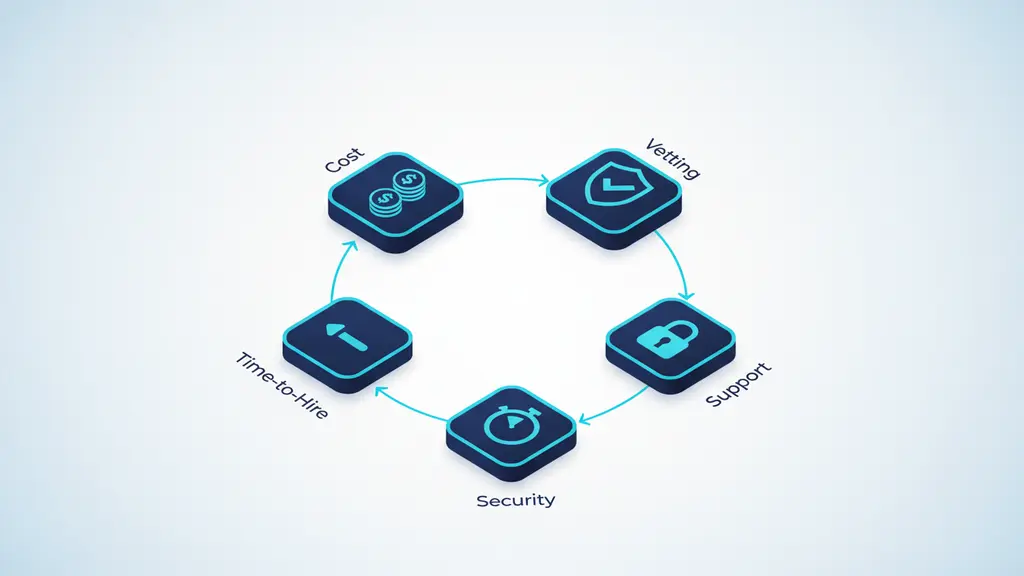
When evaluating where to hire remote developers, focus on five primary factors that impact project outcomes and risk.
Summary table of key comparison factors:
| Factor | Typical Spread/What to Look For |
| Cost | Hourly ($10–$180/hr), project, or placement fee. Vetted platforms trend higher but lower long-term risk. |
| Vetting | Ranges from none (open boards) to multi-stage skills/interview screening (Toptal, Arc, Lemon.io). |
| Security & IP | Contracts/NDA standard for agencies, vetted sites; open boards rely on your diligence. |
| Support | Account managers, trial/refund policies, and post-hire support—stronger with agencies/vetted. |
| Time-to-Hire | Instant (Fiverr, Upwork), 1–3 days (Arc, Lemon.io), 1–2 weeks (Toptal, Mobilunity). |
Additional details:
- Cost structures: Most platforms use hourly or milestone payments; agencies may bill monthly or per team member.
- Vetting depth: Key for complex, secure or high-budget projects. Vetted platforms reduce risk via live interviews, code reviews, and soft skills assessment.
- Security/compliance: Critical for IP-sensitive work—seek platforms that offer NDAs, secure payments/Escrow, and/or legal contract templates.
- Support: Look for platforms with refund/trial periods and active post-hire support, not just an introduction.
- Time-to-hire: Prioritize platforms with rapid matching if speed is vital; vetted marketplaces offer a balance between speed and quality.
Expert Tips: How to Hire Remote Developers Effectively
Efficiently sourcing, vetting, and onboarding remote developers maximizes results and minimizes headaches. Here’s how experienced tech leaders do it:
Top expert tips for effective remote developer hiring:
- Structure technical interviews with real-world challenges. Use screening tasks tailored to your stack to assess practical skills, not just résumé claims.
- Leverage platform tools and trials. For example, Toptal and Arc offer risk-free trials—use them to validate both technical and communication fit.
- Establish communication from day one. Introduce collaboration via Slack, Zoom, or GitHub; clarify expectations on deliverables and time zones.
- Focus on culture and fit, not just code. Evaluate soft skills—especially for long-term or full-time hires—during interviews or through trial projects.
- Protect your IP and payments. Use Escrow payments (Upwork, Freelancer), insist on NDAs, and always onboard via the platform’s secure contracting system.
- Avoid common rush mistakes. “Rushed hiring compounds mistakes. Take time for a test project, even if your project is urgent,” advises an HR manager at a fast-growing SaaS company.
What Are the Most Common Mistakes When Hiring Remote Developers—And How to Avoid Them?
Many companies repeat avoidable errors in remote hiring, leading to project issues or failed engagements. Learn these pitfalls to ensure your next hire succeeds.
Top remote hiring mistakes:
- Ignoring time zone and cultural alignment: Overlapping hours and culture fit directly impact collaboration speed and quality.
- Skipping in-depth vetting: Bypassing technical skills checks or test tasks increases the risk of costly misfires.
- Neglecting contract or IP agreements: Failing to secure NDAs or using vague contracts can compromise your business’s core assets.
- Choosing the lowest price over best fit: Ultra-cheap rates may reflect inexperience or corner-cutting, especially for critical projects.
- Lacking post-hire support or feedback loops: Ongoing onboarding, clear KPIs, and structured feedback help remote hires stay productive and aligned.
How to avoid:
Set clear hiring criteria, use platforms with proper vetting and support, always formalize contracts, and prioritize collaboration fit alongside technical skill.
Step-by-Step Checklist: Hiring a Remote Developer Successfully

Follow these steps to streamline your remote developer hiring process and improve your project outcome:
- Define your project needs.
- List tech stack, timeline, scope, and budget.
- Select the most suitable hiring platform.
- Match your needs to vetted, freelance, agency, or job board models.
- Screen and vet candidates effectively.
- Review portfolios, conduct technical interviews or assign test tasks.
- Set up clear legal/IP contracts.
- Use NDAs, platform contracts, and clarify payment terms.
- Onboard and integrate your developer.
- Share documentation, tools, set communication norms.
- Monitor, communicate, and support post-hire.
- Give structured feedback, regular check-ins, and performance reviews.
Conclusion
Choosing the best site to hire remote developers is a strategic step that can determine your project’s success, cost-efficiency, and code quality. With the right platform and process—matched to your business needs and project scope—you’ll minimize risks and unlock global tech talent advantage.
Use this expert playbook to make confident, informed decisions. Download our hiring checklist or dive deeper into our platform comparisons for tailored support. Ready to build your remote tech team? Start your search on one of the recommended platforms above, or consult with our experts for personalized guidance.
Key Takeaways
- The top platforms to hire remote developers in 2026 offer varied models—vetted, freelance, agencies, and job boards—to match different project needs.
- Thorough vetting, secure contracts, and post-hire support reduce the most common remote hiring risks.
- Aligning hiring strategy with project size, budget, tech stack, and time zone needs leads to better developer matches and project outcomes.
- Use decision-making frameworks and actionable checklists to streamline your hiring process.
- Expert recommendations, cost comparisons, and in-depth platform reviews drive confident hiring decisions.
FAQs: Common Questions About Hiring Remote Developers
What are the best sites to hire remote developers?
Top sites include Toptal, Arc, Upwork, Lemon.io, We Work Remotely, Fiverr, Mobilunity, Hired, Freelancer.com, and Wellfound, each suiting different project scopes and budgets.
How do platforms vet developers?
Vetting ranges from portfolio review and user ratings on open marketplaces to live interviews, technical assessments, and reference checks on vetted platforms like Toptal and Arc.
How much does hiring a remote developer cost?
Remote developer costs span $10/hr on open boards to $180/hr for elite, vetted talent, with most professional hires falling between $40–$120/hr, plus platform or agency fees.
How do I protect my IP when hiring remotely?
Use platform contracts with clear NDAs and IP clauses. Favor platforms or agencies that provide legal protections and payment security systems.
What is faster: hiring through a marketplace or an agency?
Marketplaces (Fiverr, Upwork) enable instant hiring, while vetted sites (Arc, Lemon.io) can deliver quality candidates in 24–72 hours. Agencies may require a week or more but offer deeper support and management.
This page was last edited on 1 February 2026, at 5:37 pm
Contact Us Now

Contact Us Now
Start a conversation with our team to solve complex challenges and move forward with confidence.


