
As IoT projects become more complex and business-critical, assembling the right development team can make or break your success. Failing to align roles, skills, and processes often leads to project delays, security gaps, or costly setbacks.
IoT initiatives blend hardware, software, connectivity, and real-time data—making team structure and skill alignment essential for project delivery. Recent IoT Analytics data reports that nearly 60% of IoT projects miss original goals or timelines due to skills gaps and integration issues.
This guide offers a practical, step-by-step framework to build—and support—your IoT development team, from defining goals through long-term success strategies. By following these tips to build the best IoT development team, you’ll confidently assemble a team ready for the challenges and opportunities of IoT in 2026.
How Do You Define Your IoT Project Goals and Scope?
Defining clear project goals and scope is the first step to building an effective IoT development team. A precise scope ensures you recruit the right skills, avoid budget overruns, and set the stage for successful delivery.
How to Clarify Your IoT Project Scope:
- Break Down Business Needs:
Translate business objectives (e.g., reduce downtime, enable smart monitoring) into technical requirements. - Specify Use Cases:
List concrete use cases, such as predictive maintenance, remote monitoring, or asset tracking. - Document Requirements:
Capture both functional (what the system should do) and non-functional needs (performance, security, scalability). - Consider Constraints:
Note any relevant limitations (budget, compliance, device types, or legacy system integrations).
Project Scope Clarification Checklist:
| Question | Example |
| What business outcome are we targeting? | Reduce equipment failure by 40% via predictive monitoring |
| Which devices/sensors will we connect? | Environmental sensors, smart meters, security cameras |
| What data needs will we have? | Real-time telemetry, cloud analytics, edge processing |
| What compliance/regulatory standards? | GDPR for data, ISO 27001 for security |
| What’s our timeline and budget? | 8 months, $1.2 million |
Key Takeaway: A well-defined project scope will directly inform the size, roles, and skill sets needed for your IoT development team.
What Roles and Skills Are Essential for the Best IoT Development Team?

A high-performing IoT development team blends hardware, software, networking, security, and analytics expertise. Each project requires a unique mix of roles and technical skills mapped to its business goals.
Core IoT Team Roles (2026):
- Project Manager: Orchestrates planning, delivery, and stakeholder communication.
- Solution Architect: Designs overall system architecture across hardware, firmware, cloud, and apps.
- Embedded/Hardware Engineer: Develops device hardware, PCB design, sensor integration.
- Firmware Engineer: Programs device logic; ensures reliable low-level operation.
- Cloud/Backend Developer: Builds APIs, data processing, integration with cloud platforms (AWS, Azure, GCP).
- Mobile/Web App Developer: Creates user interfaces and device management applications.
- Data Scientist/Analyst: Enables analytics, AI/ML, and visualization.
- IoT Security Specialist: Ensures secure data flow, device protection, compliance.
- QA/Test Engineer: Verifies functionality, reliability, and performance.
- DevOps Engineer: Automates deployment, CI/CD, and monitoring processes.
IoT Team Skills Matrix (2026)
| Role | Key Skills |
| Project Manager | Agile for IoT, risk management, team leadership |
| Solution Architect | IoT protocols (MQTT, CoAP), systems integration |
| Embedded Engineer | PCB design, C/C++, real-time OS, hardware debugging |
| Firmware Engineer | Embedded C, RTOS, Bluetooth, Zigbee, reliability testing |
| Cloud Developer | AWS/Azure IoT Suite, Python, REST APIs, serverless |
| Mobile/Web Developer | React/Flutter, device management UI/UX, API integration |
| Data Scientist | ML modeling, streaming analytics, data pipelines |
| Security Specialist | Secure boot, data encryption, vulnerability assessment |
| QA/Test Engineer | Automated testing, hardware-in-loop, security testing |
| DevOps Engineer | CI/CD pipelines, IoT device fleet management, monitoring |
Emerging Needs: With AI-driven IoT and rising threats, expect growing demand for AI/ML engineers, 5G specialists, and advanced cybersecurity expertise.
Team Structure Best Practices:
- Cross-functional pods: Group hardware, firmware, and cloud experts for each feature/release.
- Clear communication pathways: Use collaboration tools (Slack, Jira) and weekly cross-role standups.
Key Takeaway: Map each team role to your project’s technical needs, ensuring full coverage of device, connectivity, app, data, and security skillsets.
Should You Build In-House or Outsource Your IoT Team?
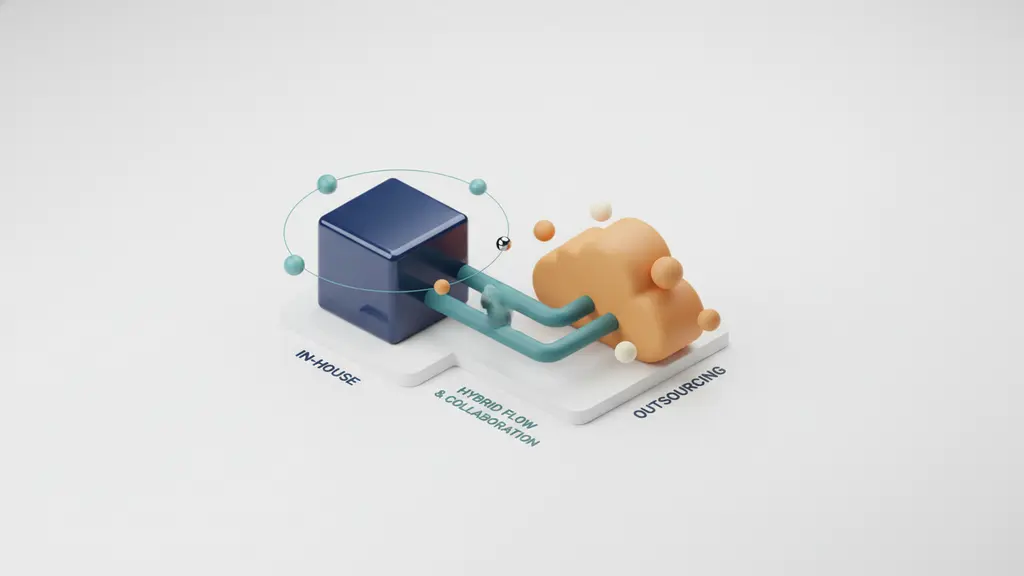
Choosing between in-house and outsourced IoT development shapes your project’s speed, cost, and control. The right mix depends on internal capacity, project complexity, and need for specialized skills.
In-House vs. Outsourced IoT Development: Key Differences
| Criteria | In-House | Outsourced/Hybrid |
| Cost | Higher fixed cost (salaries/benefits) | Variable (project/contract-based) |
| Speed | Hiring/training time required | Rapid scale-up with existing talent |
| Control | Full hands-on management | Depends on vendor transparency |
| Expertise | Limited to internal skills | Access to broad & advanced skillsets |
| Risk | Knowledge retention, culture alignment | IP, vendor dependence, handoff challenges |
How to Choose the Best Model:
- Assess Project Complexity:
Advanced projects (AI, integrations, security) may benefit from proven partners. - Consider In-House Capabilities:
Strong internal engineering? Build core in-house; otherwise, consider hybrid or outsourcing. - Evaluate Vendor Fit:
- Industry/project experience
- Portfolio and client references
- Process transparency
- Security, compliance, and IP safeguards
Vendor Evaluation Checklist:
- Documented case studies in relevant IoT domains
- Robust developer onboarding and knowledge handover plans
- Transparent communication and escalation processes
Hybrid Models: Blending in-house leadership with outsourced specialists or nearshore teams often offers the best balance for complex or scaling projects.
Key Takeaway: Choose in-house for control and culture, outsourcing for speed and expertise—or hybrid for optimal flexibility.
How to Recruit and Onboard Top IoT Talent Effectively?

Streamlined recruitment and thoughtful onboarding are crucial to attract, engage, and retain top IoT developers. A structured process also reduces ramp time and early attrition.
Proven IoT Recruitment Channels:
- Specialized job boards (IoT Jobs Board, AngelList, LinkedIn)
- Industry communities and hackathons
- University partnerships and IoT meetups
- Tech consulting partners and talent networks
Interview & Assessment Best Practices:
- Use scenario-based tasks mimicking real IoT project challenges.
- Include multi-stage technical interviews (hardware, cloud, security).
- Assess soft skills: collaboration, adaptability, and user empathy.
IoT Developer Onboarding Checklist (First 30/60/90 Days):
- Day 0–30:
- Set up dev environments, devices, access rights
- Peer/buddy assignment, mentoring kick-off
- Review codebase, architecture, process docs
- Day 31–60:
- Shadow cross-functional teams
- Complete initial hands-on deliverables
- Feedback session with manager/buddy
- Day 61–90:
- Lead a small feature or sprint
- Collaborate in cross-role review
- Document learnings and suggest improvements
Mentorship & Engagement Strategies:
- Assign “developer buddies” for rapid knowledge transfer.
- Schedule regular one-on-ones focused on goals, blockers, and growth.
- Use AI-driven skills assessments and learning management tools for tailored upskilling.
Cultural Alignment:
- Communicate mission and values clearly from day one.
- Celebrate quick wins, encourage transparent Q&A, and foster inclusive collaboration.
Key Takeaway: Effective recruitment combined with a clear, supportive onboarding process creates a foundation for high engagement and performance on your IoT development team.
How Can You Train, Motivate, and Support Your IoT Team for Long-Term Success?
Continuous learning and supportive management are vital for sustained IoT team success, innovation, and retention—especially in fast-changing tech environments.
Ongoing Training & Upskilling:
- Sponsor technical certifications (e.g., AWS Certified IoT, Google Cloud IoT).
- Provide access to self-paced and cohort-based online courses.
- Encourage participation in IoT conferences, webinars, and knowledge-sharing sessions.
Agile/DevOps for IoT:
- Implement agile sprints with hardware/software tandem planning.
- Use DevOps-style CI/CD and device fleet management to streamline feedback loops.
- Hold regular retrospectives to surface process improvements.
IoT Team Performance Metrics (KPIs):
| KPI | Description |
| Feature velocity | New features delivered per sprint/release |
| Uptime/Reliability | Device uptime, data delivery success rates |
| Code quality | Bug rate, code review completion |
| Security compliance | Vulnerability incidents, audit pass rates |
| Team satisfaction | Engagement and peer feedback scores |
Team Wellness & Motivation:
- Promote realistic workload estimates and flexible work arrangements.
- Offer mental health resources and encourage regular breaks.
- Recognize achievements and reward innovation.
Effective Collaboration:
- Use project management/collaboration tools (Jira, Confluence, Miro).
- Facilitate cross-functional sync meetings to align hardware, cloud, and mobile teams.
Feedback & Post-Launch Optimization:
- Establish regular feedback loops via surveys and review sessions.
- Continuously monitor team metrics, adjust structure/processes as needed.
Key Takeaway: Investing in continuous training, Agile processes, wellness, and clear metrics ensures your IoT development team stays productive, motivated, and ready for future challenges.
What Are the Most Common Pitfalls in IoT Team Building—and How Can You Avoid Them?
Missteps in IoT team building can lead to project delays, technical debt, and burnout. Recognizing these pitfalls is key to proactive risk management.
Most Frequent IoT Team Building Pitfalls:
- Underestimating System Integration:
Failing to plan for hardware-software interdependencies causes late-stage rework. - Neglecting Security Early:
Overlooking security requirements exposes projects to vulnerabilities and compliance risks. - Inadequate Cross-Role Alignment:
Silos between hardware, firmware, and cloud/app teams disrupt communication and slow delivery. - Limited Onboarding or Handover:
Poor documentation and rushed onboarding often result in knowledge gaps and slow starts. - Unrealistic Timelines:
Failing to buffer for hardware prototyping or regulatory approval stretches schedules.
Expert “Dos and Don’ts” (From Industry Leaders):
- Do:
- Facilitate early and open cross-functional workshops.
- Prioritize secure design and architecture reviews.
- Invest in structured onboarding and ongoing team training.
- Don’t:
- Assume IT-only skills are enough for IoT success.
- Rely solely on documentation—enable active knowledge transfer.
Key Takeaway: Sidestep these pitfalls by embedding cross-team alignment, security-by-design, and robust onboarding from the start.
Essential Tips to Build the Best IoT Development Team
Learning from seasoned IoT leaders accelerates team effectiveness. Field-tested practices can help your organization avoid common roadblocks and foster sustained innovation.
Quotes & Insights from IoT Practitioners:
“We scaled our IoT platform to millions of devices by investing early in DevOps automation and multi-disciplinary teams.”
— Tech Lead, VeryTechnology
“Cross-training hardware engineers in cloud workflows—and vice versa—minimized miscommunication and sped up delivery.”
— IoT Manager, N-iX
Case in Point:
- N-iX enabled rapid scaling for a European utility by assembling cross-functional squads blending firmware, QA, and data analytics. This enabled them to cut release cycles by 30% (N-iX case study, 2024).
- Memfault reduced post-launch incident response by integrating continuous health monitoring and regular incident reviews, highlighting the value of built-in observability (Memfault blog, 2024).
Proven Expert Strategies:
- Implement mentorship programs to share knowledge between senior and junior engineers.
- Use “innovation sprints”—dedicated time for new tech exploration and team learning.
- Prioritize transparency and peer recognition to foster collaboration.
Key Takeaway: Adopt practices from successful IoT teams—emphasizing continuous learning, DevOps, and cross-discipline training—for superior project outcomes.
Key Takeaways and Action Steps for Building Your IoT Development Team
To sum up, building a world-class IoT development team in 2026 requires a structured, end-to-end approach anchored in business goals, matched with the right blend of skills and ongoing support.
IoT Team Building Framework:
- Define clear IoT project goals and scope.
- Map needed roles and skills to address technical and business demands.
- Choose the ideal team model: in-house, outsourced, or hybrid.
- Recruit strategically and onboard with structured mentoring and support.
- Invest in continuous training, Agile workflows, and wellness.
- Monitor, measure, and optimize team performance.
- Proactively avoid common pitfalls through robust cross-functional alignment.
Conclusion
Building a successful IoT development team in 2026 requires clear goals, the right skills, and a structured approach. Whether in-house, outsourced, or hybrid, aligning your team’s expertise with business objectives is key. Continuous training, cross-functional collaboration, and agile processes ensure long-term success and innovation. By avoiding common pitfalls and focusing on security and integration, your IoT projects will meet and exceed expectations, driving growth for your business in the connected world.
FAQs: Your Top Questions About Building an IoT Development Team Answered
What are the key roles in an IoT development team?
Core roles include project manager, solution architect, embedded/hardware engineer, firmware engineer, cloud/backend developer, mobile/app developer, QA/test engineer, security specialist, data scientist/analyst, and DevOps engineer.
Which skills are critical for IoT engineers in 2026?
Key skills are expertise in embedded systems (C/C++), IoT protocols (MQTT, Zigbee), cloud platforms (AWS, Azure IoT), security (secure boot, encryption), real-time data analytics, and cross-disciplinary teamwork.
How do I choose between in-house and outsourced IoT teams?
Consider project complexity, speed, internal skills, confidentiality, and cost. In-house allows more control, while outsourcing offers speed and specialized expertise. Hybrid models are increasingly popular for flexibility.
What is the typical onboarding process for IoT developers?
The onboarding process spans 30/60/90 days: setup and access, initial shadowing and deliverables, then ownership of features. Assigning mentors and fostering cultural alignment help drive early success.
How does Agile methodology impact IoT team performance?
Agile adapts well to IoT by structuring short iterations and fostering feedback. Combining hardware and software sprints, DevOps automation, and frequent cross-functional reviews accelerates delivery and issue resolution.
What are the best practices for monitoring IoT development teams?
Monitor performance via metrics like feature velocity, uptime, code quality, and team satisfaction. Use collaborative tools and conduct regular retrospectives for continuous improvement.
How can I continuously upskill my IoT team?
Offer certifications, online courses, industry event participation, and learning resources. Encourage knowledge sharing through internal workshops and mentorship programs.
What pitfalls should be avoided when building an IoT team?
Common pitfalls include neglecting security early, siloed teams, poor onboarding, incomplete knowledge transfer, and setting unrealistic timelines. Prioritize integration, alignment, and security from day one.
How can cross-functional collaboration improve IoT project outcomes?
Effective collaboration breaks down silos, streamlines integration between hardware, firmware, and cloud teams, and reduces costly miscommunications or rework.
What metrics should I use to measure my IoT team’s success?
Track KPIs such as delivery velocity, device uptime, code quality, security compliance, and team satisfaction to monitor, support, and optimize team effectiveness.
This page was last edited on 18 February 2026, at 5:33 pm
Contact Us Now

Contact Us Now
Start a conversation with our team to solve complex challenges and move forward with confidence.


