
As global companies look for more reliable and efficient ways to manage operations, nearshoring has emerged as a powerful strategy. Many business leaders are now searching for an example of nearshoring to better understand how organizations successfully move production, services, or development work to nearby countries while maintaining strong collaboration and cost efficiency. By relocating operations closer to their primary markets, companies can reduce supply chain risks, improve communication, and respond faster to changing market demands.
In recent years, supply chain disruptions, rising operational costs, and increasing regulatory pressures have accelerated interest in nearshoring across industries. Manufacturers, technology firms, and service providers are adopting this model to strengthen resilience and maintain competitive advantage. This guide explores the concept through clear explanations and practical insights, highlighting real business cases that demonstrate how an example of nearshoring can work across different sectors and why this strategy is gaining momentum among global organizations.
What Is Nearshoring?
Nearshoring means moving business operations or sourcing to a nearby country to lower costs and shorten delivery times. For example, Whirlpool shifted appliance manufacturing from Asia to Mexico to boost speed-to-market for US consumers.
Simply put, nearshoring is the practice of relocating business processes or production to countries that are geographically close to your main market. This strategy helps companies reduce transportation costs, navigate fewer time zones, and respond faster to shifts in demand or policy.
- Offshoring: Moving production to distant countries, often for cost savings (e.g., US to China).
- Reshoring: Bringing operations back to the company’s home country.
Whirlpool, an American appliance manufacturer, nearshores by moving manufacturing from China and other Asian countries to Mexico. This allows them to reduce logistics costs, benefit from USMCA trade agreements, and deliver products to North American customers more quickly.
How Does Nearshoring Compare to Offshoring and Reshoring?

Nearshoring offers a balanced approach between offshoring’s cost savings and reshoring’s local control. Companies weigh these options based on cost, speed, regulatory risk, and market needs.
Below is a direct comparison of nearshoring, offshoring, and reshoring:
| Strategy | Definition | Typical Region | Main Advantages | Common Challenges | Example Industries |
| Nearshoring | Moving operations to nearby country for proximity | Mexico/Latin Am (US), Eastern Europe (EU) | Faster delivery, cultural alignment, tariff benefits | Higher costs than offshore, talent pools may vary | Manufacturing, IT, services |
| Offshoring | Outsourcing to faraway countries (often Asia) | China, India, SE Asia | Labor cost savings, large-scale capacity | Long transit times, IP risk, time zone mismatches | Electronics, apparel, call centers |
| Reshoring | Returning operations to home country | US, Germany, UK | Control, quality, supports local jobs | Highest costs, capacity limits | Specialized manufacturing |
At a glance:
– Nearshoring balances cost and convenience, reducing delivery times and making compliance with local regulations easier.
– Offshoring focuses on maximizing cost efficiency, but faces increased risk from global disruption.
– Reshoring provides the highest control but at the most expensive rates.
What Are Real-World Examples of Nearshoring Across Industries?
2026’s nearshoring landscape is shaped by prominent brands across manufacturing, IT, BPO, and retail moving operations closer to major markets. The following cases illustrate how industry leaders are using nearshoring to drive speed, flexibility, and resilience.
Manufacturing: Nearshoring in Action
- Whirlpool: Moved appliance manufacturing from Asia to Mexico to leverage USMCA tariff benefits and speed up US distribution.
- Boeing: Sourced key aerospace components from Mexico, cutting delivery time and supply chain risk.
- Toyota & General Motors: Invested in assembly plants in Mexico and Canada to streamline North American market access.
- Volkswagen: Expanded production capacity in Puebla, Mexico, reducing lead times for US buyers.
Motivators:
Fast logistics, trade incentives, lower tariffs, rapid response to market shifts.
IT & Software Development: Nearshoring Success Stories
- Microsoft & Oracle: Set up software development teams in Poland, Romania, and Mexico to harness skilled talent and closer time zone alignment with the US and EU.
- SAP & IBM: Used nearshore centers in Colombia and Eastern Europe for both software engineering and client support.
Motivators:
Access to top tech talent, shared or overlapping work hours, language familiarity, competitive costs.
Customer Service & BPO: Nearshoring Moves
- Amazon: Established regional support centers in Colombia and Costa Rica, enabling 24/7 bilingual customer service for US customers.
- HP & Dell: Relocated BPO and technical support operations to Mexico—gaining lower attrition rates and improved response speed.
Outcomes:
Higher customer satisfaction, stronger retention, and optimized coverage for US time zones.
Fashion & Retail: Nearshoring for Speed
- Inditex (Zara): Produces significant volumes in Portugal, Morocco, and Turkey to quickly pivot inventory and respond to fast-changing fashion trends.
- H&M: Invests in nearshore suppliers in Turkey to accelerate distribution in European markets.
Focus:
Minimized time-to-market, reduced working capital, and more flexible inventory management.
Summary Table: Top Nearshoring Examples At-a-Glance
| Company | Industry | Nearshore Country | Key Benefit |
| Whirlpool | Appliances | Mexico | 30% faster delivery to US; USMCA tariffs |
| Boeing | Aerospace | Mexico | Shorter supply chain, reduced disruptions |
| Microsoft | Software | Poland / Mexico | Overlapping time zones, skilled tech talent |
| Amazon | Customer Service | Colombia / Costa Rica | 24/7 support, 15% lower attrition |
| Inditex (Zara) | Fashion/Retail | Portugal / Turkey | Rapid trend turnaround, agility |
| SAP | IT/Software | Romania | Cost-effective dev, language match |
| GM | Automotive | Mexico / Canada | Integrated NA supply, tariff savings |
| Volkswagen | Automotive | Mexico | Speed-to-market, logistic savings |
Note: Percentage improvements are based on reported company outcomes and industry benchmarks, where available.
What Are the Key Benefits and Challenges of Nearshoring?
Nearshoring offers companies faster response times, lower tariffs, and greater supply chain resilience—but may present challenges in talent availability, regulatory compliance, and scaling operations.
Benefits of Nearshoring
- Speed-to-Market: Products reach core markets faster due to reduced shipping time.
- Resilience: Shorter, regional supply chains are less exposed to global shocks.
- Cost Savings: While not always as cheap as offshoring, nearshoring reduces logistics and hidden costs.
- Tariff and Trade Advantages: Trade agreements (like USMCA) can lower duties and simplify cross-border processes.
- ESG Improvements: Regional production often means greater environmental controls and social accountability.
“Nearshoring is increasingly being adopted as companies seek to de-risk supply chains and capitalize on regional trade agreements.”
— KPMG Global Manufacturing Outlook 2024
Challenges of Nearshoring
- Talent Pool Limitations: Some regions may lack specialized skills or capacity.
- Regulatory Complexity: Navigating labor, tax, and compliance laws in new countries.
- Political Risks: Policy swings, trade disputes, or changes in regional stability.
- Scale: Nearshoring may not match offshore regions’ massive output at the same cost.
| Benefits | Challenges |
| Faster fulfillment | Smaller talent pool |
| Less trade friction | Compliance needs |
| Risk mitigation | Limited economies |
| ESG advantages | Potential instability |
How Does a Company Implement Nearshoring? Step-by-Step Guide
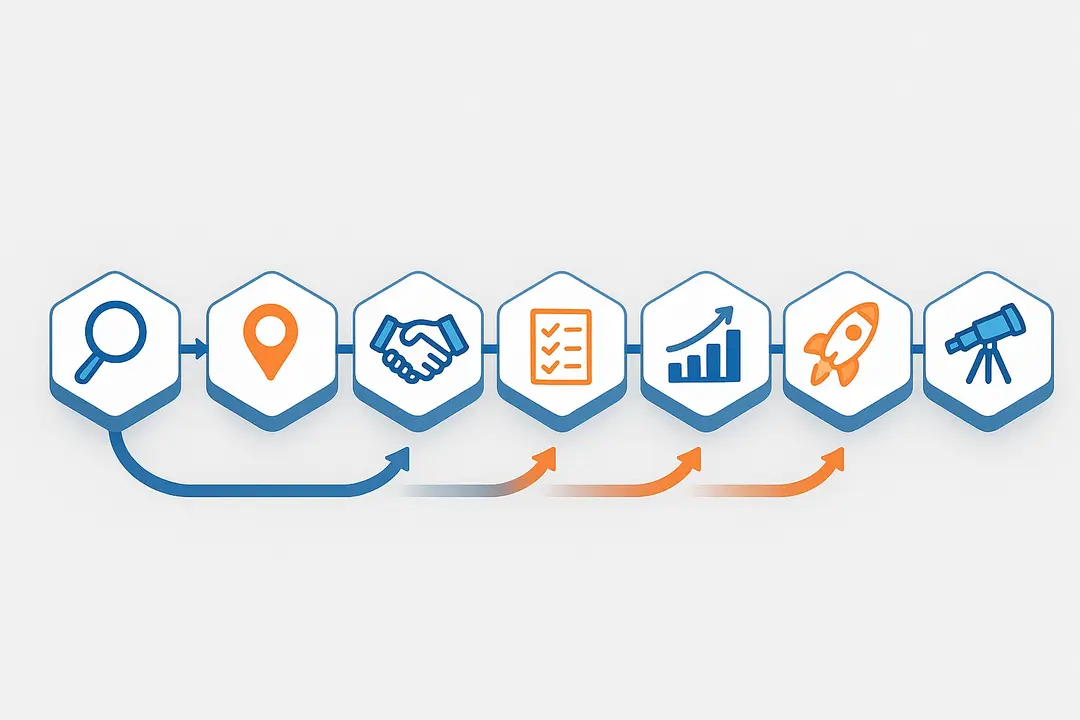
Implementing nearshoring requires a structured process: assess needs, evaluate locations, choose partners, and manage risk for a smoother transition.
Step-by-Step Nearshoring Framework:
- Define Operational Needs: Identify the processes or products best suited for nearshoring.
- Evaluate Locations: Consider proximity, labor skill, infrastructure, incentives, and time zone alignment.
- Select Partners: Assess suppliers or facility operators based on experience, capabilities, and track record.
- Conduct Legal & Compliance Checks: Understand local laws, trade agreements, and required certifications.
- Cost and Benefit Analysis: Map logistics, tax exposure, labor cost, and projected savings.
- Pilot and Scale: Start with a limited operation, monitor KPIs, and expand as stability grows.
- Monitor & Adapt: Continuously assess risks and adjust for policy, labor, or economic changes.
Tip: Use a detailed checklist to compare vendor bids and manage transition milestones. Downloadable templates are increasingly available from sourcing consultants and leading supply chain organizations.
How to Choose the Right Nearshoring Partner
Choosing a nearshoring partner requires assessing expertise, operational maturity, compliance, and cultural fit.
Key Evaluation Criteria:
- Industry Experience: Proven track record in your sector.
- Technical Capabilities: Current technology stack and process automation.
- Compliance & Certification: Alignment with legal, regulatory, and ESG standards.
- Stability & Scale: Financial health and ability to meet your growth needs.
- Cultural & Language Match: Shared work expectations and smooth communication.
Top Questions to Ask:
- What similar projects has your team delivered in the past two years?
- How do you ensure quality and regulatory compliance?
- Can you provide client references or industry certifications?
- What is your disaster recovery and supply chain continuity plan?
Sample Vendor Shortlist by Industry:
| Industry | Top Nearshore Regions |
| Manufacturing | Mexico, Poland, Turkey |
| IT & Software | Romania, Colombia, Mexico |
| BPO & Customer Service | Costa Rica, Colombia, Portugal |
Nearshoring in 2026: Trends, Policies, and the Impact of USMCA
Nearshoring is accelerating in 2024 due to trade policy changes, the “China Plus One” strategy, and new regional incentives like USMCA.
- Trade Flow Shifts: North American imports from Mexico reached record highs in 2023, as reported by Statista.
- USMCA Impact: The United States-Mexico-Canada Agreement (USMCA) has simplified trade in North America, making Mexico particularly attractive for US firms.
- “China Plus One”: Companies diversify away from China to reduce supply risk, often choosing Mexico or Eastern Europe as their “plus one.”
- EU/Eastern Europe: Poland and Romania emerge as top nearshore hubs for EU businesses, driven by skilled talent and favorable business environments.
Nearshoring Growth Timeline (2018–2024):
2018–2019: Early adoption as tariffs rise.
2020–2021: COVID-19 underscores need for resilient, regional supply.
2022–2023: USMCA comes into force; Europe faces energy and logistics shocks.
2024: Record investments in Mexico, Central & Eastern Europe; sector expansion beyond manufacturing.
Frequently Asked Questions: Nearshoring Examples, Risks, & Industry Guidance
What is an example of nearshoring in business?
An example of nearshoring is Whirlpool relocating part of its appliance manufacturing from Asia to Mexico. This nearshoring business example allowed the company to reduce shipping times, improve supply chain efficiency, and benefit from regional trade agreements when supplying the US market.
Which companies provide well known nearshore outsourcing examples?
Several global brands offer clear nearshore outsourcing examples. Companies such as Whirlpool, Boeing, Toyota, General Motors, and Volkswagen have moved portions of their manufacturing operations closer to their primary markets in North America. These cases are often cited as strong examples of nearshoring in modern supply chain strategy.
What is the difference between nearshoring and offshoring in global operations?
An example of nearshoring usually involves relocating operations to a nearby country that shares similar time zones or trade agreements. Offshoring, by contrast, typically moves work to distant regions primarily for lower labor costs. Many nearshore outsourcing examples demonstrate how proximity can improve logistics and communication compared to traditional offshoring.
Which industries show strong nearshoring business examples?
Industries such as manufacturing, software development, customer support services, and fashion retail frequently demonstrate strong nearshoring business examples. These sectors benefit from faster delivery cycles, regional supply chains, and easier collaboration when using nearshore partners.
What advantages can companies see from nearshore outsourcing examples?
Real nearshore outsourcing examples show several benefits including shorter supply chains, reduced transportation costs, faster product delivery, and stronger collaboration between teams. Studying an example of nearshoring can help businesses understand how regional outsourcing strategies improve operational efficiency.
Can the technology industry provide an example of nearshoring?
Yes, the technology sector offers many nearshore outsourcing examples. Many US and European companies move software development projects to nearby regions such as Latin America or Eastern Europe. This nearshoring business example allows teams to collaborate in similar time zones while accessing skilled engineering talent.
What risks should companies consider before following an example of nearshoring?
Although an example of nearshoring can highlight many advantages, companies should also consider potential risks such as limited labor availability in certain markets, regulatory complexity, or political and economic changes. Reviewing multiple nearshore outsourcing examples helps organizations understand how to manage these risks effectively.
What is a real world nearshoring business example in the fashion industry?
A well known nearshoring business example comes from Inditex, the parent company of Zara. The company produces much of its clothing in nearby countries such as Portugal and Turkey. This example of nearshoring allows Zara to respond quickly to changing fashion trends and maintain fast inventory turnover.
How do trade agreements influence nearshore outsourcing examples?
Trade agreements can significantly support nearshore outsourcing examples by lowering tariffs and simplifying cross border logistics. Agreements such as USMCA make countries like Mexico attractive locations for companies seeking a practical example of nearshoring within North America.
How can companies choose the right partner for nearshore outsourcing?
Organizations considering an example of nearshoring should evaluate potential partners based on technical expertise, regulatory compliance, communication practices, and industry experience. Reviewing successful nearshoring business examples and requesting references can help ensure a reliable partnership.
Why are more companies searching for an example of nearshoring today?
Businesses are increasingly interested in finding an example of nearshoring because global supply chains have become more complex and unpredictable. Studying real nearshore outsourcing examples helps decision makers understand how regional partnerships can improve resilience, efficiency, and long term growth.
Conclusion: Is Nearshoring Right for Your Business?
Nearshoring has become a practical strategy for companies aiming to improve efficiency, strengthen supply chain resilience, and respond more quickly to market changes. Real world examples across industries show that moving operations closer to key markets can help businesses reduce operational risks, improve collaboration, and maintain better control over production and service delivery.
Understanding an example of nearshoring helps organizations see how this approach can support long term growth and operational stability. By carefully evaluating business goals, supply chain needs, and regional opportunities, companies can determine whether nearshoring is the right strategy for improving performance and building a more adaptable global operation.
Key Takeaways
- Nearshoring moves business processes closer to home markets, reducing cost and response time.
- Real examples span manufacturing (Whirlpool, GM), IT (Microsoft, SAP), customer service (Amazon), and fashion (Inditex/Zara).
- Nearshoring is driven by trade policy (USMCA), supply chain resilience, and the “China Plus One” trend.
- Key benefits: speed, resilience, tariff advantage, ESG potential.
- Main challenges: variable talent pools, compliance needs, and political or economic instability.
This page was last edited on 22 March 2026, at 10:22 am
Contact Us Now

Contact Us Now
Start a conversation with our team to solve complex challenges and move forward with confidence.


