
Enterprise recommendation engine development plays a pivotal role in helping organizations dramatically increase ROI by delivering highly personalized experiences at scale. As enterprises navigate growing data volumes, stricter privacy regulations, and complex system integrations, investing in structured enterprise recommendation engine development has become essential for sustainable growth and competitive advantage.
This comprehensive guide presents a modern, step by step framework covering strategy, architecture design, model selection, deployment, and continuous optimization—tailored for both business leaders and technical teams.
An enterprise recommendation engine is a robust, scalable system built through enterprise recommendation engine development practices. It leverages machine learning and advanced analytics to deliver personalized product, content, or service recommendations across complex environments, supporting millions of users while ensuring compliance, security, and seamless integration with existing enterprise systems.
Enterprise Recommendation Engine Benefits:
- Drives revenue growth through personalized upsell/cross-sell
- Boosts user engagement and retention
- Integrates with existing enterprise platforms (ERP, CRM, CMS)
- Ensures data security and compliance at scale
By the end of this guide, readers will have a clear blueprint for developing, deploying, and optimizing enterprise recommendation engines—from core architectures and algorithms to operational best practices and future trends.
What Is an Enterprise Recommendation Engine?
An enterprise recommendation engine is an AI-powered platform designed to deliver individualized recommendations within large organizations, combining scalability, security, and advanced integration features.
Key Features of Enterprise Recommendation Engines:
- Scalability: Handles millions of users and vast item catalogs with low latency.
- Security & Compliance: Built to meet strict data privacy and regulatory demands (GDPR, HIPAA, etc.).
- Integration: Connects smoothly with core business systems (ERP, CRM, CMS).
- Explainability: Offers transparent, auditable results for business trust and compliance.
Enterprise vs. SMB Recommendation Engines
| Feature | Enterprise Solution | SMB Solution |
| User/item scale | Millions | Thousands or less |
| Compliance requirements | High (GDPR, HIPAA, SOC2, etc.) | Low |
| Integration complexity | Multi-system, real-time, batch integrations | Single system, basic export |
| Explainability | Required for audits | Not usually prioritized |
Mini-Glossary:
- User-Item Matrix: A grid representation of user preferences or interactions with items.
- Hybrid System: A recommender that blends multiple algorithms (e.g., collaborative and content-based).
- Semantic Recommendation Engine: Leverages knowledge graphs or ontologies to enhance recommendation relevance.
Why Do Enterprises Need Scalable Recommendation Engines?
Scalable enterprise recommendation engines enable organizations to provide personalized, context-aware experiences while meeting operational, compliance, and growth demands.
Top Reasons Enterprises Invest in Scalable Recommenders:
- Personalization at Scale: Tailors content or product suggestions in real time, boosting conversions.
- Enhanced Engagement: Increases customer retention and satisfaction.
- Cross-sell/Upsell: Surfaces relevant offers to maximize customer value.
- Operational Efficiency: Automates intelligent decision-making to support sales, marketing, or support teams.
Enterprise Challenges:
- Massive data volumes and high-throughput requirements
- Regulatory and privacy obligations
- Integration across multiple legacy and cloud systems
Industry Example:
In e-commerce, enterprise recommendation engines have driven repeat purchase rates up to 2–3x over generic suggestions, according to recent retail analytics studies.
What Are the Leading Approaches to Enterprise Recommendation Engine Development?
Enterprise recommendation engines can be developed using several core paradigms, each suited to different contexts and requirements.
Comparison of Leading Approaches:
| Approach | Pros | Cons | Best Fit For |
| Collaborative Filtering | Captures peer/user trends, adaptive | Needs large datasets, cold start issues | Retail, Media |
| Content-based Filtering | Leverages item/user metadata, easy to start | Less diversity, harder to discover unknown | Publishing, Cold Start |
| Semantic/Knowledge Graph | Rich contextual recommendations, explainable | Complex setup, higher compute | B2B/Enterprise, Regulated |
| Hybrid Systems | Combines strengths of multiple approaches | Increased complexity | E-commerce, Healthcare |
| Real-Time Recommendation | Instant, event-driven personalization | Engineering and latency challenges | Finance, Live Media, Support |
When to Use Real-Time vs. Batch:
- Real-time systems enable immediate, context-aware recommendations (e.g., next-click suggestions on e-commerce sites).
- Batch systems generate recommendations in scheduled intervals for periodic updates or reporting.
Which Algorithms Power Enterprise-Scale Recommendation Systems?
Enterprise-scale recommendation engines rely on both classic and emerging algorithms to ensure accuracy, scalability, and relevance.
- Collaborative Filtering
User–Item Matrix Factorization: Finds patterns of user-item interactions at scale (e.g., SVD, ALS algorithms). - Content-Based Filtering
TF-IDF, Embeddings: Analyzes item/user metadata to generate relevance scores. - Hybrid & Ensemble Methods
Blends collaborative and content-based approaches, often using ensemble models or weighted voting. - Deep Learning Approaches
Neural Networks, Autoencoders: Learn complex behavioral patterns for richer personalization. - Graph-Based & Semantic Methods
Knowledge Graphs, Graph Databases: Model relationships between entities for advanced, explainable recommendations. - Reinforcement Learning
Adapts recommendations dynamically through feedback loops and trial-and-error optimization.
Algorithm Selection Checklist:
- Do you have large and diverse user/item data?
- Is explainability/auditability a legal requirement?
- Need real-time or batch recommendations?
- Must handle cold start scenarios?
- Any industry-specific compliance needs?
What Is the Step-by-Step Process for Building an Enterprise Recommendation Engine?
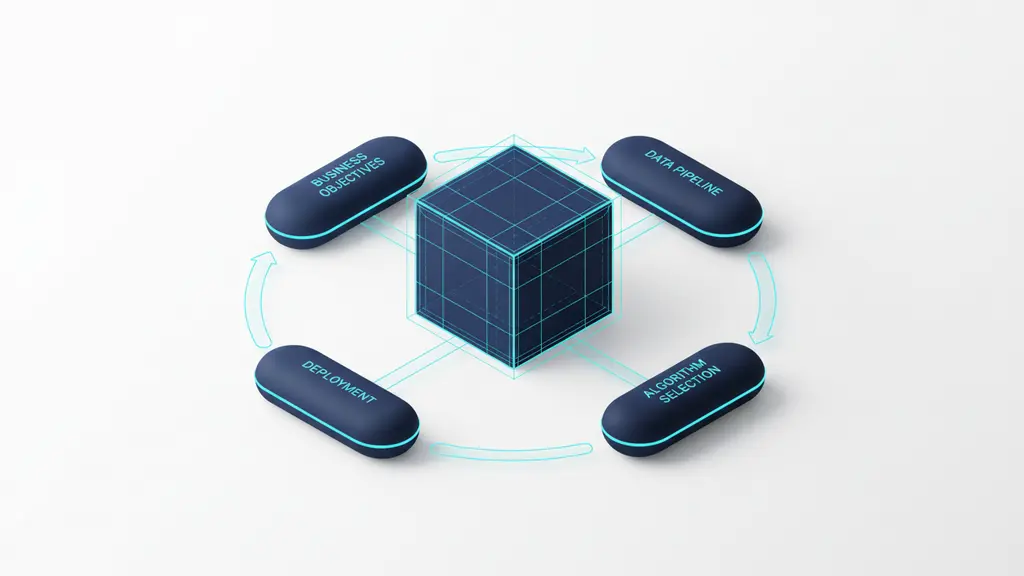
Building an enterprise recommendation engine follows a practical, iterative process that emphasizes clarity, scalability, and operational readiness.
Step-by-Step Framework:
- Define Use Case & Business Objectives
– Identify primary purpose (e.g., product suggestion, content personalization).
– Set measurable KPIs (conversion rates, engagement, ROI). - Design Data Model and Pipeline
– Draft the user-item matrix, capture interaction events.
– Ensure data governance (privacy/compliance), real-time/batch ingestion, and cleaning. - Select/Build Recommendation Algorithms
– Choose algorithms based on data diversity, latency, explainability, and integration needs.
– Prototype candidate models on representative data. - Architect for Scalability and Integration
– Design for load handling, redundancy, and horizontal scaling.
– Ensure modularity for plug-and-play with CRM, ERP, and CMS systems. - Implement, Test, and Validate
– Deploy the system in a sandbox or staging environment.
– Use offline metrics (precision, recall, NDCG) and live A/B testing for evaluation. - Launch with MLOps, Monitoring, and Retraining
– Set up CI/CD pipelines for continuous deployment.
– Monitor performance, detect drift, schedule retraining.
How Do You Architect for Real-Time, Scalable Enterprise Recommendations?
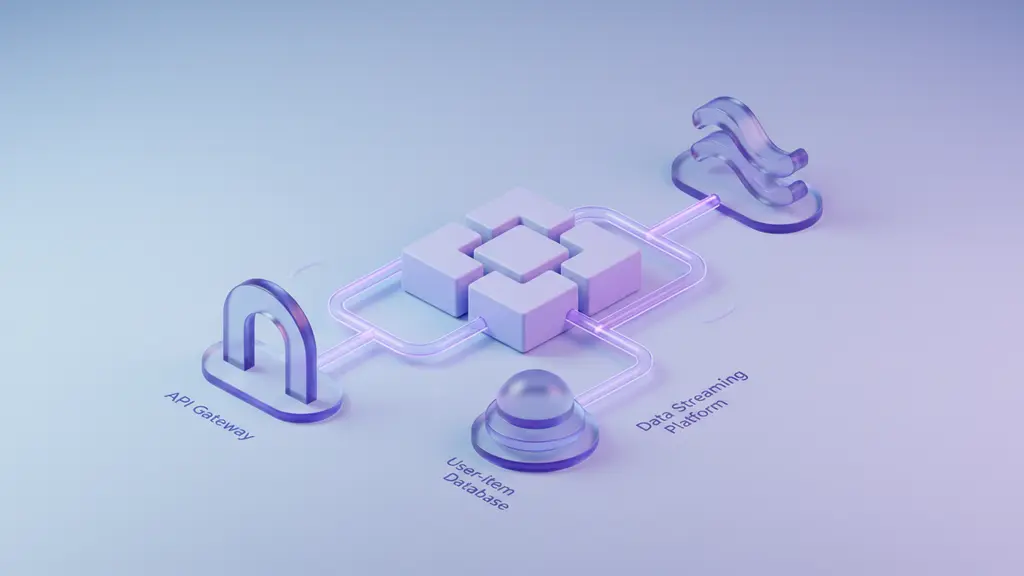
Achieving real-time, scalable recommendations in the enterprise requires thoughtful architectural design that balances speed, reliability, and flexibility.
Core Architectural Patterns:
- Microservices vs. Monolithic: Microservices allow independent scaling, frequent deployments, and fault isolation, which is favored for modern recommenders.
- Real-Time vs. Batch: Real-time architectures leverage streaming platforms (Apache Kafka, AWS Kinesis) for low-latency updates, while batch systems focus on periodic refreshes.
- Data Ingestion and User Signals: Use streaming or scheduled ETL pipelines to process behavioral data (clicks, purchases, ratings).
- Tech Stack Patterns: Cloud-native (AWS, Azure, GCP), serverless approaches (AWS Lambda, Google Cloud Functions), or hybrid/on-premise models meet diverse regulatory and scalability requirements.
Architecture Blueprint Example:
(User/API Request) --> [API Gateway] --> [Recommendation Microservice] <--> [Model Store]
                                       |                                |--> [User-Item Database]
                                       |                                |--> [Streaming Data Platform]
                                       |                                |--> [Monitoring Stack]
How to Integrate Recommendation Engines Into Enterprise Systems (ERP, CRM, CMS, etc.)
Integrating recommendation engines into complex enterprise environments is essential for maximizing business value and operational efficiency.
Typical Integration Points:
- ERP Systems: Personalize purchase recommendations, automate reorder alerts.
- CRM Platforms: Drive targeted email campaigns or sales follow-ups.
- CMS/E-commerce Engines: Deliver real-time content or product suggestions.
Common Data Exchange Methods:
- REST APIs
- GraphQL
- Streaming (Kafka, AWS Kinesis, Webhooks)
Integration Checklist:
- Map key data flows and events (user/actions, inventory, content metadata).
- Establish secure, authenticated APIs for data transfer.
- Plan for privacy, consent, and synchronization between platforms.
Case Example:
An e-commerce retailer integrated its recommendation engine with ERP and CMS platforms, resulting in faster inventory turnover and 20% higher average order values, as reported in industry case studies.
Monitoring, MLOps, and Continuous Improvement for Enterprise Recommenders
Ongoing monitoring and strong MLOps practices are critical for sustaining high-quality, reliable enterprise recommendation engines.
Best Practices:
- Continuous Integration/Deployment (CI/CD):
Automate QA, testing, and deployment using pipelines (Jenkins, Azure DevOps, GitHub Actions). - Model Monitoring and Performance:
Track prediction accuracy, user engagement, latency, and system errors.
Set up alerting for drift, data quality, and infrastructure issues. - Retraining Pipelines:
Run scheduled or triggered retraining to counteract data drift and cold start problems. - Tooling and Frameworks:
Leading options include Kubeflow (Kubernetes-based), MLflow (open source), and AWS SageMaker (managed cloud).
Launch Monitoring Checklist:
- Define key success metrics.
- Set thresholds and automatic alerts.
- Test failover and rollback capabilities.
- Document retraining and incident resolution workflows.
How to Address Privacy, Security, and Regulatory Compliance in Recommendation Engines

Ensuring privacy, security, and regulatory compliance is non-negotiable for enterprise recommendation systems, especially in regulated industries.
Core Requirements:
- Data Privacy: Adhere to standards like GDPR (Europe), HIPAA (US healthcare), and SOC2 (security control).
- Secure Design Controls: Use access management, encryption, and detailed audit logging.
- Explainable AI and Auditability: Generate human-understandable explanations and maintain traceable recommendation histories for audits.
- Privacy-Preserving & Federated Learning: Explore techniques that minimize data exposure (federated learning, differential privacy) to reduce compliance risk.
Example:
A healthcare provider deployed an explainable recommendation engine with federated learning to comply with HIPAA, allowing personalized patient content while keeping sensitive data on-premises.
Privacy & Compliance Checklist:
- Identify applicable laws for regions and industry.
- Map all data flows and storage locations.
- Audit explanation and override mechanisms.
- Document incident/breach response plans.
Enterprise Use Cases & Mini-Case Studies: Sector-by-Sector Insights
Enterprise recommendation engines drive measurable business impact across major industries.
Sector Use Cases:
- E-commerce:
Dynamic cross-sell and upsell, omni-channel personalization, and real-time integration with ERP for stock and logistics.
Result: Brands have reported up to 35% of sales generated via personalized recommendations (source: McKinsey, 2023). - Finance:
Risk and fraud detection, regulatory-suitable explainable recommendations for lending and investment.
Result: Financial institutions use recommendations to increase cross-product adoption while staying within compliance guidelines. - Healthcare:
Personalized patient content, medication/treatment suggestions, privacy-first architectures meeting HIPAA.
Result: Patient engagement platforms have documented improved adherence rates and reduced admin burden. - Media/Publishing:
Customized content curation pipelines, next-article or video suggestions to boost retention.
Mini-Case Study Infobox
| Industry | Use Case | Highlighted Result |
| E-commerce | ERP-integrated recommenders | +20% average order value |
| Finance | Explainable AI compliance | Faster audit approvals |
| Healthcare | Federated learning | Improved patient engagement |
How to Choose the Right Tools, Frameworks, and Partners for Enterprise Recommendation Engine Projects
Selecting the right technologies and partners is crucial for lasting success in enterprise recommendation engine development.
Open Source vs. Commercial Solutions:
| Choice | Pros | Cons |
| Open Source | No license fees, full control | Requires integration & support |
| Commercial | Fast implementation, vendor support | Higher cost, lock-in risk |
Deployment Models:
- Cloud-Native: Scalable, faster deployment (AWS, GCP, Azure)
- On-Premises: Complete data control for sensitive industries
- Hybrid: Combines scale with compliance benefits
Key Selection Criteria:
- Existing infrastructure and integration capabilities
- Scalability and performance benchmarks
- Model explainability and compliance features
- Vendor roadmap and support track record
Sample RFP Questions:
- How does your platform handle regulatory compliance?
- What support exists for real-time and batch architectures?
- How easily can your system integrate with our ERP/CRM/CMS stack?
- What monitoring, MLOps, and rollback tools are provided?
Frequently Asked Questions About Enterprise Recommendation Engines
What is an enterprise recommendation engine?
An enterprise recommendation engine is a scalable, AI-driven system that delivers personalized suggestions for products, content, or actions within large organizations, supporting advanced integration, security, and compliance requirements.
How does enterprise recommendation engine development differ from standard recommenders?
Enterprise recommendation engine development focuses on large-scale deployment, stringent data privacy and compliance, integration with complex systems, and the ability to serve diverse business units and stakeholders.
What are the most effective algorithms for enterprise-scale recommendation engines?
The most effective algorithms include collaborative filtering (e.g., matrix factorization), content-based filtering, hybrid models, deep learning methods, and, increasingly, graph-based and reinforcement learning approaches—selected based on specific business needs and data realities.
How can organizations integrate a recommendation engine into existing enterprise systems?
Organizations typically use APIs (REST, GraphQL), streaming data platforms, and secure authentication to connect recommendation engines with core systems like ERP, CRM, and CMS, with careful attention to data privacy and synchronization.
What are the key steps in building an enterprise recommendation engine?
The main steps are: defining business objectives, designing the data pipeline, selecting/building algorithms, architecting for scalability/integration, implementing and testing, and enabling ongoing monitoring and retraining (MLOps).
What are the common challenges in scaling and deploying enterprise recommendation systems?
Key challenges include managing massive data volumes, ensuring real-time performance, handling compliance requirements, overcoming the cold start problem, and integrating with diverse, legacy business platforms.
How do real-time and batch recommendation engines differ in their architecture?
Real-time systems are designed for immediate, user-triggered recommendations using streaming data and APIs, while batch systems generate periodic suggestions, often for offline or scheduled campaigns.
What trends will impact enterprise recommendation engines in 2025?
Major trends include broader adoption of explainable AI, privacy-centric architectures (like federated learning), reinforcement learning for dynamic personalization, and increased edge computing for low-latency delivery.
How can recommendation engines ensure privacy and regulatory compliance?
By following data protection laws (GDPR, HIPAA), using secure access controls, deploying explainable AI models, maintaining audit trails, and exploring privacy-preserving techniques like federated learning.
What is the typical cost and timeline for enterprise recommendation engine development?
Costs and timelines vary widely based on scope, team expertise, data requirements, and integration complexity, but most enterprise projects span several months and require investment in both infrastructure and skilled personnel.
Conclusion
Enterprise recommendation engine development is no longer a competitive advantage reserved for digital giants; it is becoming a foundational capability for organizations seeking sustainable growth in data-driven markets. As personalization expectations rise and regulatory scrutiny intensifies, enterprises must move beyond basic recommendation models toward scalable, secure, and explainable systems.
Successful enterprise recommendation engine development requires more than selecting the right algorithm. It demands clear business alignment, robust data engineering, scalable architecture, responsible AI governance, and continuous optimization through MLOps practices. When implemented strategically, recommendation engines improve customer engagement, increase conversion rates, strengthen retention, and unlock measurable ROI across channels.
The enterprises that lead in the coming years will be those that treat recommendation systems not as isolated features, but as core infrastructure embedded across products, platforms, and decision workflows. By combining technical excellence with governance and long term scalability planning, organizations can build recommendation engines that are intelligent, compliant, and built to evolve with changing market demands.
Key Takeaways
- Enterprise recommendation engines deliver personalized, data-driven value at massive scale—with strict compliance and integration needs.
- Success depends on a robust stepwise framework (from business alignment to MLOps) and the right blend of tools and algorithms.
- Real-time and privacy-centric architectures are now essential factors.
- Industry-proven frameworks and checklists accelerate development, reduce risk, and maximize ROI.
This page was last edited on 18 February 2026, at 10:41 am
Contact Us Now

Contact Us Now
Start a conversation with our team to solve complex challenges and move forward with confidence.


