
Understanding the cost of real estate app development like Property Finder is a critical first step for anyone planning to launch a competitive digital property platform. Building a real estate app as robust as Property Finder can make or break a property tech venture, particularly in fast-moving markets such as the UAE and other global real estate hubs.
Vague cost estimates and unrealistic budgeting often lead to project delays, scope creep, or unexpected financial strain. That’s why having a structured, data-driven view of development expenses is essential for founders, investors, and digital transformation leaders.
This guide removes the uncertainty from your planning process. You’ll discover realistic cost ranges, feature-based pricing tradeoffs, regional development benchmarks across the UAE, US, EU, and Asia, and practical budgeting strategies. By the end, you’ll have a clear framework to estimate the investment required, compare development options strategically, and confidently plan your next move in the real estate app market.
What Is the Cost of Real Estate App Development Like Property Finder?
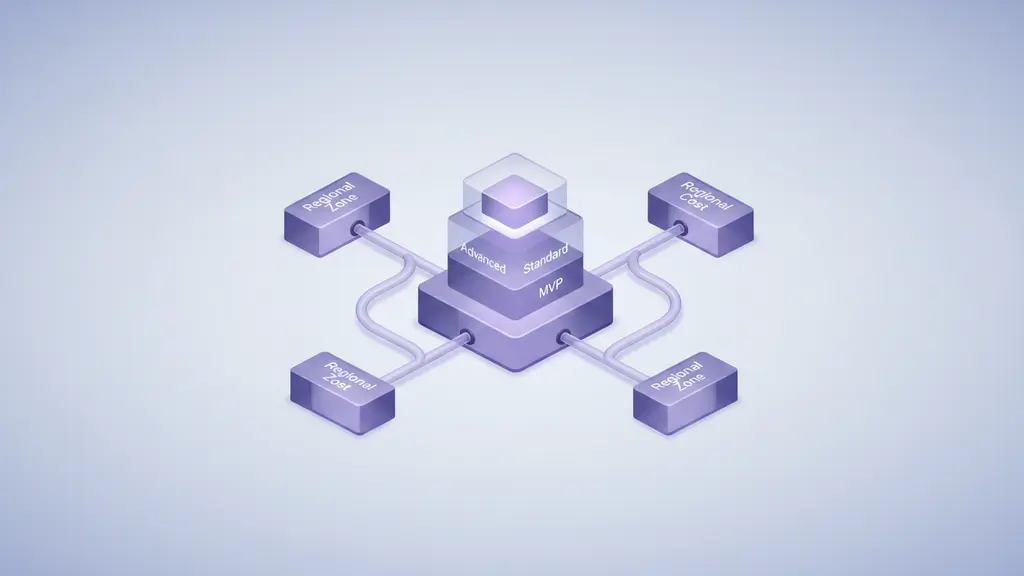
The cost to develop a real estate app like Property Finder in 2024 typically ranges from $40,000 for a basic MVP to over $300,000 for a full-featured, market-leading platform. Factors such as feature complexity, region, and development approach all play crucial roles.
At a Glance: Cost Breakdown Table
| App Complexity | UAE Estimate | US Estimate | EU Estimate | India/Asia Estimate |
| Simple MVP | $40,000–$80,000 | $60,000–$110,000 | $55,000–$95,000 | $40,000–$65,000 |
| Standard App | $90,000–$180,000 | $120,000–$200,000 | $100,000–$170,000 | $60,000–$110,000 |
| Advanced Build | $200,000–$300,000+ | $250,000–$350,000 | $220,000–$300,000 | $120,000–$180,000 |
Scenario-Based Cost Modeling
- MVP (Minimum Viable Product): $40,000–$80,000 (core listings, search, basic map, user accounts)
- Full-featured App: $120,000–$300,000+ (virtual tours, chat, analytics, advanced filtering, dashboards)
- Top-tier/Enterprise: Upwards of $300,000, especially with cutting-edge features (AI/ML, AR, multi-region support)
Tip: The developer’s region, tech stack, and feature set are the three primary levers affecting your total investment.
Which Features Impact Your Real Estate App Development Cost the Most?

The largest cost drivers in real estate app development are your feature choices—some are essentials, while others dramatically increase both upfront and long-term spend.
Feature Cost Impact Table
| Feature | MVP (Essential) | Advanced (Adds Cost) |
| Property Listings | ✔ | |
| Search & Filter | ✔ | Advanced filtering, AI |
| Map Integration | ✔ | Custom, 3D, heatmaps |
| User Accounts/Profiles | ✔ | Social login, SSO |
| Virtual Tours | 360° and AR | |
| Chat/Messaging | AI chatbot | |
| Analytics Dashboards | Real-time, advanced | |
| Push Notifications | ✔ | Personalized alerts |
| Reviews & Ratings | ||
| Payment Integration | Wallets, Stripe, PayPal | |
| Admin Panel | Basic | Advanced reporting |
Prioritizing Features: MVP vs. Full Build
- MVP: Focus on basics—property listing, user signup, search, map view.
- Growth/Full Build: Layer in virtual tours, real-time chat, messaging, analytics, personalization, and monetization modules.
- High-End: AI-driven property matching, AR/VR experiences, CRM integrations, custom dashboards.
Insight: Each major feature step—especially virtual tours and AI-driven search—can add $10,000–$50,000+ to the total cost, dependent on depth and third-party integration complexity.
What Major Factors Influence the Total App Development Cost?
Real estate app development cost is shaped by multiple technical and operational factors, not just feature count.
Core Cost Drivers:
- UI/UX Design: Investing in a premium, user-centric design can increase costs 15–25% but often drives higher engagement.
- Platforms: Building for iOS, Android, or both (cross-platform) affects both price and timeline.
- Tech Stack Selection: Native apps (Swift/Kotlin) are more expensive than hybrid (Flutter, React Native) or low-code options, but offer better performance.
- Development Team Region: Hourly rates vary globally (see regional section), impacting total build costs.
- Regulatory Compliance: Markets like the UAE have strict data protection laws—compliance can increase project costs 10–15%.
- Third-Party Integrations: Map APIs, chat, payments, and analytics all add licensing fees and development overhead.
Example: Including a live chat feature using a third-party provider often involves both upfront integration costs and ongoing subscription fees.
How Does Real Estate App Development Cost Vary by Region & Platform?
Developer Hourly Rate Comparison (2024)
| Region | Avg. Hourly Rate (USD) |
| UAE | $45–$80 |
| US | $80–$150 |
| Western Europe | $65–$120 |
| Eastern Europe | $35–$65 |
| India/Asia | $20–$45 |
Regional Case Study: Full-Featured Property Finder Clone
| Region | Est. Total Cost | Timeframe |
| UAE | $200,000–$300,000 | 7–9 months |
| US | $250,000–$350,000 | 7–9 months |
| Europe (avg) | $220,000–$300,000 | 7–9 months |
| India/Asia | $120,000–$180,000 | 7–9 months |
Platform Impact
- Native (iOS + Android): Higher development cost, top-tier UX, recommended for large user bases.
- Cross-Platform (Flutter, React Native): Cost savings of 20–30%, faster go-to-market, best for MVPs or multi-platform parity.
Benchmark: Property Finder’s market rivals like Zillow (US) and Bayut (UAE) exhibit similar advanced features and comparable development footprints.
What Is the Typical Real Estate App Development Timeline?

A real estate app like Property Finder usually takes between 4 and 9 months to develop, with timelines directly proportional to app complexity and feature set.
Development Timeline Table
| App Type | Timeline (Months) |
| Simple MVP | 3–4 |
| Standard Build | 5–7 |
| Advanced/Custom | 7–9+ |
Phase-Based Timeline (Typical)
- Discovery & Planning: 2–4 weeks
- UI/UX Design & Prototyping: 4–6 weeks
- Development & Testing: 10–20 weeks
- Deployment & Launch: 2–4 weeks
- Post-Launch Support: Ongoing
Note: Change requests or adding advanced features mid-project are leading causes of timeline (and budget) escalation.
What Are the Step-by-Step Stages in Developing a Property Finder-Style App?
Developing a real estate app follows a systematic process to reduce risk and maximize ROI.
Step-by-Step App Development Process:
- Discovery & Requirements Gathering
Stakeholder interviews, market analysis, feature list creation - UI/UX Design & Prototyping
Wireframes, user journey mapping, clickable prototypes - Development & Testing
Backend (server, database), frontend (mobile/web), quality assurance - Launch & Deployment
App store submission, cloud deployment, final bug fixes - Ongoing Maintenance & Upgrades
Feature updates, bug fixes, compliance patches
Best Practice: Tackling clear milestones and keeping stakeholders involved at each step is essential to prevent major delays or budget surprises.
How Can You Monetize a Real Estate App—and What’s the ROI?
Real estate apps can generate sustainable revenue through multiple monetization models, which also influence the overall cost of ownership and long-term ROI.
Top Monetization Models Table
| Model | Description | Example in Market |
| Featured Listings | Agents/owners pay to highlight properties | Property Finder, Bayut |
| Subscriptions | Tiered user or agency accounts | Zillow’s “Premier Agent” |
| In-App Advertising | Display ads for relevant services | Trulia |
| Freemium Model | Free basic use, paid advanced features | Redfin, Realtor.com |
| Transaction Fees | Commission per sale/rental via app | Some US/EU platforms |
Estimating ROI
- Revenue vs TCO: Compare projected annual revenue (from above streams) to total cost of ownership (including build + annual maintenance, typically 15–20% of build cost per year).
- Break-Even: Many apps target break-even within 18–36 months depending on scale and adoption.
Case Example: Property Finder generates significant revenue via both premium listings and value-added subscription services in the UAE, making it a sustainable model for replication.
How Can You Reduce Real Estate App Development Costs Without Compromising Value?
Strategic planning, technology choice, and team selection can help you manage costs—without undercutting app quality or business potential.
Proven Cost-Reduction Tactics:
- Launch with an MVP: Prioritize must-have features first, postpone advanced add-ons.
- Strategic Outsourcing: Collaborate with reliable offshore or nearshore teams to access lower hourly rates.
- Low-Code/No-Code: Consider platforms like Bubble or OutSystems for simple apps or internal tools—only where high scalability or custom UX is not critical.
- Feature Roadmap Planning: Map features over a phased approach (v1, v2, v3), aligning spend with validated business needs.
- Team Augmentation: Use expert freelancers for niche features (e.g., AI module, AR).
Example Scenario:
A UAE startup launched an MVP with listings, search, and basic chat (cost: ~$70,000), then reinvested early revenues into virtual tours and premium analytics in year two.
Warning: Cutting corners on compliance, UX, or backend scalability often leads to higher costs later.
What Common Pitfalls and Hidden Costs Should You Watch Out For?
Many real estate app projects encounter hidden costs or avoidable mistakes—learning these before you build is vital.
Common Red Flags Checklist:
- Post-Launch Maintenance Underestimated: Annual maintenance typically costs 15–20% of initial build price.
- Scope Creep: Adding features mid-project rapidly inflates costs and timelines.
- Integration Surprises: Third-party services (maps, payments) may have usage-based fees not budgeted initially.
- Compliance Costs: Local data regulations (e.g., UAE privacy laws) require early planning and specialized expertise.
- Technical Debt: Quick/cheap builds without code best practices can result in future rework, higher bug rates, and poor scalability.
Recommendation: Invest upfront in a detailed requirements phase and clarify total cost of ownership at project kickoff.
FAQ – Real Estate App Development Cost & Planning
How much does it cost to develop a real estate app like Property Finder?
The cost to develop a real estate app like Property Finder typically ranges from $40,000–$80,000 for an MVP and $120,000–$300,000+ for a full-featured platform. The final real estate app development cost depends on features, development region, integrations, and scalability requirements.
What key features should be included in a Property Finder-type app?
When calculating the cost of real estate app development like property finder, essential features include property listings, advanced search filters, map integration, user accounts, and push notifications. Advanced versions add virtual tours, AI-based property recommendations, analytics dashboards, and real-time chat.
What factors most influence real estate app development cost?
The overall real estate app development cost is driven by feature complexity, UI/UX sophistication, target platforms (iOS, Android, or both), compliance requirements, backend architecture, and third-party integrations such as payment or CRM systems.
How does app complexity affect total price and delivery time?
As complexity increases, so does the cost to develop a real estate app like Property Finder. Features such as AR/VR tours, predictive analytics, and multi-country support require specialized development, increasing both timelines and total investment.
What’s the typical development timeline for a real estate marketplace app?
The timeline associated with the cost of real estate app development like property finder ranges from 3–4 months for an MVP to 7–9+ months for a fully scalable, production-ready solution.
How do regional hourly rates impact the total budget?
A major component of real estate app development cost is team location. US and Western European developers may charge 2–4 times more than teams in Asia or Eastern Europe, significantly affecting total project expenses.
What are the ongoing maintenance costs after launch?
Beyond the initial cost to develop a real estate app like Property Finder, businesses should allocate 15–20% of the original build cost annually for maintenance, performance updates, security patches, and compliance changes.
How can I reduce development cost without sacrificing quality?
To optimize the real estate app development cost, begin with a focused MVP, use cross-platform frameworks, phase feature releases strategically, and clearly define scope before development begins.
Which tech stack is best for real estate marketplace apps?
The technology stack directly impacts the cost of real estate app development like property finder. Native stacks (Swift, Kotlin) deliver premium performance, while cross-platform frameworks (Flutter, React Native) can reduce early-stage development costs.
What monetization strategies work best for real estate apps?
Revenue models that help justify the cost to develop a real estate app like Property Finder include featured listings, subscription plans, transaction commissions, advertising placements, and hybrid monetization strategies.
Conclusion and Next Steps: Launching Your Real Estate App
Understanding the cost of real estate app development like Property Finder requires more than a rough estimate. It demands careful evaluation of feature scope, technology choices, development region, scalability goals, and long-term maintenance planning. Clear budgeting and phased execution can significantly reduce risk while improving your return on investment.
By applying a structured, scenario-based approach to cost planning, you can align your technical vision with financial reality. Whether you start with a lean MVP or a fully featured marketplace platform, thoughtful prioritization and the right development strategy will position your app for sustainable growth.
With the proper planning and execution, your real estate platform can compete effectively in today’s digital property market while remaining scalable, compliant, and future ready.
Key Takeaways – Real Estate App Development Cost at a Glance
- App development cost ranges from $40,000 (basic MVP) to $300,000+ (advanced/enterprise) depending on features and region.
- Features like virtual tours, AI, and advanced analytics are the largest cost drivers.
- Development region and team rates can shift your budget by 2–4x—benchmark options globally.
- Typical timelines: 3–4 months (MVP) up to 9+ months for complex builds.
- Ongoing maintenance and careful roadmap planning are essential to avoid hidden costs and technical debt.
This page was last edited on 26 February 2026, at 10:11 am
Contact Us Now

Contact Us Now
Start a conversation with our team to solve complex challenges and move forward with confidence.


