CNRS Graphoskop

A robust, scalable browser-based web application transforming a legacy Java desktop plugin into a modern scientific tool. Integrated seamlessly with the ARCA MSS visualization platform to empower research teams with high-precision manuscript analysis, large-scale image processing, and advanced statistical exports directly in-browser.

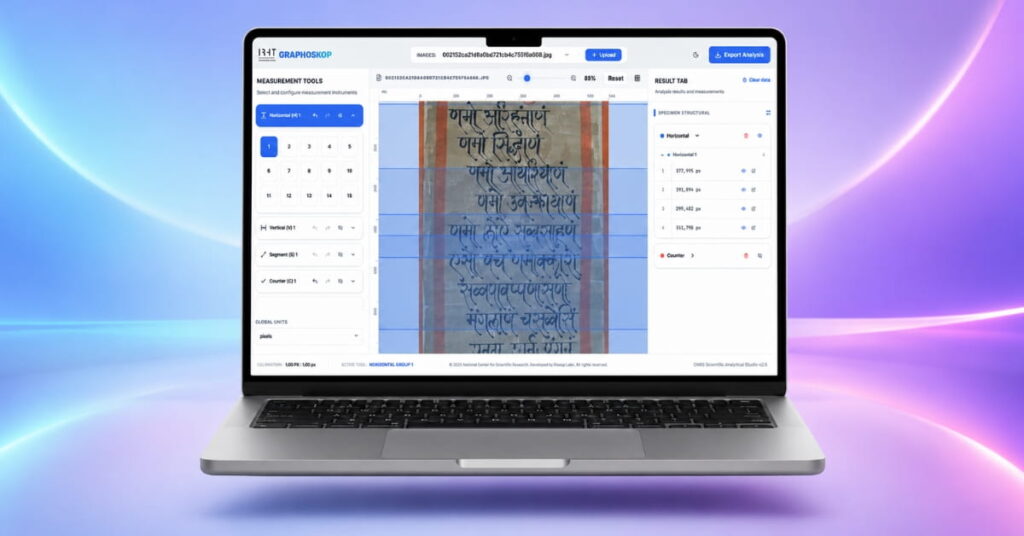
CNRS Graphoskop Web Application Banner

Project Summary

IRHT, a premier French research institute under CNRS, needed to free its manuscript analysis workflows from a legacy desktop dependency. Their researchers relied on Graphoskop, a specialized Java ImageJ plugin to perform high-precision paleographic measurements on historical manuscripts. We undertook a full migration of the Java-based desktop plugin into a modern browser-based web application, integrating it into IRHT’s existing ARCA MSS manuscript visualization platform and deployed securely on CNRS infrastructure.

Client

IRHT – Institut de recherche et d’histoire des textes

Industry

Scientific Research

Project Type

Enterprise Web Application Development

Scope

Legacy Plugin Transformation

Key Website Features & Capabilities

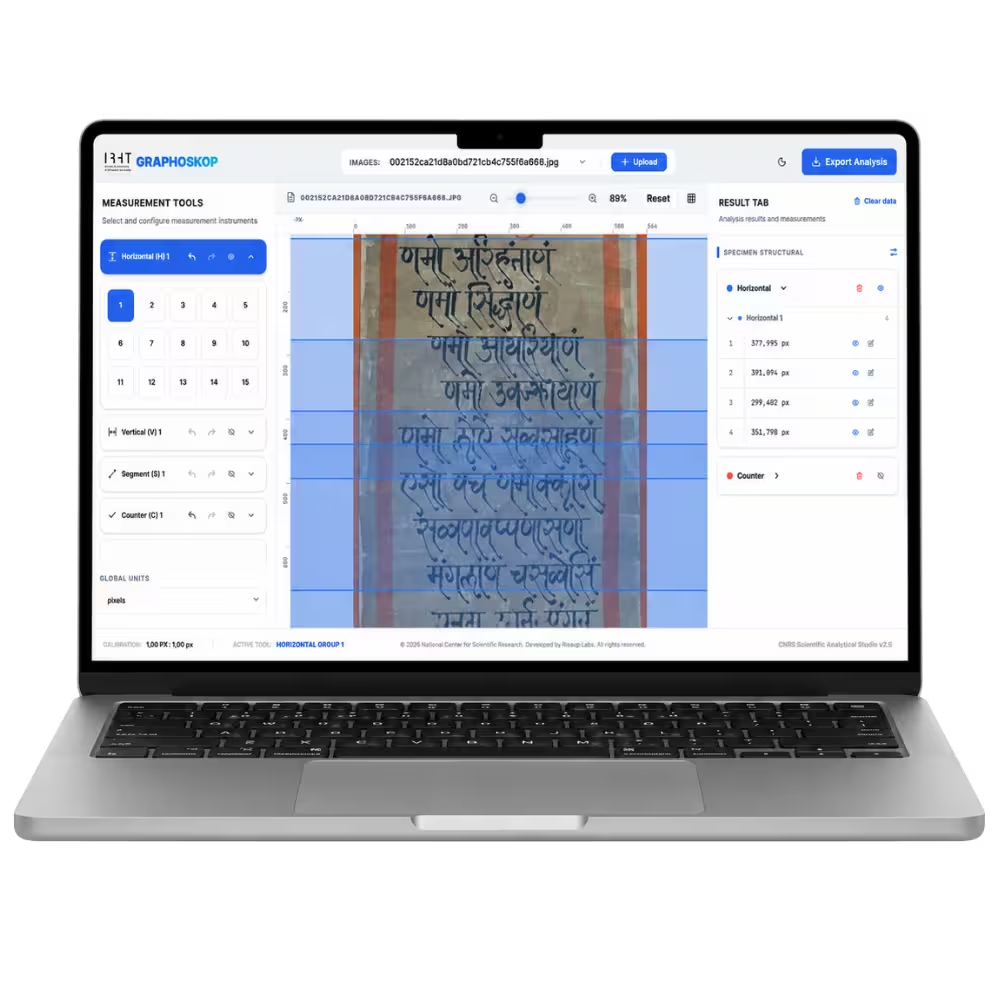
We engineered a custom web interface that bridges the gap between complex digital humanities research and a user-friendly browser experience. The platform equips researchers with specialized tools for in-depth manuscript and historical text analysis.

Image Upload & Batch Processing

The application supports multiple image formats including TIFF, JPG, PNG, and BMP, making it compatible with the wide variety of file types used in manuscript research. It can handle up to 200 images in a single research session, with optimized memory management ensuring stable performance even across large-scale datasets.

Linear Measurement Tools

Researchers can precisely measure interline spacing and detect upper and lower stroke heights directly on manuscript images. The tool also supports word spacing and character body ("eye of writing") analysis, alongside comprehensive margin detection covering top, bottom, inner, and outer margins, as well as inter-column spacing for multi-column layouts.

Angle & Curvature Measurement

The application accurately detects writing angles and stroke inclinations, with separate analysis available for both upper and lower strokes. Trigonometric-based curvature computation allows researchers to quantify subtle variations in script geometry that would be difficult to measure manually.

Surface & Density Analysis

Users can detect and measure the active writing surface area within a manuscript image, alongside black pixel percentage analysis to quantify ink density across a page. Region-based rectangular selection enables targeted analysis of specific areas rather than requiring whole-image processing.

Interactive Visualization System

A Canvas-based rendering engine delivers high-performance display of manuscript images directly in the browser, without any plugin or desktop dependency. Measurement results are visualized through color-coded overlays, and all measurement lines are interactive and draggable, with zoom support for high-precision placement.

Calibration System

The built-in calibration system converts pixel-based measurements into real-world units, supporting centimeters, millimeters, and custom units defined by the researcher. Image normalization is also available to ensure consistent, comparable measurements across different scans and image sources.

Statistical Engine & Export

All measurement data is automatically processed to compute mean, standard deviation, and mode, giving researchers instant statistical insight without manual calculation. Cross-image comparative analysis is supported alongside structured data export to Excel (OpenOffice-compatible) and CSV formats, with results organized into both per-image and aggregated global datasets.

Security & Architecture

The application is deployed exclusively within CNRS's internal infrastructure, keeping sensitive research data fully contained within the institution's environment. Computationally intensive and sensitive processing logic runs server-side, and the architecture is built with role-based access controls ready to be activated for future needs. The entire system is packaged using a Dockerized multi-stage build pipeline, ensuring consistent and reproducible deployments.

Technologies Used

We leveraged the latest high-performance frontend frameworks and robust deployment pipelines to build this complex academic application.

React+ TypeScript

Powers the highly interactive, type-safe, and dynamic user interface.

Tailwind CSS & shadcn/ui

Ensures a clean, modern, and highly accessible user experience through utility-first styling and Radix-based components.

HTML Canvas API

Drives the core rendering engine for ultra-fast image loading and dynamic measurement overlays.

Vite

Lightning-fast frontend build tool ensuring rapid deployment and optimal performance.

Docker

Utilized multi-stage builds to create a fully containerized, secure deployment pipeline.

Nginx

Serves as the optimized production server layer for fast routing and high availability.

Have a Complex Legacy System That Needs Modernization?

Let’s discuss how we can transform your desktop-bound software or legacy tools into highly scalable, modern web applications.

Related Insights

CNRS Graphoskop Web Transformation – Case Study

Transforming a fragmented, legacy desktop plugin into a modern, highly scalable academic research platform capable of processing hundreds of manuscript...
TO TOP