
AI performance metrics for business leaders are no longer a technical afterthought; they are a strategic imperative. As AI budgets expand and expectations rise, boards and executive teams are demanding clear proof that artificial intelligence initiatives are generating measurable business outcomes, not just experimental momentum.
Despite significant investment, many organizations struggle to translate model accuracy, automation rates, or system uptime into revenue growth, margin improvement, or risk reduction. Reporting often remains fragmented between technical teams and executive stakeholders, creating visibility gaps that weaken decision-making and dilute accountability.
This executive playbook provides a structured, leadership-focused framework for defining, measuring, and communicating AI performance in terms that matter to the C-suite. By aligning metrics with strategic objectives, financial impact, and operational efficiency, you will gain the clarity needed to turn AI from a cost center into a measurable driver of enterprise value.
Summary Table: Executive AI Metrics Quick Reference
| Metric | Definition | Executive Impact | Recommended Frequency |
|---|---|---|---|
| Revenue Growth from AI | Sales uplift tied to AI efforts | Core ROI metric | Quarterly |
| Cost Reduction with AI | Operational costs reduced by AI | Margin and efficiency gain | Quarterly |
| AI Adoption Rate | % of users actively using AI | Change management, utilization | Monthly/Quarterly |
| Productivity Improvement | Work/time saved per employee after AI adoption | Workforce performance | Quarterly |
| eNPS Post-AI | Employee satisfaction linked to AI implementations | Culture and retention | Biannually |
| Customer Satisfaction Index | Customer approval rating after AI deployment | Client loyalty/impact | Quarterly |
| System Uptime | AI system availability percentage | Operational risk/trust | Monthly |
| AI Error Rate | Frequency of AI output errors | Quality, risk management | Monthly |
What Are AI Performance Metrics for Business Leaders?

AI performance metrics for business leaders are executive-focused KPIs that quantify the results, adoption, and impact of AI initiatives—translating technical activity into actionable business value.
While technical teams may track model accuracy or system latency, C-suites and boards require metrics that align with core business outcomes—such as cost reduction, revenue growth, adoption rates, and regulatory compliance. The right metrics bridge AI investment with strategy, accountability, and next-stage decisions.
Key characteristics of executive AI performance metrics:
- Outcome-oriented: Focus on business results, not just technical outputs.
- Aligned to strategy: Support organizational goals (growth, efficiency, risk, or workforce).
- C-suite relevance: Convey value clearly and credibly to non-technical stakeholders.
| Metric Type | Definition | Executive Use |
|---|---|---|
| Financial Impact | Measures on revenue, cost savings, ROI | Board ROI reporting, business value |
| Workforce/Adoption | Gauges employee/user uptake and productivity | Change management, engagement |
| Operational/System | Tracks efficiency, uptime, risk, compliance | Process health, disruption alerts |
| Customer/Market | Shows external impact: satisfaction, market share | Go-to-market and competitive review |
What Are the Top AI Performance Metrics Every Executive Should Track?
The top AI performance metrics for business leaders focus on financial, operational, workforce, and adoption indicators with direct boardroom relevance.
To cut through complexity, here are the most effective executive AI KPIs—with clear definitions, business uses, and reporting guidance.
Executive AI Metric Summary Table
| Metric | Definition | Business Use | Reporting Frequency |
|---|---|---|---|
| Revenue Growth from AI | Percent of total/company revenue linked to AI | Showcases topline impact | Quarterly |
| Cost Reduction with AI | Dollars or % saved through AI-driven efficiency | Key for ROI analysis | Quarterly |
| AI Adoption Rate | % of target users actively using AI tools | Change management, value tracking | Monthly/Quarterly |
| Productivity Improvement | Output/employee before vs. after AI implementation | Workforce, efficiency validation | Quarterly |
| Employee Net Promoter Score (eNPS) | Staff willingness to recommend employer, post-AI | Cultural impact, retention | Biannually |
| Customer Satisfaction Index | Change in customer CSAT or NPS tied to AI services | Market impact, client retention | Quarterly |
| Model Uptime/Uptime % | % of time AI systems are available/functional | Operational reliability | Monthly |
| Regulatory Compliance Score | Compliance rate for AI systems/processes | Board risk management | Quarterly/Annually |
| AI Error Rate | % of failed or incorrect AI outputs | Risk mitigation, quality control | Monthly |
| Generative AI Output Quality | Human-validated score of generative AI results | Outcome trust, content quality | Monthly/Quarterly |
Rationale:
These metrics move beyond technical outputs—demonstrating clear business impact, supporting confident investment decisions, and building executive trust in AI initiatives.
How Do Financial Impact Metrics Prove AI ROI and Business Value?
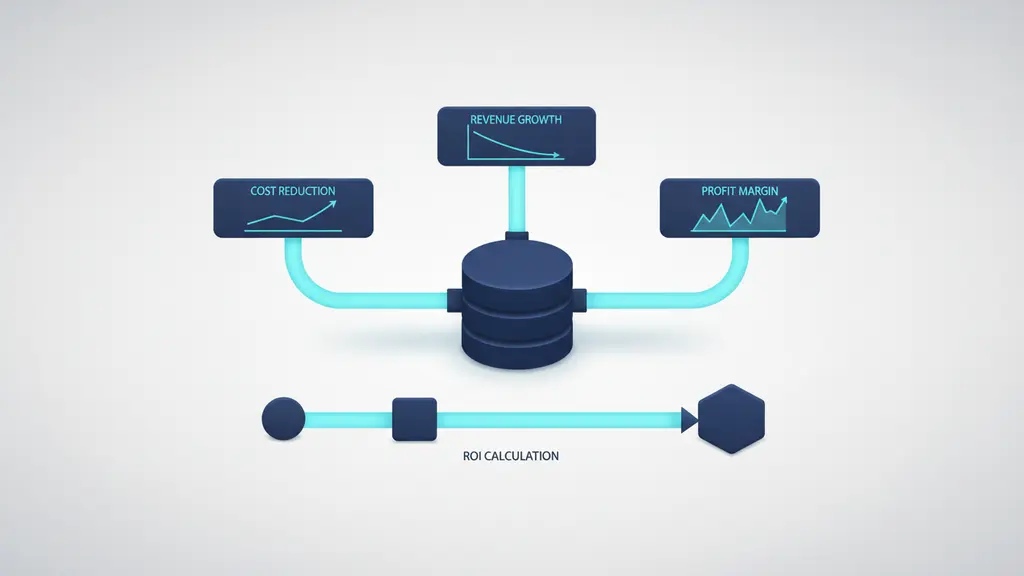
Financial impact metrics—such as revenue growth and cost reduction—are the most direct way for business leaders to prove AI ROI and communicate real business value.
Boards and investors demand clear, dollars-and-cents evidence of success. The metrics below form the foundation of board-level AI ROI reporting:
- Revenue Acceleration:
AI can drive new revenue by enabling product innovation, automating sales tasks, or boosting conversion rates. For instance: “After implementing an AI-driven recommendation engine, Company X saw a 7% uplift in average order value over six months” (example consistent with McKinsey findings on AI revenue impact). - Cost Efficiencies:
Automation, process optimization, and reduced labor hours can lead to significant cost savings. Metrics capture savings in OPEX, reduced error costs, or streamlined workflows. E.g., “AI-powered invoice processing reduced finance team labor costs by 30% year-over-year.” - Profitability and Margin:
When AI increases revenue and reduces costs, margin improvements commonly follow. Tracking gross margin before and after AI deployment illustrates end-to-end value.
Example: Calculating AI-Driven ROI
AI ROI (%) = ((Financial Benefit from AI – Total AI Investment) / Total AI Investment) x 100
Board Reporting Best Practices:
- Compare forecasted ROI to actuals each quarter.
- Isolate AI-attributable improvements from other business changes where possible.
- Visualize with before/after charts for clarity.
Which Workforce and Adoption Metrics Matter for C-suite Success?
Workforce and adoption metrics—such as user uptake, productivity, and employee engagement—capture how well AI is embedded into daily operations and its effect on human capital.
Unlike purely financial KPIs, these people-centric metrics reveal whether AI is driving real, sustainable transformation.
- Staff Adoption Rate: % of targeted employees or users actively leveraging new AI systems.
- Frequency of AI Use: How often (daily, weekly) AI-powered tools are used—an indicator of operational integration.
- Productivity Gains: Comparison of key output or processing time before and after AI.
- Employee Engagement/eNPS: Changes in employee net promoter score, retention, or satisfaction post-AI deployment.
- Change Management Indicators: Training completion rate, user feedback, support ticket trends.
Business leaders who monitor these metrics can address friction points early, demonstrate progress to the board, and support stronger, more resilient adoption.
Quick Reference Table: Workforce & Adoption Metrics
| Metric | Definition | Why It Matters |
|---|---|---|
| AI Adoption Rate | % of staff using AI as intended | Measures real organizational change |
| Productivity Index | Tasks/output per employee post-AI | Demonstrates efficiency gains |
| eNPS Post-AI | Staff survey score after AI rollout | Reveals engagement, retention risk |
What Are Operational and System KPIs for Executive-Level AI Dashboards?
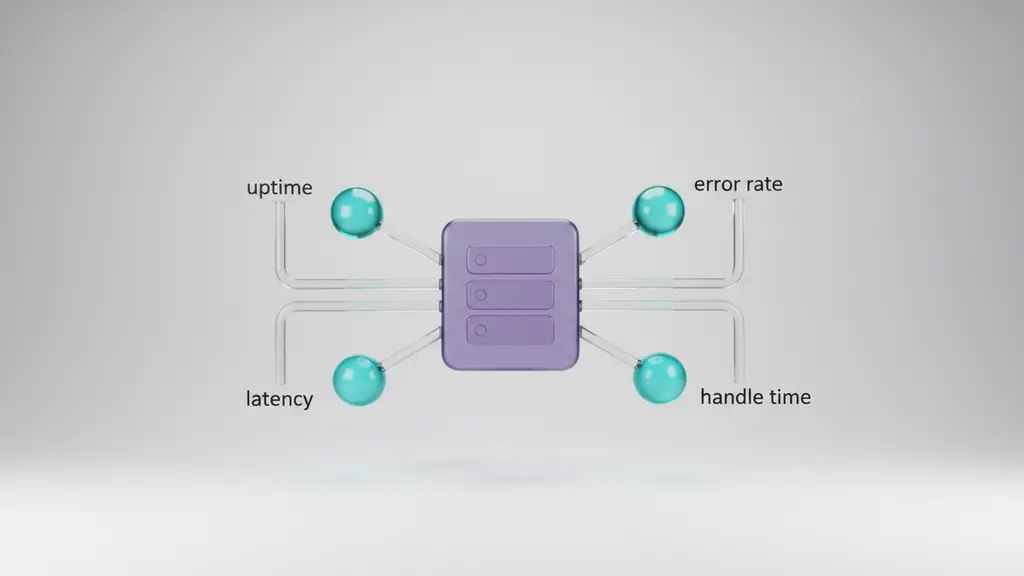
Operational and system KPIs—such as uptime, handle time, and error rate—provide executives with an at-a-glance view of AI system health, risk, and business process efficiency.
These non-financial metrics allow leaders to identify bottlenecks, ensure reliability, and support compliance—all critical for trust and ongoing investment.
Key Operational & System Metrics:
- Average Handle Time: Time to complete core process (e.g., customer inquiry resolution) with AI versus before.
- Containment Rate: % of issues resolved by AI systems without human intervention.
- System Uptime: % of time AI services are fully available.
- Latency: Average time for AI system to respond or deliver outcomes.
- Error Rate: Frequency of incorrect or failed AI predictions/actions.
- Compliance/Risk Score: Incidents of non-compliance, bias detection, or security flags.
- Generative AI Output Quality: Human or automated assessment of AI-generated content quality.
Infographic: End-to-End AI Metrics Stack
Technical/Operational KPIs → Workforce Adoption KPIs → Financial Impact KPIs → Strategic/Market Outcome KPIs
| KPI Category | Example Metric | Executive Value |
|---|---|---|
| Technical/System | Latency, uptime | Trust, continuity, risk management |
| Operational | Handle time, containment | Process efficiency |
| Workforce | Adoption rate, eNPS | Change validation, cultural alignment |
| Financial | Revenue, cost | ROI, strategic performance |
How Do You Select the Right AI Metrics for Your Organization?
Choosing the right AI performance metrics requires aligning measurement with your company’s strategy, sector, and AI maturity—avoiding information overload and focusing on KPIs that truly drive decisions.
Step-by-step framework:
- Stakeholder Analysis:
Identify what matters most to the board, CEO, CFO, business units, and regulatory bodies. - Sector Context:
Recognize that healthcare, financial services, retail, and other sectors may need tailored KPIs (e.g., patient outcome improvements vs. fraud detection rates). - Balance Leading and Lagging Indicators:
Leading indicators (AI adoption rate, employee training) predict future success.
Lagging indicators (revenue, margin, cost reduction) confirm outcomes. - Prioritize Quality Over Quantity:
Tracking fewer, highly relevant metrics is more actionable than monitoring dozens—executives rarely need more than 5–8 strategic AI KPIs on their dashboard. - Review and Revise:
As AI deployments mature, update metrics to reflect evolving objectives and new risks.
Sample AI Metric Selection Checklist
– Does this metric link directly to a core business objective?
– Can it be clearly explained to non-technical stakeholders?
– Is it measurable with current tools/data?
– Does it drive action or decision-making?
What Frameworks and Templates Can Streamline Executive AI Measurement?
Frameworks and reporting templates help leaders move from identifying AI metrics to embedding them into business processes—making executive AI measurement efficient, repeatable, and board-ready.
Popular frameworks:
- SMART Metrics:
Ensure all AI KPIs are Specific, Measurable, Achievable, Relevant, and Time-bound. - OKR Alignment:
Anchor AI key results within broader business Objectives and Key Results structures. - Data-Driven KPI Mapping:
Visualize how AI activities lead to operational/process improvements and ultimately financial or customer outcomes.
Sample Executive AI Dashboard (Description):
– Snapshot view: Top 5–8 AI business KPIs, with traffic-light visuals (green/yellow/red).
– Trend tracking: Quarter-over-quarter changes.
– Commentary section: Key wins, risks, and calls to action.
To customize: Start with this baseline template, overlay your company’s strategic goals, and select sector-relevant metrics for a tailored executive view.
Case Studies & Industry Benchmarks: How Do Leading Companies Track and Report AI Success?
Leading organizations—across sectors—combine business, operational, and adoption metrics to create actionable AI dashboards, align incentives, and report progress to boards.
Mini-Case Summaries:
- Global Retailer (Fortune 100):
Tracked revenue per customer, cost elimination, NPS scores, and generative AI product usage. Demonstrated a 10% increase in quarterly revenue from AI-enabled personalization. - Major Healthcare Network:
Focused on AI-driven reduction in diagnostic errors, staff adoption rate (physician usage), and patient satisfaction. Shared real-time dashboards with C-suite and compliance offices. - Financial Services Leader:
Benchmarked fraud detection accuracy, customer onboarding time (automation), and compliance incidents. Used monthly board reporting cycles for transparency.
Industry Benchmarks:
According to sector reports referenced by Gartner and Deloitte, leading companies most often measure:
– Financial impact (cost, revenue)
– AI adoption and engagement
– Operational efficiency (process speed, error rate)
– Risk and compliance
Pattern:
Consistent across industries: successful AI programs link a small set of business-aligned KPIs to executive incentives, and adapt dashboards as maturity grows.
How Can Metrics Be Integrated into Executive Reporting and Compensation Plans?
Integrating AI performance metrics into board reporting cycles—and executive compensation plans—is essential for closing the loop from measurement to accountability and strategic action.
Best practices:
- Reporting Cycles:
Align AI metric reviews with regular board meetings (quarterly) and executive updates (monthly/quarterly). Tailor reports for each audience, blending high-level summaries and drill-downs. - Linking to Compensation:
Increasingly, executive bonuses or variable comp are tied to achieving AI-driven outcomes (e.g., specific cost savings, adoption targets, or compliance milestones), as analyzed by Equilar and Harvard Law. - Regulatory Considerations:
Document and report AI KPIs for transparency—address emerging disclosures on bias, risk, or explainability per regional requirements.
Sample Board Report Excerpt:
“In Q2, AI-enabled automation reduced processing costs by 18% versus forecast, supporting an adjusted gross margin increase of 2%. Adoption among key business units reached 80%, ahead of the 2024 plan.”
What Are the Most Common Mistakes When Measuring AI Performance at the Executive Level?
Business leaders often undermine the value of AI programs by focusing on activity, tracking too many metrics, or neglecting workforce impact—limiting insight and buy-in.
Top mistakes to avoid:
- Tracking activity, not outcomes:
Reporting “number of AI models deployed” rather than business value delivered. - Metric overload:
Overwhelming dashboards with excessive or irrelevant KPIs—diluting focus. - Neglecting people metrics:
Underestimating the importance of adoption, engagement, or satisfaction. - Failing to adapt:
Sticking to early KPIs, even as AI matures or pivots in use. - Lack of actionability:
Tracking data that doesn’t drive clear decisions or accountability.
By steering clear of these pitfalls, leaders ensure AI metrics drive real strategic impact and foster lasting credibility.
Frequently Asked Questions about AI Performance Metrics for Business Leaders
1. What Are The Most Important AI Performance Metrics For Business Leaders?
The most critical ai performance metrics for business leaders include revenue growth driven by AI, cost savings from automation, adoption rate, productivity gains, customer satisfaction, system uptime, error reduction, and compliance indicators. These enterprise ai performance kpis translate technical progress into measurable business value.
2. How Should Executives Approach AI ROI Measurement For Executives?
Effective ai roi measurement for executives requires isolating the financial impact directly attributable to AI initiatives. This includes increased revenue, reduced operating costs, efficiency gains, and risk mitigation compared against total AI investment. Clear attribution models and disciplined reporting are essential for board-level transparency.
3. Which Financial Metrics Best Reflect Success In AI Performance Metrics For Business Leaders?
For strong ai performance metrics for business leaders, prioritize revenue uplift linked to AI initiatives, operational cost reductions, improvements in gross or operating margin, and capital efficiency gains. These financial indicators resonate most with boards and investors.
4. How Long Does AI ROI Measurement For Executives Typically Take?
The timeline for ai roi measurement for executives varies by deployment scale and complexity. Many organizations begin seeing measurable impact within 6 to 18 months, particularly for targeted automation, personalization, or predictive analytics projects.
5. What Is The Difference Between Activity Metrics And Enterprise AI Performance KPIs?
Activity metrics track implementation efforts, such as models deployed or pilots launched. In contrast, enterprise ai performance kpis measure tangible outcomes, such as cost savings, revenue growth, risk reduction, or improved customer retention. Business leaders should prioritize outcome-driven metrics.
6. How Do You Select The Right AI Performance Metrics For Business Leaders?
To define effective ai performance metrics for business leaders, align each metric with strategic priorities, ensure data reliability, and limit tracking to a focused set of KPIs that influence executive decisions. Clarity and relevance matter more than volume.
7. How Many Enterprise AI Performance KPIs Should Executives Track?
Most executive dashboards include 5 to 8 high-impact enterprise ai performance kpis. This balance ensures strategic focus while avoiding reporting overload.
8. Can AI ROI Measurement For Executives Be Linked To Compensation?
Yes. Leading organizations increasingly tie ai roi measurement for executives to performance incentives. Metrics such as adoption rates, efficiency gains, cost reductions, and compliance milestones can be incorporated into executive compensation frameworks.
9. What Frameworks Support AI Performance Metrics For Business Leaders?
Structured goal-setting systems such as OKRs, SMART objectives, and value-driver mapping help define clear ai performance metrics for business leaders. These frameworks improve alignment between AI initiatives and measurable enterprise outcomes.
10. What Are Common Pitfalls In Tracking Enterprise AI Performance KPIs?
Common mistakes include tracking too many irrelevant indicators, focusing solely on technical metrics, neglecting workforce adoption, and failing to update KPIs as AI programs mature. Strong enterprise ai performance kpis evolve alongside strategy and scale.
11. How Often Should AI Performance Metrics For Business Leaders Be Reviewed?
For effective governance, ai performance metrics for business leaders should be reviewed quarterly at minimum, with monthly operational reviews for major AI programs. Regular reassessment ensures alignment with changing business priorities.
Conclusion: Turning AI Metrics into Business Results
Tracking the right AI performance metrics for business leaders is no longer optional. It is essential for turning artificial intelligence from a promising initiative into a measurable driver of enterprise value. When metrics are aligned with strategic priorities, financial outcomes, and operational impact, AI moves beyond experimentation and becomes a disciplined engine for growth and competitive advantage.
By adopting a structured, executive-focused approach to measurement and reporting, organizations can strengthen board-level confidence, improve accountability, and make smarter investment decisions. With clarity on what truly matters, leaders can ensure their AI strategy delivers sustainable results that support long-term business success.
Key Takeaways
- Boardroom-ready AI metrics should always link directly to business outcomes—not just technical successes.
- Financial, workforce, operational, and adoption KPIs offer a 360° view of AI program impact.
- Executive dashboards work best with 5–8 focused, action-driving AI KPIs.
- Industry leaders tailor AI metrics to sector needs, reporting cycles, and maturity.
- Embedding AI metrics into reporting and compensation drives accountability and results.
This page was last edited on 6 March 2026, at 9:03 am
Contact Us Now

Contact Us Now
Start a conversation with our team to solve complex challenges and move forward with confidence.


