
Data augmentation is the process of creating new training examples by modifying or generating data while preserving meaningful labels. It helps machine learning teams expand limited datasets, reduce overfitting, improve model accuracy, and address class imbalance without collecting large amounts of new data.
Your AI model can only be as reliable as the data behind it. When training data is limited, unbalanced, or too repetitive, even a sophisticated model can overfit, miss important edge cases, and struggle when it reaches production.
That is where data augmentation becomes valuable.
So, what is data augmentation, and why does it matter? It is a practical way to expand and diversify existing training data through transformations, synthetic examples, and other augmentation techniques—without constantly collecting new datasets from scratch.
Done well, data augmentation can improve model accuracy, reduce bias, strengthen generalization, and make better use of the data you already have.
In this guide, you will learn how data augmentation works, why it matters in 2026, the best techniques for images, text, audio, and other data types, leading tools, real-world examples, and practical ways to automate your augmentation workflow.
What Is Data Augmentation?
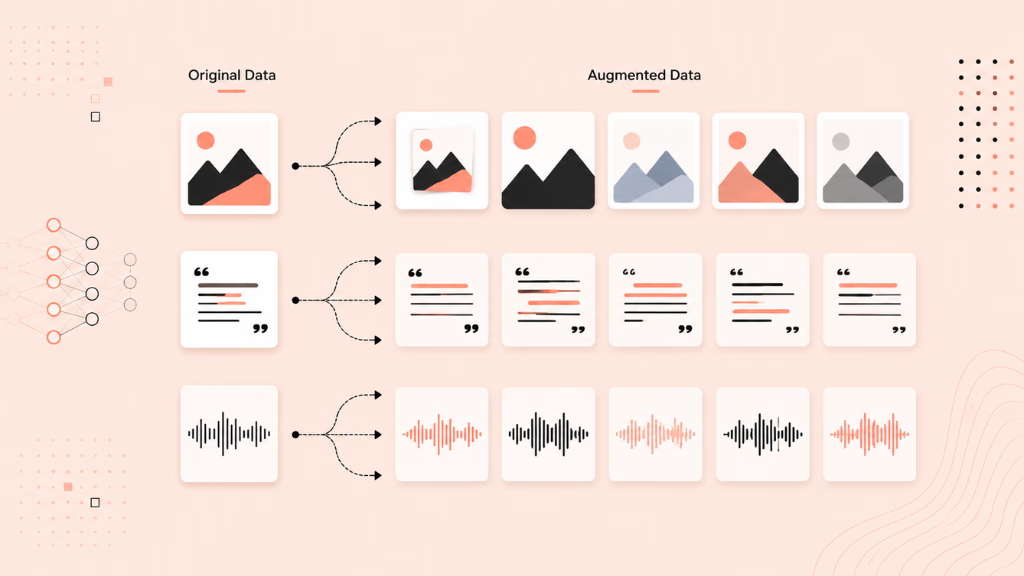
Data augmentation in machine learning is the process of generating new data samples by transforming existing data. These transformations maintain the core meaning and label of the data but shift features like orientation, phrasing, or noise.
In my POV, data augmentation is not about making up data wildly, but about extracting more value from what you have. It is a key part of the ML pipeline and helps models generalize to new inputs, handle data imbalance, and limit overfitting. I have seen this technique save projects where datasets were too small for direct use.
Some teams overlook the quality checks needed here. Effective augmentation must keep the essential information intact. When done right, it increases both the volume and quality of training data, strengthening the model’s ability to succeed in real-world conditions.
Why Is Data Augmentation Important in Machine Learning and Deep Learning?
Data augmentation matters because most real-world datasets are too small, too narrow, or too biased for strong machine learning outcomes. As seen in many ML projects, more data usually means better models—but collecting more raw data is expensive and slow.
Augmentation offers a scalable, cost-effective way to address:
- Overfitting prevention by increasing data diversity
- Better generalization to new, unseen cases
- Improvement on small and imbalanced datasets
- Support for privacy protection by making it harder to re-identify individuals
- Reduction of algorithmic bias when diverse transformations are used
I have seen significant gains in model accuracy and resilience in healthcare and finance projects, all thanks to smart data augmentation.
How Does Data Augmentation Work in Practice? (Step-by-Step Framework)
To get the real benefit from data augmentation, follow a clear workflow that fits into your ML pipeline. Below is a typical step-by-step process that I have used in many projects over the past year:
Augmentation fits best right after data collection and cleaning, but before model training. This is where teams can test how new, synthetic samples affect model outcomes.
Data Augmentation Workflow
- Select Source Data
Identify what needs augmentation and assess its weaknesses (size, balance, coverage). - Choose Augmentation Methods
Depending on data type, pick techniques like rotation for images, or back-translation for text. - Apply Transformations
Use libraries or scripts to create new samples, ensuring label consistency. - Validate Augmented Data
Check if augmentations improve validation performance, do not introduce bias, and retain data quality. - Integrate into Pipeline
Automate these steps with frameworks that fit with your ML stack.
Here is a simple example in Python (using TensorFlow 3):
import tensorflow as tf

datagen = tf.keras.preprocessing.image.ImageDataGenerator(
    rotation_range=20,
    horizontal_flip=True,
    brightness_range=[0.8,1.2]
)

augmented = datagen.flow_from_directory('train_images')
Before augmentation, your set might have 1,000 images; after, you effectively train with tens of thousands of unique views. In my experience, this step alone often gives a stubborn model the push it needs.
What Are the Main Data Augmentation Techniques by Data Type?
Not all data is the same. Augmentation techniques must fit the type—images, text, audio, tabular, or time series. Below I break down the most effective methods I have seen for each.
Image Data Augmentation Methods
Image data often benefits most from visual transformations that change appearance, not meaning.
- Geometric transforms (flip, rotate, crop, scale): Change orientation or size, commonly used in vision tasks.
- Color or photometric adjustments: Vary brightness, contrast, or hue to make models less sensitive to lighting changes.
- Noise injection and occlusions: Add noise or block parts of images to improve robustness. Cutout is a strong example.
- Advanced methods (Mixup, adversarial examples): Mix images or generate adversarial samples for extra diversity.
Many ML teams rely on libraries like Albumentations or TensorFlow’s ImageDataGenerator for these functions.
Text Data Augmentation Methods
Text augmentation focuses on creating meaning-preserving variety.
- Synonym replacement/insertion/deletion: Swap or change words to create new sentences.
- Back-translation: Translate text to another language and back as a way to paraphrase.
- Contextual LLM-based synthesis: Use models like GPT-4 or GPT-5 to generate new sentences or paraphrases.
- Random shuffling, masking, noise injection: Change word order or add noise for extra variety.
I find GPT-based techniques especially powerful in 2026, as they create near-human paraphrases for many domains.
Audio & Signal Data Augmentation
For audio, adjustments often mirror the challenges of speech and sensor data.
- Time warping/shifting: Change speed or position of the audio without changing content.
- Pitch/speed manipulation: Vary the sound, useful in voice recognition.
- Background noise/reverberation: Add real-world interference.
- Frequency masking and random cropping: Hide sections or alter signal shape.
- Signal-specific transforms (jitter, scaling, permutation): Often used in sensor and wearables data.
Open-source packages like audiomentations (for audio) and tsaug (for time series) are standard here.
Tabular Data & Other Modalities
Tabular data needs more careful handling.
- SMOTE/ADASYN: Generate synthetic samples for underrepresented classes.
- Noise injection, feature permutation: Change data slightly to test model stability.
- Synthetic row generation: Combine features to create realistic new records.
- Time series-specific: Use sliding windows, jitter, or trend alteration.
I have seen the best results when teams avoid random row shuffling and instead use smarter synthetic generation like SMOTE.
Table: Data Augmentation Techniques by Data Type
| Data Type | Common Methods | Advanced Methods |
| Image | Rotate, flip, crop, brightness, noise | Mixup, Cutout, adversarial |
| Text | Synonyms, shuffling, back-translation | GPT-based rewriting |
| Audio | Time shift, speed, pitch, noise, masking | Diffusion/AI audio synth |
| Tabular | SMOTE, noise, permutation, synthetic rows | VAE/GAN for records |
| Time Series | Sliding window, jitter, scaling | Auto-augmentation |
What Are the Latest Automated & Generative Approaches to Data Augmentation?
Recent advances in deep learning have made automated and generative augmentation practical for many teams. These approaches use AI to create data that is much more realistic or varied.
GANs, VAEs, and Diffusion Models for Augmentation
Generative Adversarial Networks (GANs) have become standard for producing high-quality synthetic images and, increasingly, audio. I have used GANs in manufacturing defect detection to create rare failure samples. Variational Autoencoders (VAEs) learn data distributions and generate new, plausible samples – I often choose these for tabular or sensor data.
Diffusion models now set the state of the art for image and even audio generation. They iteratively add and remove noise, creating hyper-realistic outputs. For example, models like Stable Diffusion (2026 versions) can fill gaps in training data for medical images that are otherwise impossible to collect.
Open-source frameworks now routinely support these generative models, with PyTorch v2 and TensorFlow 3 offering built-in plugins and APIs. According to industry benchmarks, diffusion models show top performance in image diversity and realism.
LLM-based Approaches for Text Augmentation
Large language models (LLMs) such as GPT-4 and GPT-5 are now common for text data augmentation in 2026.
Teams use prompt engineering—such as asking the model to rewrite, summarize, or paraphrase—to create high-quality new samples. I often recommend using LLMs to generate labeled data for rare intent classes in chatbot projects.
It is vital, however, to check for bias and ensure the output matches the original label. This is where many teams struggle. Automated quality checks or human-in-the-loop reviews are now standard.
How Is Data Augmentation Different from Synthetic Data Generation?
Many teams get these terms mixed up. Data augmentation takes existing real data and makes varied versions by applying transformations. Synthetic data generation creates data from scratch, often using generative models.
Here is a side-by-side summary:
| Aspect | Data Augmentation | Synthetic Data Generation |
| Source | Real, labeled data | Model-based or simulated |
| Methods | Transformations (rotate, etc) | GAN, VAE, simulation |
| Goal | Enrich/fix existing data | Fill broad gaps, new patterns |
| Risk | Keeps context, limits drift | May create unrealistic data |
| Use Case | Overfitting, imbalance | Missing scenarios, privacy |
I have seen teams combine both approaches. For compliance work, synthetic data can avoid privacy risks, while augmentation sharpens real-world generalizability.
What Are the Main Benefits, Limitations & Challenges of Data Augmentation?
Data augmentation is a powerful tool, but like all tools it presents both strengths and trade-offs. A balanced view helps avoid costly mistakes.
Main benefits include:
- Better generalization for models after deployment
- Higher accuracy and robustness on real-world data
- Improved balance for class-imbalanced problems
- Enhanced privacy for sensitive data
The limitations and challenges I have seen most often are:
- Poorly chosen transformations can distort true data, creating noisy labels
- Augmented data can introduce or amplify bias if not monitored
- Extra computation and storage costs, especially with large generated datasets
- Risk of data leakage when transformations blur training and validation boundaries
- Regulatory and compliance issues if transformations are not transparent
A best practice is to tightly validate augmented datasets and involve domain experts in selecting augmentation parameters.
What Are the Top Tools & Frameworks for Data Augmentation in 2026?
The right tool can save weeks of development and ensure consistency. In my experience in 2026, these frameworks stand out for maturity, features, and active support.
- TensorFlow 3/Keras
Built-in data augmentation layers for image, text, tabular; easy to use within training loops. - PyTorch v2+ and torchvision
Flexible for custom transforms; strong open-source support for images and audio. - Albumentations
Widely used, especially for advanced image augmentation pipelines. - AugLy
Multi-modal (image, video, audio, text); used for social media, NLP scenarios. - nlpaug
Extensive text augmentation library; integrates LLM plugins. - audiomentations
Open-source audio augmentation; common for speech and audio ML. - AutoAugment/RandAugment
Automated policy selection for augmentation; strong results on image benchmarks.
Below is a summary table for quick comparison:
| Tool/Library | Data Types | Notable Features | Integration |
| TensorFlow 3 | Image, text, tabular | Native, fast, auto | Keras, TF pipeline |
| PyTorch v2+ | All (plus custom) | Customizable, active | torchvision, torchtext |
| Albumentations | Image | Fast, advanced | OpenCV, PyTorch |
| AugLy | Image, audio, video, text | Social/NLP focus | Standalone |
| nlpaug | Text | Embeddings/LLM-aware | HuggingFace, custom |
| audiomentations | Audio | Open, audio-specific | PyTorch, TensorFlow |
| AutoAugment | Image | Auto policy search | PyTorch, TF |
Open-source notebooks and vendor platforms now offer plug-and-play support for most major tools. Setting up augmentation is as easy as a few lines of config or code in 2026.
How Is Data Augmentation Applied in Real World Industries? (Case Studies)
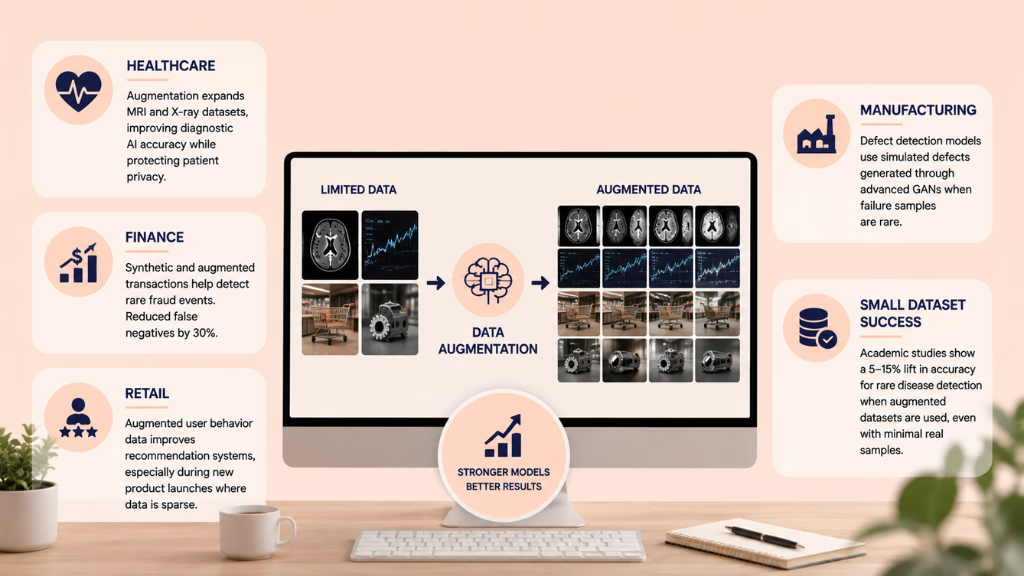
Healthcare Imaging:
Teams use augmentation to expand small MRI or X-ray sets, boosting diagnostic AI accuracy while protecting patient privacy.
Finance:
Synthetic and augmented transactions help detect rare fraud events. One team I guided reduced false negatives by 30%.
Retail:
Augmentation of user behavior data improves recommendation systems, especially during new product launches where data is sparse.
Manufacturing:
Defect detection models rely on simulated defects, generated through advanced GANs, when failure samples are rare.
Small Dataset Success:
Academic studies have shown a 5–15% lift in accuracy for rare disease detection when augmented data sets are used, even with minimal real samples.
What Are the Best Practices & Common Pitfalls in Data Augmentation?
The real issue is that augmentation can help or hurt, depending on how you set it up. In my experience, the following practices help teams get it right:
- Always choose transformations that keep labels correct. For example, flipping a “left arrow” image for a self-driving car may break the model.
- Monitor for data leakage — never allow augmented training data into the validation or test set.
- Regularly assess the performance impact with each type of augmentation.
- Consider the risk of adding new biases or overfitting to synthetic patterns.
- Document all augmentation steps for compliance, especially if working on privacy-regulated projects.
Checklist:
- Validate each augmentation type for label fidelity
- Separate augmented data across train/validation/test sets
- Monitor for unexpected bias shifts
- Involve domain experts in parameter selection
- Document the full process for audit
How Riseup Labs Helps ML Teams Solve Data Augmentation Problems
Limited, imbalanced, or sensitive datasets can quickly become a bottleneck for machine learning projects. Riseup Labs helps ML teams overcome these challenges with practical data augmentation strategies tailored to their models, data types, and business goals.
Our ML experts support teams with selecting the right augmentation techniques, designing scalable pipelines, and automating data workflows across industries such as healthcare, finance, and manufacturing. Whether you need to improve dataset diversity, reduce bias, or streamline an existing augmentation process, Riseup Labs can provide the technical expertise and custom support needed to move your project forward.
Conclusion
Data augmentation is no longer an option for serious ML teams—it is essential. By turning limited and imbalanced datasets into strong, resilient training material, data augmentation improves model performance, fairness, and privacy.
Smart teams use both traditional and automated methods, fitting tools to their data and goals. As AI models grow more complex, keeping human experts in the loop remains critical to ensure quality, compliance, and business impact.
If you want to build AI systems that stand up to real-world demands, investing in rigorous data augmentation—and the right expertise—will set your team apart. To explore how this fits into your next ML project, the Riseup Labs team is ready to help.
AI-assisted development with expert guidance is the path forward. Your data deserves the best shot at success.
FAQs
What is data augmentation in machine learning?
Data augmentation in machine learning means making new data samples by changing real ones. This process helps models learn better and avoid overfitting.
How does data augmentation work?
Data augmentation works by applying transformations, such as flipping or adding noise, to existing data. This creates new, more varied data for model training.
What are the most common data augmentation techniques for images?
The most common image data augmentation methods are flipping, rotation, cropping, scaling, brightness adjustment, and adding noise.
How is data augmentation different from synthetic data?
Data augmentation changes real data using transformations. Synthetic data is made entirely by models or simulations, not from real examples.
Why is data augmentation important for deep learning?
Data augmentation supports deep learning by providing more data variety, helping prevent overfitting and improving model accuracy.
Which tools or libraries can I use for data augmentation?
Popular tools include TensorFlow 3, PyTorch v2, Albumentations, AugLy, nlpaug, and audiomentations. They cover all main data types.
Can data augmentation help with small or imbalanced datasets?
Yes, data augmentation is especially useful for small or imbalanced datasets. It increases data size and balances class representation.
What are the risks or limitations of data augmentation?
Main risks include introducing bias, creating unrealistic data, and causing data leakage between training and test sets.
How does automated data augmentation work?
Automated data augmentation uses AI or algorithmic policies to select and apply the best transformations for given data and tasks.
Are there any privacy concerns with data augmentation?
Sometimes. While augmentation can protect privacy, poor methods may accidentally leak sensitive features. Careful design and review are needed.
This page was last edited on 20 August 2026, at 2:38 pm

Start a conversation with our team to solve complex challenges and move forward with confidence.