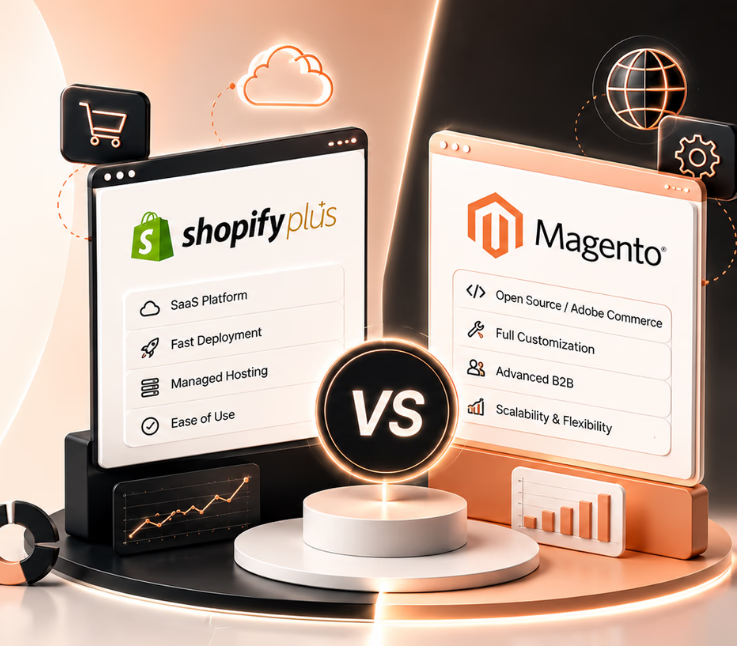
Shopify Plus is generally better for businesses that prioritize fast deployment, predictable platform costs, managed hosting, and easier maintenance. Magento, including Magento Open Source and Adobe Commerce, is better for businesses that require complete code control, advanced B2B workflows, complex catalogs, and extensive customization.
Choosing an enterprise eCommerce platform is not simply a technical decision. It affects how quickly your business can launch new storefronts, expand into new markets, manage wholesale customers, integrate business systems, and adapt to future growth.
Shopify Plus and Magento are two widely considered options, but they approach enterprise commerce differently.
Shopify Plus is a fully hosted software-as-a-service platform. Shopify manages the core infrastructure, security updates, hosting, and platform maintenance, allowing merchants to concentrate more on commerce operations and customer experience.
Magento Open Source and Adobe Commerce offer greater architectural freedom. Businesses can customize more of the platform, control their hosting environment, and build highly specialized shopping and operational workflows. That flexibility, however, comes with greater development and maintenance responsibility.
This Shopify Plus vs Magento comparison examines pricing, customization, B2B features, scalability, integrations, SEO, security, and total cost of ownership to help you determine which platform best fits your business.
Shopify Plus vs Magento at a Glance
| Feature | Shopify Plus | Magento Open Source / Adobe Commerce |
|---|---|---|
| Platform model | Fully hosted SaaS | Open-source or enterprise commerce platform |
| Hosting | Included and managed | Self-managed, third-party, or Adobe-managed |
| Ease of use | Generally easier | More technically demanding |
| Customization | Themes, apps, APIs, and Shopify Functions | Extensive code-level customization |
| Maintenance | Largely handled by Shopify | Merchant, agency, hosting provider, or Adobe |
| B2B features | Native B2B with advanced Plus capabilities | Extensive Adobe Commerce B2B suite |
| Launch speed | Usually faster | Usually longer for complex builds |
| Cost structure | More predictable platform fee | Variable license, hosting, development, and maintenance |
| Code control | Limited core access | Extensive control, especially with Open Source |
| Best suited for | Fast-growing brands seeking simplicity | Businesses with complex technical or operational needs |
Overall verdict: Choose Shopify Plus when speed, ease of management, and predictable infrastructure are priorities. Choose Magento or Adobe Commerce when deep customization, advanced B2B processes, and architectural control justify higher technical complexity.
What Is Shopify Plus?
Shopify Plus is Shopify’s enterprise commerce plan. It uses the same managed commerce foundation as Shopify’s other plans but adds features and support intended for larger, higher-volume, and more complex businesses.
Shopify hosts the platform and manages much of its underlying infrastructure. Merchants do not need to operate servers, install core security patches, or manage routine platform upgrades themselves.
Shopify Plus can support:
- Direct-to-consumer commerce
- B2B selling
- International storefronts
- Omnichannel operations
- Custom storefront development
- ERP, PIM, CRM, and fulfillment integrations
- Checkout extensibility
- Workflow automation
Shopify currently lists Plus pricing from $2,300 per month on a three-year term or $2,500 per month on a one-year term for standard setups and integrations. More complex businesses may receive variable pricing based on their arrangements with Shopify.
What Is Magento?
The term “Magento” can refer to two related but different products.
Magento Open Source
Magento Open Source is a free, downloadable eCommerce platform. Businesses can modify its source code and host it in an environment of their choice.
Although there is no software license fee, the platform is not cost-free to operate. Businesses must still pay for hosting, development, security, maintenance, extensions, monitoring, and technical support. Adobe continues to offer Magento Open Source as a flexible commerce option.
Adobe Commerce
Adobe Commerce is the enterprise platform built on Magento technology. Adobe describes Magento’s enterprise commerce offering as having evolved into Adobe Commerce, with enterprise scalability, API-first development, and Adobe ecosystem integrations.
Adobe Commerce adds enterprise capabilities such as:
- Advanced B2B commerce
- Customer-specific catalogs
- Negotiable quotes
- Purchase-order approvals
- Company accounts
- Advanced merchandising
- Adobe-powered search and recommendations
- Cloud deployment options
- Enterprise support
Adobe does not publish a simple fixed Adobe Commerce price on its primary product pages. Businesses generally need to request a customized quote.
Shopify Plus vs Magento: Detailed Comparison
The following comparison examines how Shopify Plus and Magento perform across the features that matter most to enterprise eCommerce businesses.
1. Ease of Use
Shopify Plus is usually easier to manage for nontechnical commerce teams.
Its administration interface provides centralized tools for products, orders, customers, discounts, content, markets, and reporting. Since hosting and core platform maintenance are managed by Shopify, merchants can operate without a large infrastructure team.
Magento offers more control, but it demands greater technical expertise. Even routine changes can involve developers, deployment environments, extension testing, cache management, and compatibility checks.
Winner: Shopify Plus
Shopify Plus is the stronger choice for businesses that want to reduce technical overhead and enable commerce teams to manage more of the store independently.
Magento remains suitable when a company already has experienced Magento developers or an agency managing the platform.
2. Customization and Flexibility
Customization is one of the biggest differences in the Shopify Plus vs Magento debate.
Shopify Plus supports customization through:
- Liquid themes
- Shopify Functions
- Checkout extensibility
- Custom applications
- Storefront APIs
- Hydrogen and headless storefronts
- Third-party integrations
This provides substantial flexibility for many retail and B2B businesses. However, merchants cannot directly modify Shopify’s core platform.
Magento provides much deeper code-level control. Developers can create custom modules, replace core storefront components, modify business logic, design specialized checkout flows, and control the hosting architecture.
This makes Magento particularly effective for businesses with requirements such as:
- Highly unusual pricing logic
- Complex product configurations
- Custom order-processing rules
- Specialized marketplace models
- Uncommon checkout requirements
- Deep ERP-driven operations
Winner: Magento
Magento wins when maximum flexibility is necessary.
Shopify Plus is still highly customizable, but customization takes place within Shopify’s platform framework rather than through unrestricted core access.
3. B2B Commerce
Both platforms support B2B selling, although their capabilities and implementation models differ.
Shopify B2B supports company profiles, catalogs, customer-specific pricing, payment terms, company locations, and blended B2B/DTC selling. Shopify Plus includes additional capabilities such as unlimited B2B catalogs, direct catalog assignment, deposits, partial payments, and payment requests by fulfillment.
Adobe Commerce provides an established B2B suite that includes:
- Company accounts
- Multiple buyers and user roles
- Shared catalogs
- Negotiable quotes
- Quick ordering
- Purchase-order approval rules
- Requisition lists
- Customer-specific pricing
- Parent-child company structures
These features are documented as part of Adobe Commerce’s integrated B2B offering.
Winner: Adobe Commerce for complex B2B
Shopify Plus can support many wholesale and B2B models with less setup and maintenance.
Adobe Commerce is generally stronger when a business needs complex account hierarchies, detailed purchasing permissions, negotiated quotes, approval workflows, and highly customized catalogs.
4. Pricing and Total Cost of Ownership
Comparing Shopify Plus and Magento solely by license price can be misleading.
Shopify Plus Costs
Typical expenses include:
- Shopify Plus platform fee
- Store design and development
- Paid applications
- Custom integrations
- Payment-processing costs
- Ongoing agency or developer support
Hosting, core upgrades, and most platform security maintenance are included in the managed service.
Magento Open Source Costs
Magento Open Source has no software license fee, but costs may include:
- Hosting
- Initial development
- Security management
- Core upgrades
- Extension licenses
- Extension compatibility testing
- Performance monitoring
- DevOps
- Ongoing maintenance
- Emergency technical support
Adobe Commerce Costs
Adobe Commerce can include:
- Enterprise license fees
- Implementation
- Cloud infrastructure, depending on the agreement
- Custom development
- Adobe or third-party services
- Extensions
- Maintenance
- Integration work
Winner: Shopify Plus for predictability
Shopify Plus usually offers a more predictable cost structure because the platform and infrastructure are managed together.
Magento can provide greater long-term control, but its true cost depends heavily on complexity, hosting, development resources, and custom functionality.
Businesses should compare three-to-five-year total ownership costs rather than only first-year license fees.
5. Hosting, Performance, and Scalability
Shopify Plus is fully hosted. Shopify manages infrastructure, content delivery, scaling, and core platform reliability.
This is a significant advantage during product launches, seasonal sales, influencer campaigns, and unexpected traffic spikes because the merchant does not need to scale servers manually.
Magento’s performance depends on its implementation and hosting environment.
A well-optimized Magento store can deliver excellent performance, but results depend on factors such as:
- Hosting architecture
- Cache configuration
- Database performance
- Extension quality
- Custom code
- Image optimization
- Content delivery
- Deployment practices
Adobe Commerce customers may use Adobe-managed cloud infrastructure, while Magento Open Source merchants choose and manage their own hosting.
Winner: Shopify Plus for operational simplicity
Shopify Plus makes scaling easier for teams that do not want to manage commerce infrastructure.
Magento provides more infrastructure control, which can benefit businesses with specialized performance or data-location requirements.
6. International and Multi-Store Commerce
Shopify supports international commerce through Shopify Markets and related localization capabilities. Merchants can manage currencies, languages, domains, regional catalogs, duties, and market-specific experiences from a connected administration environment.
Shopify Plus is particularly attractive for brands that want a relatively streamlined way to manage multiple markets.
Magento has long supported multiple websites, stores, and store views from one installation. Businesses can create deeply differentiated catalogs, pricing, languages, currencies, tax configurations, and experiences for separate brands or regions.
Winner: Depends on complexity
Choose Shopify Plus for simpler international management and faster regional launches.
Choose Magento when each country, brand, or division requires highly distinct catalogs, workflows, integrations, or operational rules.
7. Apps, Extensions, and Integrations
Shopify has a large application ecosystem covering marketing, customer service, subscriptions, search, reviews, fulfillment, accounting, and analytics.
Apps are generally easy to install, although relying on too many can increase monthly costs and create overlapping functionality.
Shopify Plus can also connect to enterprise systems through APIs and integration partners.
Magento has an extensive extension ecosystem and offers broad API flexibility. Developers can build integrations for ERP, CRM, PIM, warehouse, payment, tax, and procurement systems.
Magento integrations can be highly customized but may require more testing and maintenance, especially during platform upgrades.
Winner: Shopify Plus for ease; Magento for control
Shopify makes standard integrations faster to implement.
Magento is better when integrations must follow unique business logic or interact deeply with custom systems.
8. SEO Capabilities
Both Shopify Plus and Magento can support strong technical and content SEO.
Shopify provides core features such as:
- Editable titles and meta descriptions
- Canonical tags
- XML sitemaps
- Redirects
- Mobile-responsive themes
- Structured-data support through themes or apps
- Blogging tools
Its managed architecture also reduces some technical performance and infrastructure responsibilities.
Magento provides greater control over:
- URL structures
- Metadata
- Canonical implementation
- Indexation rules
- Structured data
- Layered-navigation handling
- Templates
- Server configuration
- Large-catalog SEO logic
However, having more control does not automatically produce better rankings. Magento requires experienced developers and SEO specialists to configure complex stores correctly.
Winner: Magento for advanced control
Magento offers deeper technical flexibility for large and unusual catalogs.
Shopify Plus is often easier for teams that need strong standard SEO functionality without extensive technical management.
9. Security and Maintenance
Shopify handles hosting, core patches, infrastructure security, and platform updates. This reduces the security workload placed on merchants.
Businesses remain responsible for account permissions, applications, integrations, customer-data practices, and internal operational security.
Magento Open Source places significantly more responsibility on the merchant. Teams must manage:
- Security patches
- Platform updates
- Hosting security
- Extension vulnerabilities
- Backups
- Monitoring
- Access controls
- Incident response
Adobe Commerce customers may receive more managed support depending on their deployment and agreement, but custom code and third-party extensions still require careful maintenance.
Winner: Shopify Plus
Shopify Plus is generally the safer operational choice for businesses without a dedicated commerce security and DevOps team.
Magento provides greater control, but that control creates greater responsibility.
10. AI, Personalization, and Automation
Shopify provides native automation and AI-assisted commerce tools within its ecosystem. Shopify Flow can automate operational tasks, while Shopify’s AI tools can support activities such as content creation and merchant workflows.
Adobe Commerce offers Adobe-powered product recommendations and search capabilities, along with integration opportunities across Adobe Experience Cloud. Adobe’s official feature documentation includes AI-powered Live Search and Product Recommendations among its commerce capabilities.
Magento’s open architecture also allows businesses to connect custom AI services, recommendation systems, search engines, and data platforms.
Winner: Depends on strategy
Shopify Plus is suitable for teams seeking accessible, built-in automation.
Adobe Commerce is attractive for enterprises already using Adobe products or building more customized personalization and data experiences.
Shopify Plus Pros and Cons
Shopify Plus simplifies enterprise eCommerce management, but its managed structure also creates limits for businesses that need complete technical control.
Advantages
- Fully managed hosting
- Predictable base pricing
- Faster implementation
- Easier everyday administration
- Lower infrastructure burden
- Strong app ecosystem
- Native B2B capabilities
- Automatic core updates
- Suitable for rapid international growth
Disadvantages
- No unrestricted core-code access
- Greater platform dependency
- Advanced custom workflows may require workarounds
- App costs can accumulate
- Some complex B2B requirements may exceed native capabilities
- Data and architecture portability are more limited than open source
Magento Pros and Cons
Magento offers exceptional flexibility and customization, but businesses must be prepared for greater development, maintenance, and infrastructure demands.
Advantages
- Extensive code-level control
- Highly customizable architecture
- Advanced Adobe Commerce B2B features
- Strong multi-store capabilities
- Flexible catalog and pricing logic
- Broad API and integration possibilities
- Choice of hosting with Magento Open Source
- Suitable for highly specialized commerce operations
Disadvantages
- Higher technical complexity
- Longer implementation timelines
- More maintenance responsibility
- Security patches require active management
- Greater dependence on skilled developers
- Costs can become difficult to predict
- Poor extensions or custom code can affect performance
When Should You Choose Shopify Plus?
Shopify Plus is likely the better fit when your business:
- Wants to launch or replatform quickly
- Prefers predictable platform expenses
- Does not want to manage servers
- Has limited internal development resources
- Uses relatively standard DTC or B2B workflows
- Needs reliable support for major traffic spikes
- Wants commerce teams to manage more tasks independently
- Prioritizes operational simplicity over unrestricted code control
It is particularly suitable for rapidly growing consumer brands that want to focus on merchandising, marketing, customer experience, and expansion instead of infrastructure management.
When Should You Choose Magento?
Magento Open Source or Adobe Commerce may be the better choice when your business:
- Requires deep code-level customization
- Has complex B2B purchasing processes
- Manages highly specialized catalogs
- Needs custom pricing and approval logic
- Operates many distinct storefronts
- Requires greater control over hosting and data architecture
- Has an experienced internal technical team
- Can support ongoing maintenance and security
- Needs highly customized ERP, PIM, or procurement integrations
The platform makes the most sense when its flexibility solves important business requirements rather than merely offering customization that may never be used.
Shopify Plus vs Magento Migration Considerations
Replatforming between Shopify Plus and Magento involves more than transferring products.
A migration may include:
- Product and category data
- Customer accounts
- Order histories
- Content pages
- URLs and redirects
- Design redevelopment
- App or extension replacement
- Payment systems
- Tax configuration
- Search functionality
- ERP and PIM integrations
- B2B pricing
- Customer-specific catalogs
- Analytics and tracking
- Staff training
- Quality assurance
Shopify says businesses can potentially replatform to Shopify Plus in less than 90 days, but actual timelines depend on data quality, custom functionality, integrations, design, and testing requirements.
Complex migrations can take considerably longer. Businesses should complete a technical and operational audit before choosing a launch date.
Shopify Plus vs Magento Decision Table
| Business Priority | Better Fit |
|---|---|
| Faster launch | Shopify Plus |
| Predictable infrastructure costs | Shopify Plus |
| Minimal server maintenance | Shopify Plus |
| Easy everyday administration | Shopify Plus |
| Complete code access | Magento |
| Advanced B2B workflows | Adobe Commerce |
| Highly custom checkout or order logic | Magento |
| Complex multi-brand architecture | Magento |
| Smaller technical team | Shopify Plus |
| Experienced commerce development team | Magento |
| Standard high-growth DTC | Shopify Plus |
| Unusual enterprise requirements | Magento |
Final Verdict: Shopify Plus or Magento?
There is no universal winner in the Shopify Plus vs Magento comparison.
Shopify Plus is the better choice for businesses that value rapid deployment, managed hosting, predictable expenses, simpler maintenance, and a user-friendly commerce environment.
Magento or Adobe Commerce is better suited to businesses with complex B2B operations, specialized catalogs, unusual workflows, strict architectural requirements, and the technical resources to manage a highly customized platform.
The final decision should depend on operational fit rather than the number of features available. Before choosing, review your current workflows, future growth plans, integration requirements, B2B needs, technical resources, and expected total cost over several years.
Riseup Labs can help you compare both platforms, plan a practical roadmap, and manage development, customization, integration, or migration based on your business requirements.
How Riseup Labs Can Solve Your eCommerce Challenges
Choosing between Shopify Plus and Magento or planning a migration between them, can become complex without the right technical guidance. Poor platform decisions, incomplete migrations, and weak integration planning can increase costs and delay growth.
Riseup Labs helps businesses evaluate both platforms, plan practical eCommerce roadmaps, and handle development, customization, integration, and migration work. Whether you need to scale Shopify Plus, build advanced Magento functionality, support complex B2B operations, or introduce custom AI features, the team can help reduce technical risk and create a more stable commerce platform.
Frequently Asked Questions
What Is the Main Difference Between Shopify Plus and Magento?
Shopify Plus is a fully hosted SaaS platform that prioritizes ease of use and managed infrastructure. Magento provides greater code and hosting control but requires more development, security, and maintenance resources.
Is Shopify Plus Cheaper Than Magento?
Shopify Plus often has a more predictable total cost. Magento Open Source has no license fee, but hosting, development, upgrades, security, and maintenance can make it more expensive to operate. Adobe Commerce pricing is customized.
Is Shopify Plus or Magento Better for B2B?
Shopify Plus works well for many straightforward and moderately complex B2B stores. Adobe Commerce is generally stronger for advanced company structures, negotiable quotes, purchase approvals, and complex customer-specific catalogs.
Which Platform Is Easier to Maintain?
Shopify Plus is easier to maintain because Shopify manages hosting, core updates, and infrastructure. Magento requires more ongoing technical management.
Which Platform Offers Better Customization?
Magento provides deeper code-level customization. Shopify Plus offers extensive theme, API, app, checkout, and function-based customization but does not provide unrestricted access to its core platform.
Is Magento Better for SEO?
Magento provides greater technical SEO control, particularly for complex catalogs and custom architecture. Shopify Plus offers strong standard SEO capabilities and may be easier to maintain correctly.
Can Shopify Plus Handle Enterprise Traffic?
Yes. Shopify Plus is designed for high-volume businesses, and Shopify manages the underlying hosting and scaling environment.
Is Magento Open Source Free?
The software can be downloaded without a license charge, but operating it involves hosting, development, security, extensions, updates, and maintenance costs.
Can I Migrate From Magento to Shopify Plus?
Yes. Products, customers, orders, content, and other data can be migrated, but custom extensions, B2B workflows, and integrations may need to be redesigned or replaced.
Which Platform Has Less Vendor Lock-In?
Magento Open Source generally provides less vendor lock-in because businesses control the code and hosting. Shopify Plus is proprietary, so merchants operate within Shopify’s ecosystem and platform rules.
This page was last edited on 6 August 2026, at 5:26 pm

Start a conversation with our team to solve complex challenges and move forward with confidence.