
Intelligent automation in insurance combines AI, RPA, and machine learning to automate claims, underwriting, and policy tasks. This approach can cut operational costs by as much as 70% while enabling faster claims processing, better fraud detection, and improved compliance.
Insurers face rising customer expectations, cost pressures, and complex compliance rules. The old ways of handling claims and policy tasks no longer keep up. Delayed processing and manual errors hurt both profits and customer trust.
In my experience, many insurers struggle to adapt because legacy systems and manual workflows slow them down. Meanwhile, competitors who automate get ahead fast. The risk for those lagging is not just higher costs, but losing customers and market share.
This article provides a practical, expert-backed guide to intelligent automation in insurance for efficiency. You will learn what this technology means for your business, how leading insurers implement it, proven ROI benchmarks, and the steps to start your automation journey in 2026.
Why Intelligent Automation in Insurance Matters for Efficiency
Intelligent automation in insurance unites artificial intelligence (AI), robotic process automation (RPA), and machine learning (ML) to automate routine and knowledge-based tasks in core insurance operations.
This means less time spent on paperwork and more focus on high-value tasks. In my POV, automation unlocks new speed, reduces mistakes, and helps insurers respond to both customer and regulatory demands without ballooning headcount or spending.
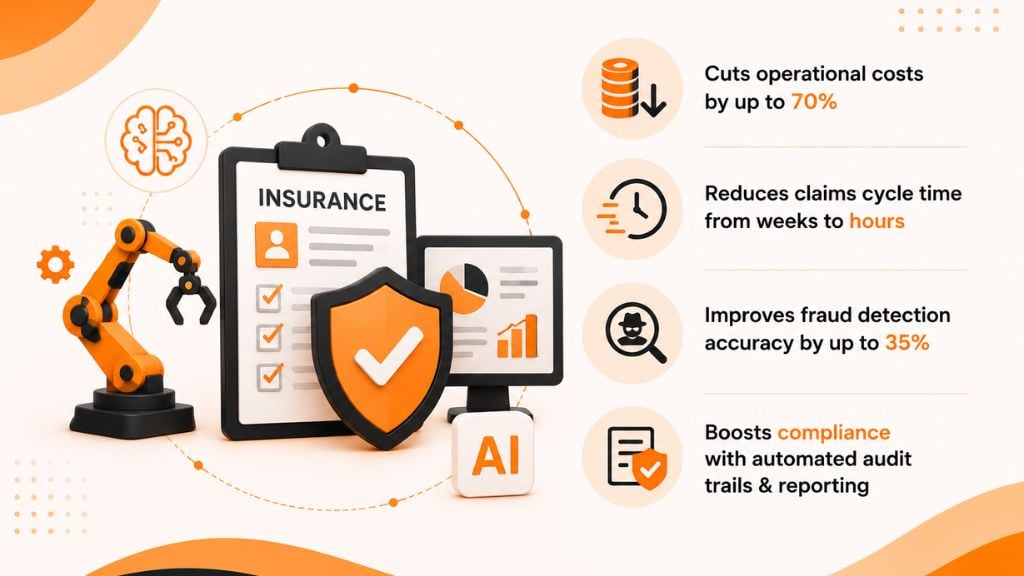
Core benefits of intelligent automation in insurance:
- Cuts operational costs by up to 70% (Gartner, 2026)
- Reduces claims cycle times from weeks to hours (Insurance Thought Leadership, 2026)
- Improves fraud detection accuracy by up to 35% (Forbes, 2026)
- Boosts compliance by automating audit trails and regulatory reporting
When these technologies work together, insurers can optimize workflows from claims to renewals. This is essential as the industry moves to “Insurance 4.0,” where digital speed and accuracy are non-negotiable.
How Intelligent Automation Drives Insurance Efficiency: Key Gains, KPIs, and What’s Possible in 2026
Efficiency gains from intelligent automation are real and measurable. The right technology stack will impact costs, processing times, errors, and customer satisfaction.
Based on the latest industry research, here is what’s possible in 2026 when insurers automate strategically.
| KPI/Metric | Before Automation | After Automation (2026 Avg) | Source |
| Claims cycle time | 7–21 days | Same-day to next-day | ITL, 2026 |
| Operational cost savings | Baseline | 30–70% lower | Gartner, 2026 |
| Fraud detection accuracy | Baseline | +35% improvement | Forbes, 2026 |
| Processing error rate | 7–10% | Below 2% | Forrester, 2026* |
| Net Promoter Score (NPS) | Industry Avg. 36 | Increased by up to 15 points | IDC, 2026 |
In my experience, teams that track and benchmark these KPIs see ROI faster. A better approach is to tie automation goals to one or two business-critical metrics—such as claims settlement speed and compliance rates—before scaling further.
Key efficiency gains:
- Faster claims resolutions drive higher customer satisfaction.
- Lower processing errors mean fewer regulatory headaches.
- Significant cost savings free up budgets for innovation.
This level of transformation is what sets top-quartile insurers apart in Insurance 4.0.
Where Intelligent Automation Delivers: Insurance Use Cases That Drive Value
Not every insurance process benefits equally from automation. The best results come from targeting high-volume, repetitive, and rules-based workflows first. Below are the most impactful use cases I have seen succeed in the field.
Claims Processing Automation: Speed, Accuracy, and Fraud Prevention
Claims handling is often the top target for automation. From first notice of loss to adjudication, manual steps can drag out the process.
Automated workflows now enable:
- Instant FNOL intake (via digital portals or bots)
- Automatic document sorting and validation
- AI-driven checks for fraud signals, catching abnormal patterns fast
I have seen insurers reduce claim settlement times from weeks to hours—and detect more fraud—by automating claims processing.
Underwriting Automation: Smarter Risk Decisions, Faster Approvals
Underwriting involves complex data collection and analysis. Automation changes the game with:
- Data extraction from documents for risk assessment
- Machine learning models to score risk and suggest premiums
- Real-time adjustments based on new data, cutting approval times
Faster underwriting means more policies sold and less risk overlooked.
Policy Administration: Efficiency in Renewals & Changes
Routine policy changes drain resources. Automation delivers:
- Instant policy issuance and endorsements
- Digital self-service for customers to manage policies
- Chatbots for basic policyholder questions
In my experience, most policy changes can be automated with high accuracy, reducing manual workload for support teams.
Compliance & Regulatory Automation: Reduce Human Error, Prove Audit Trail
Staying compliant is a top concern, especially in highly regulated markets.
Automation tools provide:
- Accurate document templates (e.g., with vendors like Templafy)
- Automated KYC/AML checks and monitoring
- Real-time tracking of regulatory changes and report generation
This approach greatly reduces audit failures and regulatory risk.
Customer Experience & Engagement: 24/7 Service & Personalization
Customers expect quick answers and tailored service.
Typical automation-driven improvements include:
- AI chatbots that answer common queries around the clock
- Targeted recommendations for coverage and renewals
- Automated notifications on claim status or policy events
Firms that invest here see higher loyalty and NPS scores.
Step-by-Step Framework: Implementing Intelligent Automation in Insurance for Efficiency
A major mistake I see is treating automation as plug-and-play. Real results demand a structured approach. Here’s a 5-step playbook that insurance leaders use for the best outcomes.
1. Identify Automation Opportunities: Map High-Value Processes
Start by analyzing workflow data. Look for repetitive, high-volume, or error-prone tasks. Claims intake, policy renewals, and document processing are often quick wins.
Select pilot processes where benefits can be proven fast. Avoid starting with the most complex legacy workflows.
2. Selecting Technologies & Vendors: Beyond Hype to Real Fit
Compare available solutions. Consider:
- AI for predictions and risk scoring
- RPA for repetitive tasks
- Document automation for compliance
Evaluate platforms like Templafy (document automation) and FinFlos (core workflow automation). Consider integration, support, scalability, and vendor reputation. Avoid choosing tech based solely on buzzwords.
3. Integration & Overcoming Legacy Systems
Legacy core systems are common pain points. Solutions should offer robust APIs or middleware support. In my experience, teams get stuck here when they try to “rip and replace” legacy platforms, instead of layering automation on top.
Connect new automation tools with minimal disruption to existing processes.
4. Managing Change: Training, Buy-In, and Automation Fatigue
Change can create resistance or fatigue. A better approach is to:
- Clearly communicate the “why” of automation to all staff
- Involve operations teams early in design and testing
- Upskill or retrain staff for new, hybrid roles
- Provide ongoing support and check-ins
Last year, when our dev team rolled out new tools, success came from early and open communication, not just great tech.
5. Measuring Success: Setting KPIs and Tracking ROI
Set clear, relevant KPIs from the start. This should include:
- Turnaround time (TAT) per claim or policy
- Cost per processed item
- NPS or customer satisfaction index
A sample ROI calculation for automation projects:
ROI = (Cost Savings + Revenue Gains from Efficiency - Automation Investment) / Automation Investment
Real-world insurers have reported direct cost savings of 30–70% (Gartner, 2026). Teams that track metrics monthly see problems and adjust faster.
What Are the Biggest Challenges with Intelligent Automation in Insurance and How to Overcome Them?
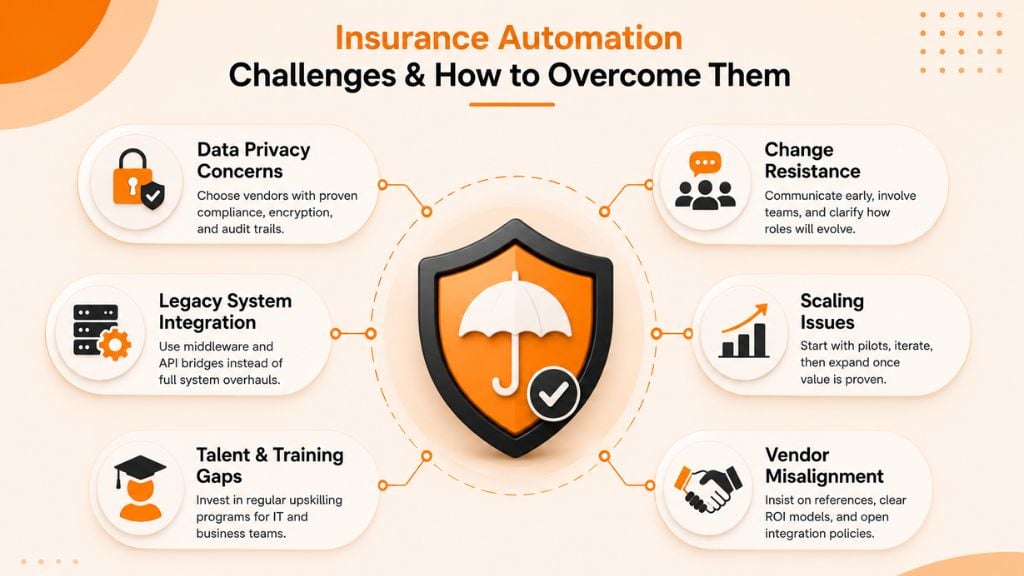
Even with strong business cases, most insurers will hit real obstacles. Below are some of the most common challenges and how leading teams address them.
Data privacy and compliance are top hurdles. Strict regulations like GDPR mean automation platforms must secure and audit all data handling.
Legacy systems slow down integration, especially where APIs are missing. Training and talent gaps also matter; new skills in data, AI, or process design are needed for long-term success. Staff may fear “automation fatigue” or role loss, unless change is managed well.
Major challenges and countermeasures:
- Data privacy concerns: Choose automation vendors with proven compliance, encryption, and audit trails.
- Legacy system integration: Use middleware and API bridges rather than full system overhauls.
- Talent and training gaps: Invest in regular upskilling programs for both IT and business operations.
- Change resistance: Communicate early, involve teams, clarify how roles will evolve.
- Scaling issues: Start with pilots, iterate, then expand to more complex workflows once value is proven.
- Vendor misalignment: Insist on references, clear ROI models, and open integration policies.
A mistake I see often is underestimating the culture and communication needed when deploying new tools. A better approach is to weave training and communication throughout every step.
Future of Intelligent Automation in Insurance: Trends, Innovations, and 2026 Outlook
The insurance industry is changing quickly. In 2026, several trends are shaping the future of automation.
Generative AI and agentic AI now impact policy drafting, claims handling, and customer interactions. The adoption of low-code and no-code platforms allows business teams to design and adapt workflows with less IT dependency. More insurers deliver fully personalized products, using AI to match coverage and pricing in real time.
These trends also bring new regulatory scrutiny, especially as AI decisions impact financial risk and customer rights.
2026 automation trends:
- Generative/agentic AI handles end-to-end workflow orchestration
- Low-code tools speed up process innovation
- Fully digital, personalized policies become the norm
- Increasing regulatory attention on AI transparency and fairness
Insurers who invest in these trends early will be better placed to adapt as Insurance 4.0 standards keep evolving.
Real-World Case Studies and Results: Intelligent Automation in Action
Industry leaders are already seeing transformation from automation. I often refer clients to these real-world examples when making the business case to leadership.
- Lemonade: Uses AI to process claims, often resolving simple ones in seconds. This led to higher NPS scores and lowered loss adjustment expenses
- AIG and Allstate: Use RPA bots for compliance reporting, reducing audit preparation times by more than 40%.
- Templafy: Helped insurers reduce manual document errors and cut processing time by automating template creation and distribution.
| Company | Automation Use Case | Result (2026) |
| Lemonade | AI claims processing | Claims settled in minutes, +20 NPS |
| AIG | RPA for compliance | 40% audit prep time saved |
| Templafy | Document automation | 95% error reduction in docs |
These benchmarks prove that results are possible with the right process and tools.
Key Factors for Insurance Automation Success
I have seen insurers succeed when they focus on a few critical factors. Early planning, right-fit technology, and robust change management set the stage for strong results. Teams that skip these steps often face costly delays or poor adoption.
Key focus areas:
- Start small and scale: Pilot simple processes, then expand.
- Track value: Tie projects to measurable KPIs.
- Involve users: Gather feedback from frontline staff and customers.
- Invest in integration: Plan for both old and new tech to work together.
A quick checklist ensures nothing is missed along the way.
How Riseup Labs Can Help Insurance Leaders Move Forward
Many insurers need a partner who knows both the technology and insurance business. I have worked with teams that lacked hands-on support, and their projects struggled as a result. Riseup Labs provides practical expertise, tailored training, and support across technology and workflow challenges.
Their teams can:
- Assess automation opportunities unique to your business
- Recommend and implement the right mix of AI, RPA, and analytics
- Guide integration with legacy systems to minimize downtime
- Train your staff and help drive adoption
For leaders seeking proven ROI and reliable rollout, expert support can make the difference.
Conclusion
Intelligent automation in insurance for efficiency is no longer just a technology upgrade. It is becoming a practical way for insurers to reduce manual work, speed up claims, improve accuracy, and deliver better customer experiences.
The best results come from starting with clear goals and choosing the right workflow to automate first. Claims processing, underwriting, compliance checks, customer support, and document handling are strong starting points for many insurers.
By combining AI, RPA, analytics, and process redesign, insurance companies can build faster, smarter, and more scalable operations. To move forward, start with a workflow audit, identify high-impact automation opportunities, and work with an experienced technology partner like Riseup Labs to plan and implement the right solution.
FAQs
What is intelligent automation in insurance?
Intelligent automation in insurance uses AI, RPA, and machine learning to automate core processes like claims, underwriting, and policy management, making operations faster and more efficient.
How does intelligent automation make insurance more efficient?
Automation reduces manual work, shortens processing times, lowers costs, and cuts errors. It allows insurers to handle claims and underwriting much faster while improving compliance and customer experience.
What are typical use cases of automation in insurance?
Common use cases include claims processing, underwriting, document management, regulatory compliance, fraud detection, and customer service chatbots.
Which insurance processes benefit most from automation?
Claims processing, underwriting, and policy renewals gain the most due to high volume and repetitive tasks, followed by compliance reporting and fraud monitoring.
How does automation help with regulatory compliance?
Automation ensures accurate record-keeping, generates audit-ready reports, automates KYC and AML checks, and tracks regulatory changes in real time.
How can insurers measure ROI from intelligent automation?
Insurers measure ROI by tracking cost savings, processing speed, error reduction, NPS scores, and revenue growth after deploying automation solutions.
What challenges do insurers face when implementing automation?
Key challenges include legacy system integration, data privacy compliance, talent gaps, change resistance, and scaling issues.
How does generative AI differ from RPA in insurance automation?
Generative AI creates content and makes complex decisions, while RPA automates rule-based, repetitive tasks. They are often used together for broader automation.
What trends define intelligent automation in insurance in 2026?
Key trends include generative and agentic AI, low-code platforms, personalized products, and stricter regulatory oversight of AI-based decisions.
Which vendors lead in providing intelligent automation for insurance?
Leading vendors in 2026 include Templafy, FinFlos, Lemonade (for AI claims), and established RPA platforms with insurance specialization.
This page was last edited on 29 June 2026, at 11:07 am

Start a conversation with our team to solve complex challenges and move forward with confidence.