Quick Answer:
Outsourcing software development to Eastern Europe gives companies access to large, skilled talent pools, competitive rates, strong English proficiency, and reliable quality. Poland, Ukraine, and Romania are leading choices—balancing cost, skill, and delivery reliability for both startups and enterprises.
Many companies choose offshore vendors to save money but encounter quality issues, miscommunication, or missed deadlines. These problems lead to slow launches and wasted budget.
Today, talent shortages and high costs make traditional outsourcing regions less attractive. Eastern Europe offers skilled teams, cost efficiency, and solid English, attracting businesses seeking better results.
This practical guide explains software development outsourcing to Eastern Europe. It compares countries, details risks, and provides clear frameworks to help you avoid mistakes and secure reliable delivery.
What Does Software Development Outsourcing to Eastern Europe Mean?
Software development outsourcing to Eastern Europe means working with external teams or agencies in countries like Poland, Ukraine, or Romania to deliver digital products or augment your internal staff.
Companies do this to expand capacity, access deep tech skills, lower costs, and ensure business continuity. Teams work remotely or through hybrid models and can take full projects, support existing teams, or provide specialist skills.
- Dedicated teams: A group works only on your projects.
- Project-based delivery: Hired for a set project with a fixed scope.
- IT staff augmentation: Add developers to your team for flexible terms.
The main goal is to achieve business results without sacrificing quality or control.
Eastern European software development outsourcing means hiring teams or vendors in countries like Poland, Ukraine, and Romania to deliver custom digital solutions, often combining technical depth, process rigor, and cost advantage.
Why Does Software Outsourcing in Eastern Europe Matter Now?
Choosing the right outsourcing region is critical for stability and growth. Most traditional destinations, such as India or Latin America, face rising costs, quality variability, or time zone challenges.
Shifts in the software market include:
- Growing global demand for skilled engineers
- More remote development after 2020
- Heightened security, IP, and compliance concerns
- Buyers demanding predictable quality and communication
Eastern Europe stands out for:
- Large STEM graduate pools and strong technical education
- EU data protection laws (GDPR)
- Good cost-to-skill ratio
- High English proficiency, especially in Poland and Romania
- Favorable time zones for US and Western Europe
Companies not adapting may struggle with delays, poor code, or reputational risk.
What Problems Are Buyers Trying to Solve?
| Buyer Type | Key Pain Points |
| Direct clients | Project delays, cost pressure, skill gaps, quality concerns |
| Partners/agencies | Overflow management, vendor reliability, control over quality |
| Staff augmentation | Fast hiring, skill matching, onboarding friction |
For example, a CTO may seek urgent capacity to meet a product launch after an internal team falls behind. A digital agency may outsource peak demand projects to avoid client delays. Procurement leads need to ensure legal, security, and quality risks are controlled.
What Are the Main Options and Engagement Models?
Understanding the main engagement models in Eastern Europe helps you choose the right fit for your needs.
- In-house team: Full internal control, but slow to scale and higher cost.
- Project-based outsourcing: Clear scope and delivery, less flexibility.
- Dedicated team: Long-term, integrated partnership, more control and flexibility.
- IT staff augmentation: Add vetted engineers to your in-house team as needed.
Comparison Table: Engagement Models
| Model | Flexibility | Control | Ramp-up Speed | Best for | Risk Level |
| In-house | Low | High | Slow | Core teams, IP setup | Low |
| Project-based | Low | Medium | Medium | Fixed scope, MVP | Medium |
| Dedicated team | High | High | Medium | Ongoing dev, scaling | Low-Med |
| Staff augmentation | High | High | Fast | Filling skill gaps | Low-Med |
The right choice depends on project type, timeline, and risk appetite.
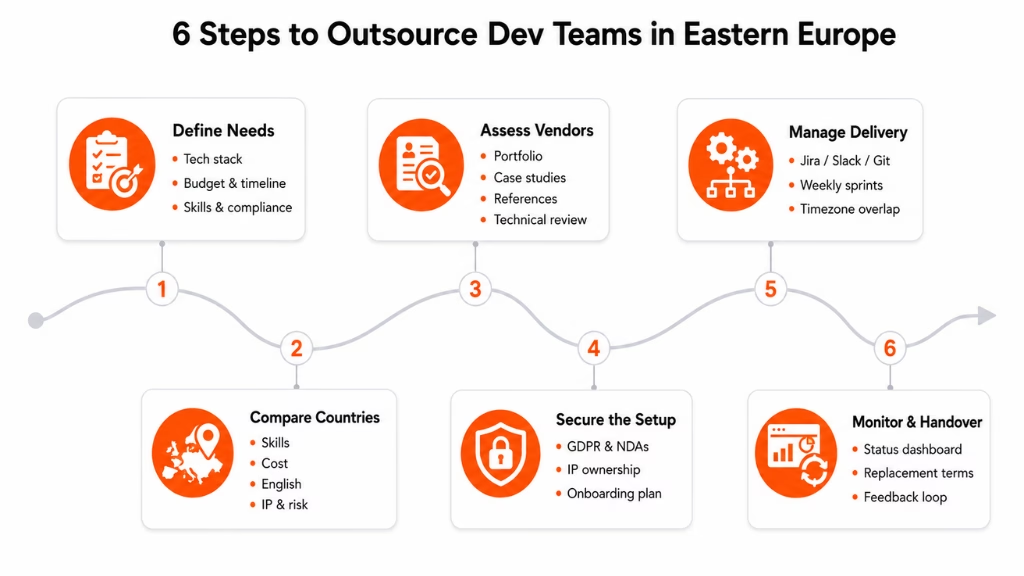
How to Outsource Software Development to Eastern Europe: 6 Steps
Step 1—Define Project and Technical Requirements
Start by specifying your technical needs and business goals. Missing this step leads to the wrong vendor or skill fit.
- Define stack (Java, Python, AI, etc.)
- Clarify budget and deadlines
- List must-have skills and compliance needs
Teams that skip this may waste time on mismatched proposals.
Step 2—Shortlist Countries Using the Fit Scorecard
Map your priorities to country strengths: tech skills, cost, English, legal/IP, risk.
Sample Scorecard
| Factor | Poland | Ukraine | Romania | Bulgaria |
| Technical skills | 5 | 5 | 4 | 3 |
| English/proc. | 5 | 4 | 5 | 5 |
| Cost | 4 | 5 | 4 | 5 |
| IP/Security | 5 | 3 | 5 | 5 |
| Risk/political | 5 | 3 | 5 | 5 |
Use this matrix to identify countries with the best fit for project goals.
Step 3—Vendor Pre-Assessment
Evaluate potential partners for experience, process, and transparency.
- Review portfolios and case studies
- Ask for client references
- Require technical reviews
Never hire on claims alone; always check delivery proof.
Step 4—Operational and Security Readiness
Ensure contracts and operational plans protect your interests.
- Review data/IP security policies (GDPR, NDAs)
- Clarify deliverable ownership
- Outline onboarding/check-in routines
Poor controls risk legal or data exposure.
Step 5—Collaboration & Delivery Management
Agree on tools and delivery cycles early.
- Align on platforms (Jira, Slack, Git)
- Set up weekly sprints or demos
- Plan for timezone overlap
Strong routines prevent miscommunication and missed deadlines.
Step 6—Monitoring, Handover, and Issue Remediation
Monitor progress and plan for team changes.
- Use transparent status dashboards
- Agree on developer replacement terms
- Capture regular feedback
Be ready to act if issues arise or the context shifts.
Country-by-Country Comparison: Strengths, Risks, and Fit
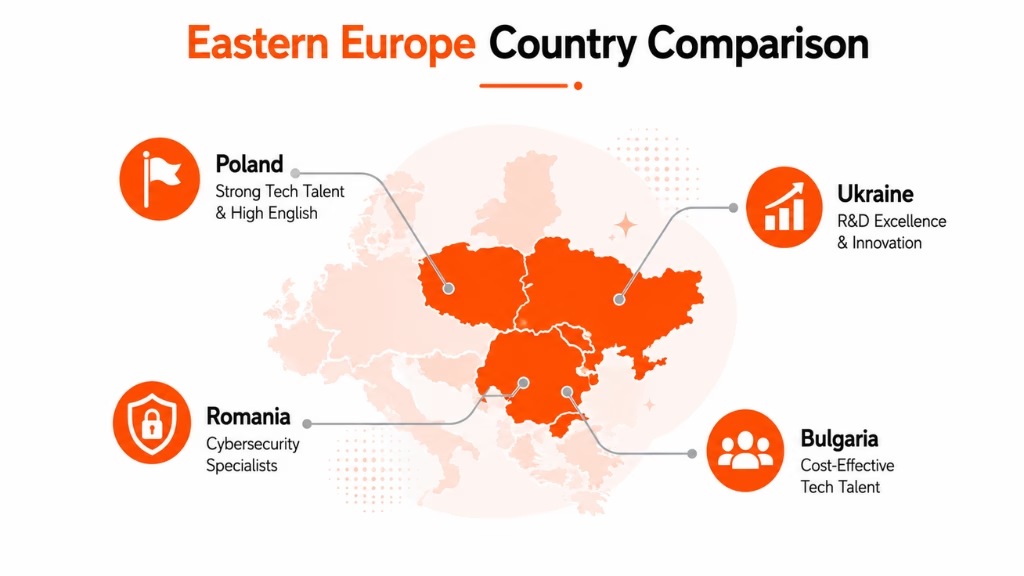
Choosing the right country shapes cost, culture, and success. Use the table and summaries below for shortlisting.
Eastern European Country Comparison Table
| Country | Tech Strengths | Avg Hourly Rate | Talent Pool | English Level | IP/Data Security | Political/Security |
| Poland | Enterprise, AWS/Java | $35–$99 | 400k+ | High | Strong (EU) | Stable |
| Ukraine | AI, R&D, Web/Mobile | $30–$85 | 200k+ | Moderate-High | Improving | Elevated in areas |
| Romania | Cyber, Embedded | $30–$80 | 140k+ | High | Strong (EU) | Stable |
| Bulgaria | Data Science, .Net | $25–$70 | 70k+ | High | Strong (EU) | Stable |
| Hungary | Automotive, QA/Testing | $30–$80 | 70k+ | Medium-High | Strong (EU) | Stable |
| Baltics | Cloud, Fintech | $40–$95 | 50k+ | High | Strong (EU) | Stable |
Poland: Top for large, complex projects and high English fluency.
Ukraine: Ideal for R&D, innovation, and rapid scaling; some political risks.
Romania: Good for cybersecurity and embedded skills, strong regulatory environment.
Bulgaria/Hungary: Lower cost with solid skill sets, especially in niche tech.
Baltics: Higher price, but advanced cloud/fintech capacity.
Choose based on your risk, skill, and communication needs.
Benefits and Risks of Software Outsourcing to Eastern Europe
Outsourcing to Eastern Europe can bring cost savings, reliable skills, and better alignment to Western standards—but it comes with specific risks.
Benefits vs. Risks Table
| Benefit | Risk |
| Lower costs | Political instability (Ukraine) |
| Large talent pool | Developer attrition |
| Strong English | Variable communication routines |
| EU data/IP laws | Legal/IP mismatch if not reviewed |
| Fast scaling | Onboarding gaps, quality drift |
| Time zone overlap | Project ownership confusion |
Risk Mitigation Checklist:
- Always use clear contracts specifying IP/data security.
- Vet vendors’ QA and monitoring processes.
- Set up proactive communication and reporting routines.
- Retain some internal technical control.
- Plan for team changes or scaling needs.
Service-Specific Technical Considerations
Technical rigor underpins project success. Eastern European teams generally excel with these stacks and methods:
- Technologies: Java, JavaScript (React, Node.js), Python, .NET, C++, PHP, AI, Cloud
- Project management: Agile frameworks (Scrum, Kanban)
- QA routines: Frequent code reviews, defect tracking, test automation
- Security/process: GDPR and EU standards, NDAs, legal clarity
- Tooling: Jira, Git, Slack, Bitbucket, Zoom—ensuring smooth collaboration
- Communication: Good English, direct feedback culture, frequent updates
- Integration: Flexible hours; many teams adapt to US/Western EU time zones
- Hand-off: Clean code documentation and stepwise knowledge transfer
A buyer should confirm the technical tools, check certifications or compliance, and validate cultural alignment.
Common Outsourcing Mistakes to Avoid in Eastern Europe
Mistakes often occur when rushing vendor selection or skipping due diligence. Avoid these common errors:
- Skipping clear project scoping up front
- Relying on verbal promises, not written proof
- Ignoring security/IP contract details
- Overlooking QA routines and process demos
- Not aligning on communication tools and routines
- Failing to plan team integration or knowledge transfer
Double-check vendor references and review their onboarding process before signing.
How to Choose the Right Eastern European Vendor or Partner
Vendor choice determines results. Use this criteria table to run due diligence.
| Criterion | Why It Matters | Buyer Question | Proof Needed |
| Tech expertise | Prevent skill gaps | Do they match my stack? | Portfolio, tech interviews |
| QA process | Minimize defects | How is quality checked? | QA docs, sample sprints |
| Security/data/IP | Risk reduction | Safe with my data? | NDA, GDPR, contract |
| Communication | Avoid misunderstanding | Will we stay in sync? | English testing, process demo |
| Team stability | Retain momentum | What if devs leave? | Replacement policy |
| Scaling | Flex as needs change | Can team size change? | Samples of scale-up/down |
| References | Proof of trust | Who has worked with them? | Client references |
| Cost model | Avoid surprises | Any hidden fees? | Rate card, SOW breakdown |
Ask for specific proof for every point, not just claims.
Cost, Timeline, and Scope Considerations
Cost and schedule depend on several factors. Avoid surprises by understanding key drivers.
Cost Factor Table
| Factor | Impact on Cost | Notes |
| Country | Labor rates, compliance costs | Poland and Baltics higher; UA/BG lower |
| Tech stack | Rarity/complexity premium | Niche skills cost more |
| Team size | Scale discounts vs. overhead | Large teams may need more onboarding |
| Model | Longer-term (lower hourly) | Staff aug/dedicated teams often more flexible |
| QA & support | More QA adds upfront cost | Reduces risk of future rework |
| Comm/process | Deeper engagement = more cost | Includes regular syncs, overlap hours |
Typical timeline to launch a team:
– Project-based: 2–6 weeks
– Staff augmentation: 1–4 weeks
Scope creep, unclear SOW, or late changes can drive up both time and cost.
Real-World Scenarios and Case Examples
- Direct client scenario: A SaaS startup’s internal team misses deadlines. They contract a Polish team for backend scaling. Onboarding clarity and weekly demos restore schedule control.
- Partner agency scenario: A European digital agency needs overflow bandwidth. By contracting a Romanian team with a clear warranty framework, they protect client delivery.
- AI staff augmentation: A fintech firm augments its AI capability with Ukraine-based engineers after failing to hire locally. Project picks up momentum, and communication routines help bridge remote distance.
These illustrate how different buyers can achieve reliability if onboarding and operational routines are managed well.
How to Measure Success: Metrics and Outcomes
- Time to team mobilization (TTM): Weeks from contract to sprint start
- Defect rate: Bugs per release; lower is better
- Sprint/QA adherence: % on-time milestone delivery
- Retention/stabilization: % team unchanged at key phase gates
- Cost savings: Payroll and total cost vs. in-house
Projects that track these see fewer surprises and better results.
When Riseup Labs May Be a Good Fit for Eastern European Outsourcing
Riseup Labs may fit projects that need reliable delivery, strong onboarding, and measurable outcomes. Buyers who benefit most include:
- Direct clients needing a custom application, AI, or mobile/web teams
- Product or digital agencies seeking staff augmentation or overflow capacity
- Teams valuing process, QA, and stepwise onboarding
- Firms concerned with scaling or stabilizing a technical team
- Buyers needing help scoping, onboarding, and integrating remote resources
If you need full project support, QA, onboarding focus, or to staff your own managed team, contact our experts to discuss your options. We focus on application development, QA, staff augmentation, and digital innovation.
Final Takeaway and Next Steps
The main decision is not just which country to choose, but how you onboard and manage delivery. Use the Country Fit Scorecard and Onboarding-to-Delivery Framework for safe, confident outsourcing in Eastern Europe.
Summing up, always:
- Define requirements first
- Align country and partner to your need
- Demand process, proof, and clear contracts
- Set up strong reporting and handoff cycles
To prepare for your journey, request a custom onboarding roadmap or a country fit consultation from Riseup Labs. Our team can review your plan and share onboarding templates and evaluation checklists tailored to your project.
FAQs: Software Development Outsourcing to Eastern Europe
What are the best countries for software outsourcing in Eastern Europe?
Poland, Ukraine, and Romania are top choices—offering skilled talent, good English, and solid legal protection. Bulgaria and Hungary are also popular for specific tech needs or budget focus.
How much does it cost to outsource to Poland, Ukraine, or Romania?
Hourly rates usually range from $30 to $99, depending on country, technology, and team seniority. Rates in Poland and the Baltics are at the higher end; Ukraine and Bulgaria are more cost-effective.
What risks do I face with Eastern European vendors?
Risks can include team attrition, miscommunication, IP or legal gaps, and, in some areas, political instability. These can be managed by using strong contracts, clear onboarding, and active project monitoring.
How do I select a reliable vendor in Eastern Europe?
Check technical proof, demand references, review client stories, and ask detailed questions about their QA, onboarding, and security processes. Favor vendors with strong documentation and clear communication routines.
How does Eastern Europe compare to Asia or Latin America for software outsourcing?
Eastern Europe offers stronger English skills, EU data standards, easier time zone overlap with Western clients, and a focus on code quality and process. Asia and LatAm can offer lower prices but may have greater delivery or communication risks.
This page was last edited on 9 July 2026, at 11:07 am

Start a conversation with our team to solve complex challenges and move forward with confidence.