Java and .NET are both powerful enterprise ecosystems, but they differ in focus and strengths. Java dominates in Big Data, Android, and cross-platform backend systems, while .NET excels in Microsoft Azure integration, high-performance APIs, and modern developer-friendly tooling. The best choice depends on your industry, cloud stack, and scalability needs.
Whether you’re a developer choosing your next tech stack, a student deciding where to invest your learning time, or a business evaluating platforms for your next big project, the .NET vs Java debate is one you’ve likely encountered. Both have been powering enterprise software for decades, both have massive ecosystems, and both refuse to go away.
So which one should you choose?
In this guide, we break down every meaningful difference between Java and .NET from architecture and performance to job market trends so you can make an informed decision rather than picking based on hype.
What Is Java?
Java is a high-level, object-oriented, platform-independent programming language first released by Sun Microsystems in 1995. Now maintained by Oracle Corporation, Java follows the famous “Write Once, Run Anywhere” (WORA) principle — code compiled on one platform can run on any device with a Java Virtual Machine (JVM) installed.
Java is one of the most widely used languages in the world, powering everything from Android mobile apps and enterprise backends to financial trading systems and big data pipelines. Its strong type system, extensive standard library, and massive open-source ecosystem make it a go-to choice for enterprise development.
Java is best suited when you need:
- True platform independence across diverse operating systems
- Large-scale enterprise or Android mobile applications
- Rich open-source tooling and third-party library support
- Integration with big data technologies (Hadoop, Spark, Kafka)
What Is .NET?
.NET is an open-source, cross-platform development framework developed and maintained by Microsoft. Originally released in 2002 as the Windows-only .NET Framework, Microsoft later launched .NET Core (2016) to support cross-platform development. Since .NET 5 (2020), the two branches were unified into a single, modern platform simply called .NET — now at version 9 as of 2026.
.NET applications run on the Common Language Runtime (CLR), which handles memory management, garbage collection, security enforcement, and exception handling. The primary language used in .NET is C#, though F# and VB.NET are also fully supported.
. NET is best suited when you need:
- Deep Microsoft ecosystem integration (Azure, Windows, Office)
- High-performance web APIs and cloud-native applications
- Cross-platform desktop applications (via .NET MAUI)
- Game development (Unity game engine runs on .NET)
History and Background
Understanding how both technologies evolved helps explain many of their design choices.
Java’s Timeline:
- 1995 — Java 1.0 released by Sun Microsystems
- 2006 — Sun open-sources Java under the GPL license
- 2010 — Oracle acquires Sun Microsystems, takes over Java stewardship
- 2017 — Java moves to a 6-month release cadence (Java 9+)
- 2021–2026 — Java 17, 21 (LTS), and beyond continue adding modern features (records, sealed classes, virtual threads via Project Loom)
.NET’s Timeline:
- 2002 — .NET Framework 1.0 released (Windows-only)
- 2016 — .NET Core 1.0 released (cross-platform)
- 2020 — .NET 5 unifies the ecosystem
- 2021–2026 — .NET 6, 7, 8, 9 bring significant performance improvements, AOT compilation, and native interop enhancements
Both platforms have matured significantly and continue to receive active investment — Java by Oracle and the OpenJDK community, .NET by Microsoft and open-source contributors on GitHub.
Core Architecture: JVM vs CLR
This is one of the most fundamental technical differences between the two.
Java Virtual Machine (JVM)
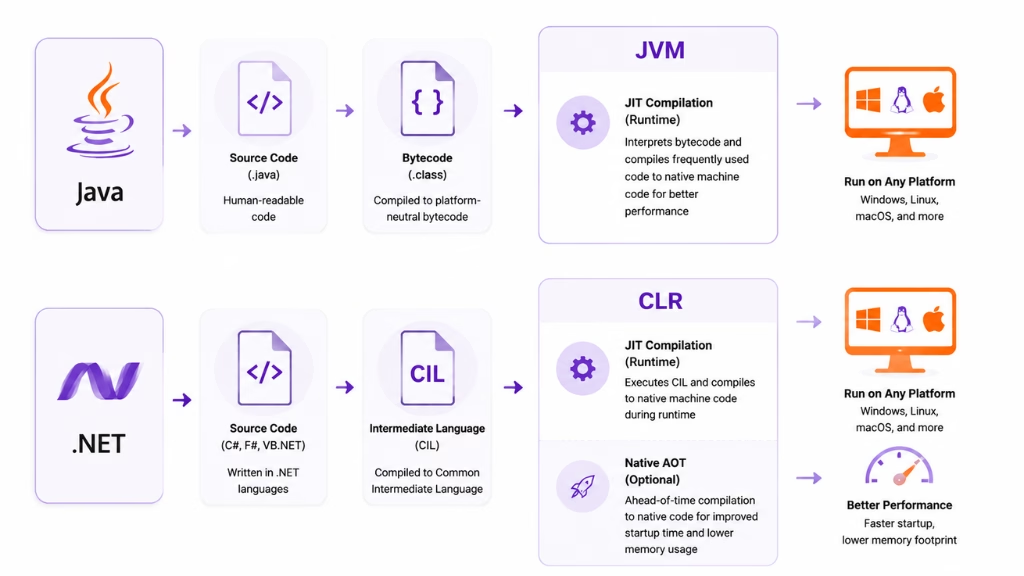
Java source code is compiled into bytecode (.class files), which is then interpreted and executed by the JVM at runtime. The JVM uses Just-In-Time (JIT) compilation to convert frequently executed bytecode into native machine code, improving performance over time.
The JVM runs on virtually any platform — Windows, Linux, macOS, and even embedded systems — as long as a compatible JVM is installed. This is what enables Java’s famous platform independence.
Common Language Runtime (CLR)
.NET source code (C#, F#, VB.NET) is compiled into Common Intermediate Language (CIL), which is then executed by the CLR via JIT compilation. The CLR also handles cross-language interoperability — meaning you can write one assembly in C# and call it from F# without any special wrappers.
With .NET’s Native AOT (Ahead-of-Time) compilation, introduced in .NET 7 and refined through .NET 9, applications can now be compiled directly to native machine code — eliminating the JIT step entirely and producing faster startup times and lower memory usage. This is especially useful for serverless workloads, microservices, and CLI tools.
Key difference: Both use JIT compilation, but .NET has a mature AOT option for performance-critical scenarios where startup time matters.
Supported Programming Languages
Java Platform Languages
The JVM supports many languages beyond Java itself:
- Java — primary language
- Kotlin — modern, concise; officially preferred for Android
- Scala — functional + OOP; popular in data engineering
- Groovy — dynamic scripting on the JVM
- Clojure — functional Lisp dialect on the JVM
.NET Platform Languages
The CLR supports multiple .NET-compatible languages:
- C# — primary and most popular .NET language
- F# — functional-first language, excellent for data science
- VB.NET — legacy language, still maintained but declining
Key difference: Java’s JVM ecosystem has a broader selection of actively maintained, production-grade languages. .NET’s C# is arguably the most modern and well-designed language of the two ecosystems, continuously adding features (nullable reference types, pattern matching, records, primary constructors).
Platform and OS Compatibility
Java
Java has always had strong cross-platform support. A Java application runs on:
- Windows
- Linux (all major distributions)
- macOS
- Android (via the Android Runtime, a modified JVM)
- Embedded systems (Java ME, GraalVM native)
Java’s platform independence is a core design goal — not an afterthought.
.NET
Modern .NET (5+) is fully cross-platform:
- Windows
- Linux
- macOS
However, some caveats exist. Microsoft’s official desktop GUI frameworks (WPF, Windows Forms) remain Windows-only. .NET MAUI (Multi-platform App UI) provides cross-platform mobile and desktop GUI development, but it’s still maturing compared to platform-native alternatives.
For server-side workloads (APIs, microservices, cloud functions), .NET runs equally well on all platforms — Linux is actually the preferred deployment target for many .NET cloud applications.
Key difference: Java has a longer history of true cross-platform consistency. Modern .NET has closed the gap significantly for server-side work, but desktop GUI support is still more Windows-centric.
Performance Comparison
Performance is nuanced and workload-dependent — there’s no absolute winner here.
JVM Performance
The JVM’s JIT compiler has become extremely sophisticated over decades of optimization. The HotSpot JVM (used in OpenJDK) profiles running code and optimizes hot paths aggressively, meaning long-running server applications can achieve near-native performance.
Project Loom (virtual threads, stable in Java 21) dramatically improves Java’s concurrency performance, enabling millions of lightweight threads without the overhead of OS threads. This makes Java extremely competitive for high-throughput I/O-bound workloads.
.NET Performance
.NET has been a performance story since .NET Core. Benchmarks from TechEmpower Web Framework Benchmarks consistently place ASP.NET Core among the fastest web frameworks in existence, beating most JVM frameworks and even some C++ frameworks in specific scenarios.
Key advantages of .NET for performance:
- Span<T> and Memory<T> — zero-allocation memory access patterns
- Native AOT — eliminates JIT warmup, reduces memory footprint
- SIMD intrinsics — direct access to CPU vector instructions
- .NET 8/9 improvements — continued aggressive optimization of the runtime
For raw throughput benchmarks (HTTP requests per second, serialization speed), .NET/C# currently leads most JVM frameworks. However, for workloads where JVM’s JIT warm-up is acceptable (long-running services), the difference narrows significantly.
Key difference: For raw peak performance and startup speed, modern .NET has an edge. For sustained throughput on warmed-up servers, they’re closely matched.
Memory Management and Garbage Collection
Both Java and .NET use automatic garbage collection — neither requires manual memory management like C/C++.
Java’s GC
Java offers multiple garbage collector algorithms, and you can choose the right one for your workload:
- G1GC — default since Java 9, balanced throughput and latency
- ZGC — ultra-low latency, sub-millisecond pause times (Java 15+)
- Shenandoah — low-pause GC from Red Hat
- Epsilon — no-op GC for GC tuning experiments
Java’s GC is highly configurable but can require careful tuning for latency-sensitive applications.
.NET’s GC
.NET’s generational GC is considered more efficient out-of-the-box for most workloads. It uses generations (0, 1, 2) to optimize collection frequency. .NET’s GC also benefits from:
- Server GC vs Workstation GC modes
- GC regions (introduced in .NET 6) for better memory management
- Low latency mode for latency-sensitive scenarios
Key difference: .NET’s garbage collector is generally acknowledged to have lower average pause times with less manual tuning required. Java offers more GC options and flexibility for specialized workloads.
Security
Both platforms take security seriously, but they differ in approach and built-in features.
Java Security
Java has a robust security model built into the JVM:
- Security Manager (deprecated in Java 17, removed in Java 21) provided sandbox isolation
- Java Cryptography Architecture (JCA) — pluggable cryptography
- Strong type safety and bytecode verification prevent many classes of vulnerabilities
- Active security patches via Oracle’s quarterly CPU (Critical Patch Update)
Java’s long history means many security vulnerabilities have been found and patched. Deserialization vulnerabilities have historically been a weak point.
.NET Security
.NET is generally regarded as a step ahead in built-in security features:
- Code Access Security (CAS) and role-based security built into the runtime
- ASP.NET Core includes built-in protections against CSRF, XSS, SQL injection, and clickjacking
- Data Protection API for key management and encryption
- SecureString for handling sensitive data in memory
- Microsoft’s Security Development Lifecycle (SDL) influences framework design
For web applications specifically, ASP.NET Core’s built-in security middleware gives it an advantage over Java’s more fragmented approach to web security.
Key difference: .NET has an edge in built-in application security features, particularly for web development. Both are secure when used correctly, but .NET makes it harder to accidentally introduce web vulnerabilities.
Database Connectivity
Java: JDBC
Java uses JDBC (Java Database Connectivity) as its standard API for database access. On top of JDBC, popular ORMs and frameworks include:
- Hibernate / JPA — the most widely used Java ORM
- Spring Data JPA — simplifies repository patterns
- JOOQ — type-safe SQL builder
- MyBatis — SQL mapping framework
- R2DBC — reactive database connectivity
.NET: ADO.NET and Entity Framework
.NET uses ADO.NET as the low-level data access API. Built on top of that:
- Entity Framework Core — the premier .NET ORM, mature and feature-rich
- Dapper — lightweight micro-ORM, popular for performance-sensitive queries
- NHibernate — Hibernate port for .NET
Key difference: Both ecosystems have excellent ORM options. Entity Framework Core is arguably more integrated and developer-friendly for RAD (Rapid Application Development), while Hibernate/JPA has a longer track record in large enterprise environments.
IDEs and Development Tools
Java IDEs
Java has multiple excellent IDEs, giving developers more choice:
- IntelliJ IDEA — widely considered the best Java IDE (JetBrains)
- Eclipse — open-source, dominant in enterprise environments
- NetBeans — Apache-maintained, simpler alternative
- VS Code — increasingly popular with Java extensions
.NET IDEs
- Visual Studio — the gold standard for .NET development on Windows; rich debugging, profiling, and test tools built-in
- Visual Studio Code — Microsoft’s lightweight editor, excellent .NET support via the C# Dev Kit extension
- JetBrains Rider — cross-platform .NET IDE, gaining popularity among developers who prefer IntelliJ-style workflows
Key difference: Java gives you more IDE choices, which can be an advantage or a source of decision fatigue. Visual Studio is one of the most powerful IDEs ever built, giving .NET developers a premium out-of-the-box experience — though it’s Windows-only. VS Code and Rider are strong cross-platform alternatives.
Web Development Frameworks
Java Web Frameworks
- Spring Boot — dominant in enterprise Java; convention-over-configuration, massive ecosystem
- Spring MVC / Spring WebFlux — reactive web programming
- Jakarta EE — the enterprise Java standard (formerly Java EE)
- Quarkus — cloud-native Java; fast startup, low memory
- Micronaut — ahead-of-time compilation, great for microservices
- Vert.x — reactive, event-driven toolkit
.NET Web Frameworks
- ASP.NET Core — the primary web framework; MVC, Razor Pages, and minimal APIs
- Blazor — C# in the browser via WebAssembly or Server rendering
- gRPC (via ASP.NET Core) — high-performance RPC framework
- SignalR — real-time web communication (WebSockets abstraction)
- Minimal APIs — lightweight HTTP API style for microservices (introduced in .NET 6)
Key difference: Spring Boot and ASP.NET Core are the kings of their respective ecosystems. ASP.NET Core consistently ranks higher in raw performance benchmarks. Spring Boot’s ecosystem is arguably broader for enterprise integration patterns (Spring Integration, Spring Batch, Spring Cloud).
Mobile Development
Java for Mobile
Java was the original Android development language. Today, Kotlin has largely replaced Java for new Android projects (Google officially recommends Kotlin), but Java Android apps remain supported and common.
.NET for Mobile
- .NET MAUI (Multi-platform App UI) — Microsoft’s cross-platform mobile and desktop framework. Build once, deploy to iOS, Android, macOS, and Windows.
- Xamarin (the predecessor to MAUI) — now deprecated in favor of MAUI
- Unity — while not a mobile framework per se, Unity (which runs on .NET/Mono) dominates mobile game development globally
Key difference: Java (and Kotlin) remain the standard for native Android development. .NET MAUI is a viable cross-platform option when you want to share code across iOS, Android, and desktop — but it can’t match the performance of fully native Android development.
Cloud and Microservices Support
Java in the Cloud
Java has a massive footprint in cloud environments:
- Kubernetes and containerization — Java runs well in containers, though historically its large memory footprint was a challenge
- GraalVM Native Image — compiles Java to native binaries, dramatically reducing startup time and memory (ideal for serverless/FaaS)
- Quarkus / Micronaut — purpose-built for Kubernetes-native Java
- Spring Cloud — comprehensive suite for microservices patterns (service discovery, circuit breakers, config management)
- All major cloud providers (AWS, GCP, Azure) have first-class Java SDKs
.NET in the Cloud
- Azure — Microsoft’s cloud is deeply integrated with .NET; Azure Functions, App Service, and AKS all have first-class .NET support
- Native AOT — makes .NET serverless functions extremely fast and cheap to run
- .NET Aspire (introduced in .NET 8) — opinionated stack for cloud-native .NET applications with built-in observability, service discovery, and orchestration
- All major clouds support .NET with official SDKs
Key difference: .NET is the obvious choice if you’re building on Azure. For AWS or GCP, both Java and .NET are well-supported first-class citizens. .NET’s Native AOT gives it a distinct advantage in serverless/FaaS scenarios where cold start time directly impacts cost.
Community, Ecosystem, and Open Source
Java’s Ecosystem
Java has one of the largest open-source ecosystems in the world:
- Maven Central hosts over 500,000+ open-source packages
- The Apache Software Foundation maintains dozens of critical Java projects (Kafka, Spark, Hadoop, Tomcat)
- Massive Stack Overflow community with decades of answered questions
- Strong presence in Big Data, fintech, and government systems
.NET’s Ecosystem
.NET’s ecosystem has grown dramatically since Microsoft open-sourced it:
- NuGet package manager hosts 350,000+ packages
- Microsoft has fully open-sourced .NET on GitHub (github.com/dotnet)
- Strong corporate backing from Microsoft ensures long-term investment
- The MAUI, Blazor, Aspire push shows continued R&D investment
Key difference: Java’s ecosystem is larger and older, with more third-party integrations, especially in data engineering and enterprise middleware. .NET’s ecosystem is growing rapidly and has the advantage of strong corporate sponsorship ensuring consistent direction and quality.
Exception Handling
Both languages use try-catch-finally exception handling, but there are meaningful differences.
Java Exception Handling
Java distinguishes between checked exceptions (which must be declared or caught, e.g., IOException) and unchecked exceptions (e.g., NullPointerException). This forces developers to explicitly handle or propagate certain exceptions.
While this makes error handling more explicit, many developers find checked exceptions verbose and cumbersome, particularly with lambdas and streams.
try {
    FileReader file = new FileReader("file.txt");
} catch (FileNotFoundException e) {
    System.out.println("File not found: " + e.getMessage());
} finally {
    System.out.println("Cleanup code here");
}
.NET Exception Handling
C# uses only unchecked exceptions — there are no checked exceptions. Exceptions are organized in a rich hierarchy under System.Exception. .NET also offers:
- Exception filters (
whenkeyword) — more expressive exception handling ExceptionDispatchInfo— rethrow exceptions while preserving the original stack trace- Better integration with async/await exception handling
try {
    var file = File.OpenRead("file.txt");
} catch (FileNotFoundException e) when (e.Message.Contains("file.txt")) {
    Console.WriteLine($"File not found: {e.Message}");
} finally {
    Console.WriteLine("Cleanup code here");
}
Key difference: .NET’s exception handling is generally considered more ergonomic, especially with modern C# features like exception filters. Java’s checked exceptions enforce more explicit error handling but create more boilerplate.
Architecture Model: Connected vs Disconnected
Java: Connected Architecture
Java traditionally uses a connected architecture — database connections remain open during data operations via JDBC. This works well for transactional systems where continuous database communication is needed.
.NET: Disconnected Architecture
ADO.NET supports a disconnected architecture via the DataSet and DataAdapter classes — data is fetched, the connection is closed, and the data is processed locally. This reduces server load and improves scalability for read-heavy scenarios.
Modern .NET (with Entity Framework Core and async/await) blurs this distinction, but the original design philosophy reflects in how ADO.NET handles data caching and offline scenarios.
Learning Curve
Learning Java
- Java’s syntax is verbose but highly explicit, making it easier to understand what code does
- Strong typing and OOP principles enforced from day one build good habits
- Massive learning resources: books, courses, university curricula all favor Java
- Android development is a popular entry point for beginners
- Modern Java (16+) has added features (records, pattern matching, text blocks) that reduce boilerplate
Learning .NET / C#
- C# is widely considered more modern and ergonomic than Java
- Features like LINQ, properties, events, extension methods, and async/await make C# elegant for beginners
- Visual Studio provides unparalleled tooling support that helps beginners with IntelliSense, debugging, and refactoring
- Blazor lets developers build full-stack web apps entirely in C#, reducing the need to learn JavaScript
- F# is available for those interested in functional programming within the .NET ecosystem
Key difference: Both are learnable for beginners. Java has more structured university/academic pathways. C# is arguably the more pleasant day-to-day language for someone starting fresh today.
Jobs and Salaries in 2026
Java | ████████████████████████ $140,000
.NET | ███████████████████████ $135,000
Java Job Market
Java consistently appears among the top 3 most in-demand programming languages globally:
- Dominant in banking and financial services (Goldman Sachs, JPMorgan, Visa)
- Core language for Big Data engineering (Spark, Kafka, Hadoop jobs)
- Largest install base in enterprise backend development
- Android development continues to use Java (though Kotlin is preferred for new projects)
- Average salary: $120,000–$160,000/year in the US (senior Java developer)
.NET Job Market
.NET developers are in strong demand, particularly in enterprise and Microsoft-adjacent industries:
- Dominant in .NET-heavy enterprise companies (healthcare, government, Microsoft partners)
- Growing demand for cloud-native .NET on Azure
- C# powers Unity game development — one of the largest gaming ecosystems
- Strong demand in fintech and insurance in Europe especially
- Average salary: $115,000–$155,000/year in the US (senior .NET developer)
Key difference: Java has a broader global job market, especially outside the US. .NET offers strong salaries in specific verticals (Microsoft ecosystem, game development, European enterprise). Neither is a poor career choice in 2026.
Java vs .NET: Side-by-Side Comparison Table
| Feature | Java | .NET |
|---|---|---|
| Created By | Sun Microsystems (now Oracle) | Microsoft |
| Initial Release | 1995 | 2002 |
| Runtime | JVM (Java Virtual Machine) | CLR (Common Language Runtime) |
| Primary Language | Java | C# |
| Other Languages | Kotlin, Scala, Groovy, Clojure | F#, VB.NET |
| Platform Support | Windows, Linux, macOS, Android, Embedded | Windows, Linux, macOS |
| Open Source | Yes (OpenJDK) | Yes (github.com/dotnet) |
| Garbage Collection | G1GC, ZGC, Shenandoah (configurable) | Generational GC (efficient out-of-the-box) |
| Performance | Excellent (especially long-running) | Excellent (best-in-class startup with AOT) |
| Web Framework | Spring Boot, Quarkus, Micronaut | ASP.NET Core, Blazor |
| ORM | Hibernate / JPA | Entity Framework Core |
| Database API | JDBC | ADO.NET |
| Architecture | Connected | Disconnected |
| Mobile | Android (native), via Kotlin | .NET MAUI, Unity |
| Primary IDE | IntelliJ IDEA, Eclipse | Visual Studio, VS Code, Rider |
| Cloud Strength | AWS, GCP, Azure (all equal) | Azure (best), AWS/GCP (excellent) |
| Serverless | GraalVM Native Image | Native AOT |
| Security | Solid, needs more manual setup | Strong built-in web security |
| Exception Handling | Checked + unchecked | Unchecked only (more ergonomic) |
| Community Size | Very large | Large and growing |
| Game Development | Minimal | Unity (dominant) |
| Learning Curve | Moderate | Moderate (C# is very learnable) |
| Primary Use Cases | Enterprise backend, Big Data, Android | Enterprise, cloud, gaming, and desktop |
.NET vs Java: Which One Should You Choose?
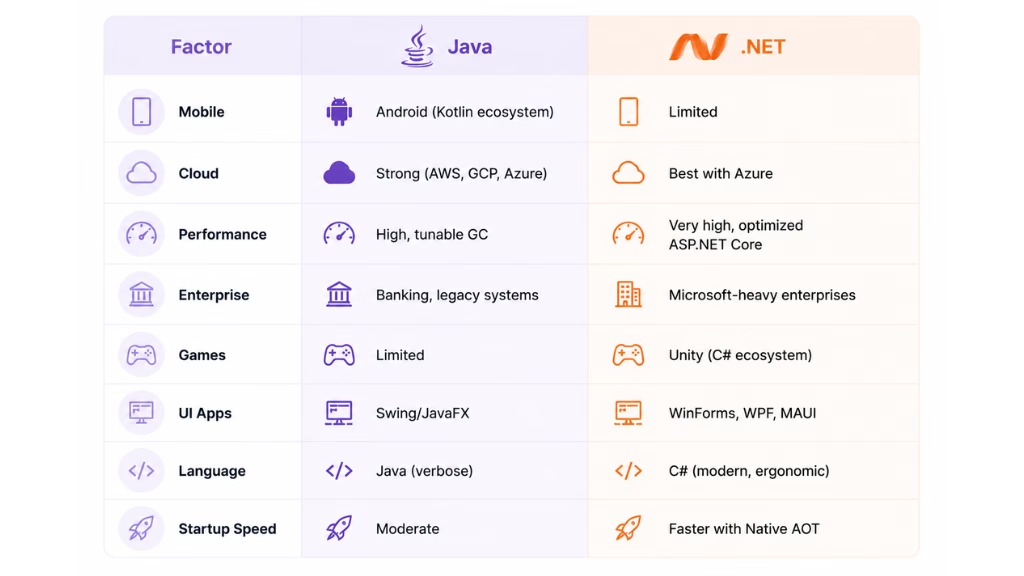
There’s no universally correct answer — the right choice depends on your context.
Choose Java if:
- You’re building Android mobile applications (with Kotlin)
- Your organization is in Big Data, data engineering, or ML pipelines (Spark, Kafka, Hadoop)
- You need the broadest possible cross-platform support including embedded and IoT devices
- You’re entering a field like banking, insurance, or government where Java dominates legacy systems
- You want the largest possible pool of third-party libraries and community resources
- You prefer more GC tuning options for performance-critical, latency-sensitive systems
Choose .NET if:
- You’re heavily invested in the Microsoft Azure ecosystem
- You want best-in-class web API performance out of the box (ASP.NET Core)
- You’re building Windows desktop applications or cross-platform apps with .NET MAUI
- You’re developing games using Unity (which uses C#/.NET)
- You want a more modern, ergonomic language — C# is consistently rated highly for developer satisfaction
- You want Native AOT for serverless workloads with minimal cold start times
- You’re building a Blazor full-stack app where your entire team knows C# and doesn’t want to write JavaScript
Both are excellent if:
- You’re building cloud-native microservices — both are first-class citizens on all major clouds
- You’re building REST APIs — Spring Boot and ASP.NET Core are both mature and battle-tested
- You need enterprise-grade security and reliability — both deliver
FAQs
Is Java or .NET better for freshers?
Both are excellent starting points. Java has more university curricula and academic resources. C# (the primary .NET language) is considered more beginner-friendly with excellent tooling via Visual Studio. Your choice should depend on what domain you want to work in.
Is .NET faster than Java?
For raw HTTP throughput and startup time, modern .NET (especially with Native AOT) currently benchmarks faster than most JVM frameworks. For long-running, warmed-up services with JIT optimization, the gap narrows significantly. Both are fast enough for virtually any enterprise workload.
Can .NET replace Java?
In server-side web development, yes — .NET is a capable full replacement. In Android development, Big Data, and certain open-source ecosystems, Java (and Kotlin) have no equivalent in the .NET world. They serve overlapping but not identical niches.
Is Java or .NET better for enterprise applications?
Both excel at enterprise development. Java dominates in industries with legacy investments (banking, telecom). .NET dominates in Microsoft-centric organizations. Greenfield enterprise projects in 2026 are often chosen based on cloud provider preference and team expertise.
Which has better performance — Java or C#?
ASP.NET Core (C#) leads raw HTTP benchmarks. Java’s JVM with modern GCs (ZGC) and Project Loom virtual threads is extremely competitive for concurrent workloads. For serverless functions, .NET’s Native AOT wins on startup time.
Is .NET free to use?
Yes. Modern .NET (5+) is completely free and open-source under the MIT license, available at github.com/dotnet.
Is Java free to use?
OpenJDK (the open-source Java distribution) is free under the GPL license. Oracle’s commercial JDK requires a paid license for production use. Many organizations use free alternatives like Amazon Corretto, Eclipse Temurin, or Microsoft’s OpenJDK distribution.
Which is better for web development — Java or .NET?
ASP.NET Core is consistently one of the top-performing web frameworks in independent benchmarks. Spring Boot has a broader ecosystem of enterprise integrations. For raw web API development, ASP.NET Core has a performance edge. For complex enterprise integration workflows, Spring has more mature tooling.
Conclusion
The .NET vs Java debate doesn’t have a winner it has two winners in different contexts. Java’s three-decade head start has given it an unrivaled ecosystem depth, particularly in enterprise, Big Data, and Android. .NET’s modern reinvention since going open-source and cross-platform has made it one of the most performant, developer-friendly platforms available today.
If you’re choosing between them today, the best decision is the one that aligns with your industry, your team’s existing expertise, and your target deployment environment. Both will serve you well for the next decade.
And if you’re learning from scratch? You genuinely can’t go wrong with either. The concepts transfer between them more easily than you might expect.
This page was last edited on 9 July 2026, at 11:10 am

Start a conversation with our team to solve complex challenges and move forward with confidence.