Delays, spiraling costs, and manual errors have long plagued legal contract review—crippling business speed and resource efficiency. In 2026, AI-driven contract review automation is redefining this landscape for legal teams, procurement, and law firms by dramatically accelerating contract cycles and improving accuracy.
This guide provides practical, step-by-step frameworks and up-to-date vendor comparisons to help you confidently assess, implement, and optimize AI systems for contract review automation. Unlike generic overviews, you’ll find actionable checklists, real-world scenarios, and data-backed benchmarks to inform your automation decisions.
By the end, you’ll know when, why, and how to automate, avoid costly pitfalls, and select the right legal AI platform for your needs.

What Is AI Contract Review Automation and How Does It Work?
AI contract review automation uses machine learning and natural language processing to analyze, extract, and assess contract terms quickly and accurately, minimizing manual legal review.
An AI contract review system processes contracts by:
- Extracting key clauses and structured data (e.g., renewal dates, obligations)
- Flagging risks and non-standard language
- Providing contract summaries and actionable recommendations
- Learning continuously from legal playbooks and human feedback
Key differences from manual review:
- Speed: AI can process large contract volumes in minutes.
- Consistency: Reduces variability in clause interpretation.
- Scope: Handles bulk, repetitive reviews (like NDAs, vendor agreements).
Example analogy:
Just as automated spellcheck highlights errors faster than human proofreading, legal AI finds contractual inconsistencies, omissions, or risks at scale and speed unreachable by manual methods.
How Do AI Contract Review Systems Work? Core Technologies Revealed
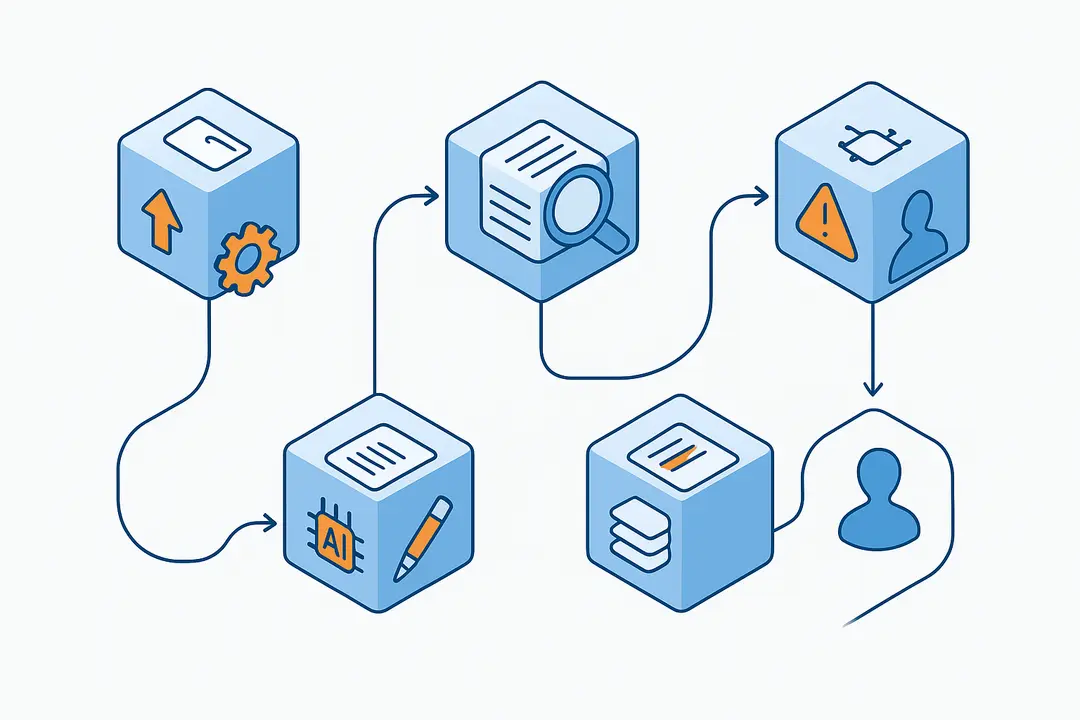
AI contract review systems automate the contract review workflow through a sequence of advanced technologies, enabling both efficiency and risk management.
Step-by-step workflow:
- Ingestion: Contracts are uploaded (PDF, Word, etc.).
- Preprocessing: Text is standardized and parsed.
- Clause Extraction (using NLP): Identifies specific clauses and key data points.
- Risk Scoring & Flagging: Machine learning models evaluate deviations from playbook standards, highlighting concerns.
- AI Redlining: Suggests edits, compares terms to benchmarks, and marks discrepancies.
- Summarization: Generates concise, human-readable contract summaries.
- Escalation: Flags complex or ambiguous sections for human legal review.
Core technologies:
- Natural Language Processing (NLP): Finds and interprets legal concepts and clause boundaries.
- Machine Learning & GenAI: Trains on historical contracts to refine accuracy, identify unusual patterns, and improve risk scoring.
- Clause Extraction AI: Converts unstructured text into structured outputs, powering analytics and reporting.
- Human-AI Hybrid Workflow: Users can seamlessly escalate ambiguous or high-stakes issues to legal experts. Human feedback retrains AI models for future improvement.
Adoption in practice:
Day 1 involves uploading “standard contracts” and activating playbook-driven checks. Over time, organizations can expand to more complex or custom agreements as the AI is tuned with human feedback and organization-specific playbooks.
When Should You Automate Contract Review? Scenarios & Use Cases Explained
AI contract review automation delivers the most value when applied to high-volume, standardized, or low- to moderate-risk agreements—yet certain scenarios still demand human oversight.
Best-suited contract types:
- NDAs (Non-Disclosure Agreements): High volume, standard terms.
- Vendor and Procurement Contracts: Routine clauses and recurring formats.
- Third-Party Paper: Initial “first pass” review for red flags.
- Renewals and Amendments: Detecting changed or unusual terms.
- Simple M&A Documents: Early-stage due diligence.
Decision Tree: When to Automate vs. Escalate
- Volume and Standardization
Large volume, standardized template: Automate
One-off or heavily negotiated: Escalate - Contract Risk Profile
Low or moderate risk (e.g., basic NDA): Automate
High-value, high-liability, new jurisdictions: Escalate - Jurisdiction and Language
Supported language/jurisdiction: Automate
Uncommon language or unfamiliar law: Escalate
Checklist for Automation Suitability:
- Is the contract routinely reviewed by your team?
- Will non-standard clauses appear, and can AI flag them?
- Does your workflow allow human review at escalation points?
Note: For cross-jurisdiction or multi-language contracts, advanced platforms like LegalOn and Luminance now offer improved support, but human legal expertise remains critical for non-standard or high-stakes matters.
What Are the Key Benefits and Limitations of AI Contract Review?
AI contract review automation can reduce turnaround time, lower costs, and standardize quality—but it introduces new challenges.
Key benefits:
- Speed: Reviews contracts up to 5–10x faster than manual methods (according to vendor studies).
- Cost savings: Reduces legal man-hours, with some enterprises reporting over 30% contract review cost reductions after adoption.
- Accuracy Improvement: Minimizes overlooked clauses or inconsistencies by systematically checking against playbooks.
- Scalability: Handles hundreds of contracts simultaneously without bottlenecks.
- Auditability: Creates structured data for analytics and future retrieval.
Measured Results – Sample Before/After Case:
| Metric | Before AI | After AI |
| Avg. NDA Review Time | 2 hours | 15 minutes |
| Error Rate | 7.5% | 1.8% |
| Annual Review Volume | 600 | 2,400 |
Source: Representative industry benchmarks, 2025
Limitations and Pitfalls:
- Complexity struggles: AI tools underperform on highly negotiated, novel, or unusual contracts.
- False positives/negatives: Some risks may go unflagged, or benign clauses may be flagged for review.
- Playbook dependency: Quality depends on well-maintained, attorney-validated playbooks.
- Human oversight: Still required for ambiguous, high-value, or regulatory-sensitive documents.
What Risks, Failure Points, and Pitfalls Should You Be Aware Of?
AI contract review systems are not infallible and present several risks that demand careful planning.
Common risks:
- Accuracy limitations: AI may miss nuanced legal risks or interpret ambiguous language incorrectly, resulting in false negatives (missed issues) or false positives (needless escalation).
- Data privacy and compliance: Handling confidential contracts demands compliance with standards like SOC 2 and GDPR; platforms that use client data to retrain models may introduce privacy risks.
- Model bias: If AI is trained on biased data, it can perpetuate errors or inconsistent risk assessment.
- Black box decisioning: Lack of transparency into why AI flagged or missed something can challenge defensibility.
- Escalation failures: Relying solely on AI can lead to missed red flags—complex contracts or those with unique clauses should always trigger human review.
Pitfalls Checklist:
- Do not rely exclusively on AI for high-risk or novel agreements.
- Ensure all vendors meet key certifications (e.g., SOC 2, GDPR).
- Regularly update playbooks and monitor for model drift.
- Validate the platform’s explainability and reporting features.
Which Are the Best AI Contract Review Platforms? 2026 Comparison Table

Selecting the right legal AI platform depends on speed, accuracy, security, cost, and ease of integration. The table below benchmarks the top 7 contract review AI vendors as of Q1 2026:
| Vendor | Speed* | Accuracy* | Setup Time | Pricing Model | Key Integrations | Security & Compliance | Differentiators |
| LegalOn | Fast | 98%+ | 1–2 days | Per user | Word, CLM, e-sign | SOC 2, GDPR | Pre-built playbooks, enterprise focus |
| Luminance | Fast | 97% | 1 week | Subscription | Word, cloud CLM | SOC 2, GDPR | Advanced analytics, multi-language |
| Spellbook | Fast | 96%+ | Day 1 | Per user | Word add-in | SOC 2 | Native in-Word experience, ease of use |
| Thomson Reuters | Moderate | 98% | 2–4 weeks | Custom | Westlaw, Practical Law | SOC 2, GDPR | Deep legal content, domain expertise |
| RapidScale | Fast | 95–97% | 3–4 days | Subscription | CLM, e-sign | SOC 2 | GenAI, lifecycle automation |
| LinkSquares | Moderate | 95% | 1 week | Per contract | CLM, CRM | SOC 2 | Focus on reporting, analytics |
| BlackBoiler | Fast | 93–96% | 3 days | Per contract | CLM, redlining | SOC 2 | AI redlining, clause learning |
*Speed/accuracy figures are representative estimates based on aggregated vendor/industry data. Please validate current metrics for your use case.
Editor’s note:
“LegalOn’s Day 1 playbooks and rapid onboarding have helped us scale NDA reviews across international offices without increasing headcount.” —Procurement Ops Lead, Fortune 1000
What Features and Integrations Matter Most in AI Contract Review Software?
Finding the right AI contract review software means looking beyond the headlines to features that ensure workflow fit, security, and future upgradability.
Must-have features:
- Attorney-validated playbooks: Automated clause libraries reflecting current legal standards.
- Clause extraction and analytics: Structured data output for reporting.
- AI redlining: Automated comparison and suggested edits.
- Multi-language support: Essential for global teams.
- Analytics and reporting: Tracks review metrics and operational impact.
Integration priorities:
- Microsoft Word: In-document reviews (e.g., Spellbook).
- Contract Lifecycle Management (CLM): Push/pull data to manage contracts end-to-end.
- e-signature tools: Streamline contract execution (e.g., DocuSign).
- CRM systems: For sales/procurement linkage.
Security and compliance:
- SOC 2 / GDPR certification
- Granular user access controls
- Data retention and deletion policies
Customization & scalability:
Customizable playbooks, scalable pricing/licensing, support for new document types and jurisdictions.
Feature Checklist:
- Playbook-driven review
- Clause extraction/analytics
- Word/CLM integration
- Multi-language
- SOC 2/GDPR
- User access control
How Do You Successfully Implement AI Contract Review? A Step-by-Step Guide
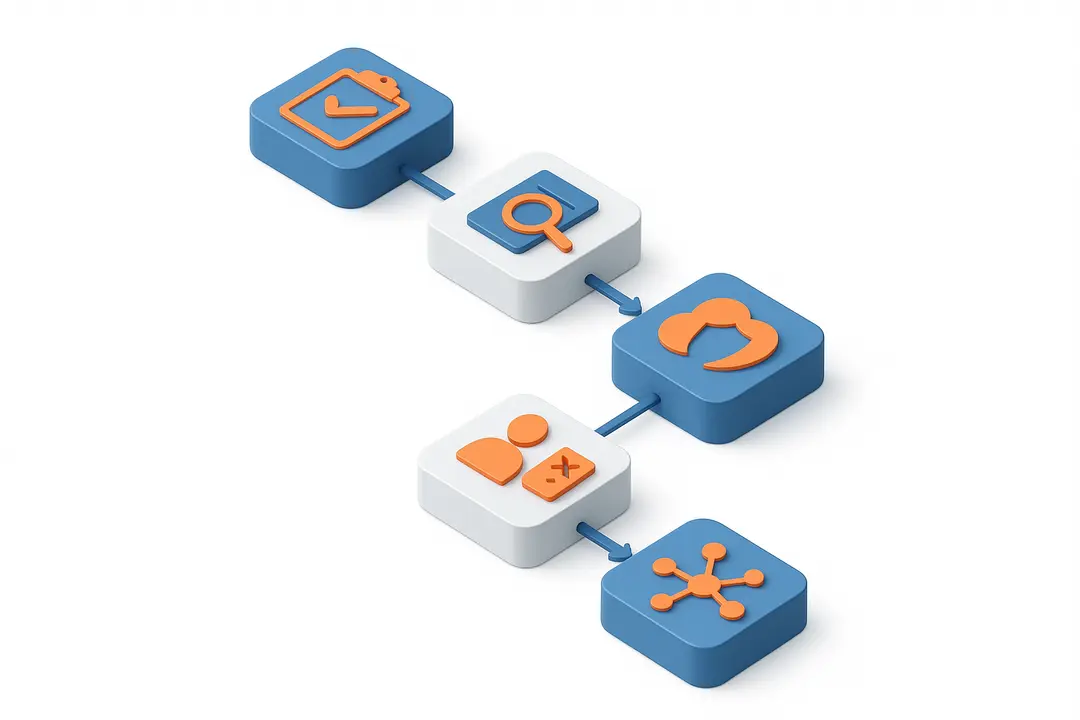
Implementation success hinges on planning, phased rollout, and ongoing review.
Step-by-step onboarding:
- Project Planning
Identify key pain points and success metrics (e.g., review turnaround, error rates).
Secure stakeholder buy-in from legal, procurement, and IT. - Pilot/Proof of Concept (POC)
Select a representative contract sample (e.g., NDAs, vendor agreements).
Benchmark baseline metrics (current review time, errors, escalations).
Run side-by-side AI/manual review for comparison. - Integration & Security Setup
Connect to document management (Word, CLM).
Align with IT/security for data mapping, access controls, and compliance review. - Training & User Onboarding
Train teams on platform use and playbook settings.
Establish feedback loops to capture pain points and retrain models. - Gradual Scale-Up
Expand coverage to more contract types and business units.
Continuously update playbooks with learnings.
Checklist for Implementation:
- Define success criteria and KPIs
- Run pilot and measure improvements
- Integrate with IT/CLM/e-sign
- Deliver role-based user training
- Set up feedback and playbook refresh cycles
Real-World Experiences: Case Studies, Testimonials & Before/After Metrics
Case Study 1: In-house Legal Team, Multinational Manufacturer
- Challenge: NDA review bottleneck (600 per year)
- Solution: Deployed LegalOn with pre-built NDA playbooks
- Result: 80% reduction in average review time (2 hours → 20 minutes), error rate dropped to <2%, and annual review capacity increased 4x without hiring.
“Automated analysis let us shift high-volume reviews to AI, freeing in-house counsel for complex negotiations. Adaptation to new templates took just days, not months.” —Legal Operations Manager
Case Study 2: Procurement, Technology Enterprise
- Challenge: Complex vendor agreements with multi-jurisdictional terms
- Solution: Hybrid AI/human workflow using Luminance
- Result: 60% reduction in standard processing time, but human legal review still required for novel or high-stakes clauses.
Lessons Learned:
- Allocate time for user adoption and playbook tuning.
- Use pilots to uncover gaps in clause coverage or language support.
- Ongoing training sharpens accuracy and trust.
Security, Compliance, and Data Privacy in AI Contract Review
Enterprise adoption of AI contract review systems requires strict attention to data security, privacy, and regulatory compliance.
Vendor data practices:
- Leading platforms segregate client data, offer robust encryption, and avoid using sensitive client contracts to retrain general models without explicit consent.
- SOC 2 and GDPR compliance are industry standards; always validate your vendor’s certification status.
- Access controls are enforced by user, department, or geography.
Best practices:
- Review and sign Data Processing Agreements (DPAs) with vendors.
- Use platforms allowing you to control data retention and deletion.
- Engage IT/security teams in vendor assessment and integration.
Procurement Compliance Checklist:
- SOC 2 audit report reviewed
- GDPR compliance verified
- Data segregation methods documented
- User access control mapped
- Ongoing security assessments scheduled
Frequently Asked Questions (FAQ)
What is AI contract review automation and how does it work?
AI contract review automation leverages machine learning and NLP to extract, analyze, and flag key contract terms and risks. The system quickly reviews contracts, highlights issues, and summarizes findings to speed up legal and procurement workflows.
Which types of contracts are best suited for AI review?
Routine, high-volume, and template-based contracts—such as NDAs, simple vendor agreements, and renewals—are ideal for AI contract review. Complex or heavily negotiated contracts typically require human legal oversight.
How does AI contract review compare to manual legal review?
AI systems review contracts much faster and more consistently than manual processes for standardized documents. However, nuanced or high-stakes contracts may benefit from a hybrid approach, combining AI’s speed with human judgment.
What are the benefits and limitations of using AI for contract analysis?
Benefits include speed, cost savings, and consistency. Limitations involve struggles with complex language, need for well-maintained playbooks, and the requirement for human review in certain scenarios.
What are the most important features to look for in an AI contract review tool?
Key features include playbook-driven reviews, clause extraction, analytics/reporting, Word and CLM integrations, SOC 2/GDPR compliance, customizable workflows, and multi-language support.
Can AI fully replace lawyers for contract review?
No. While AI automates repetitive and routine review tasks, legal professionals are essential for complex negotiations, strategy, and oversight.
How much does AI contract review automation typically cost?
Pricing varies by vendor and volume, commonly offered as per-user or per-contract subscriptions. Enterprises should also anticipate onboarding and integration fees.
How secure and compliant are AI contract review platforms?
Leading AI platforms are SOC 2 certified and GDPR compliant, with robust encryption, user access controls, and data segregation. Always validate a vendor’s certifications and security practices.
What are common mistakes to avoid when adopting contract review AI?
Over-reliance on AI for complex agreements, neglecting playbook updates, and insufficient user training can undermine success. Ensure human escalation points are built into the workflow.
How do you measure the ROI of AI contract review systems?
Track reduction in contract review time, error rates, cost per review, and user satisfaction before and after automation. Compare these metrics to initial goals to calculate payback time and ongoing ROI.
Conclusion
The automation of contract review through AI is transforming legal and procurement operations for organizations worldwide, freeing experts to focus on negotiations, strategy, and high-value matters. As vendors continue to enhance features like multi-language support and predictive analytics, the next generation of contract AI will offer even deeper business impact.
Stay ahead by benchmarking new tools, keeping playbooks current, and building hybrid AI/human workflows. To accelerate your contract review journey, request a demo with top-rated vendors, download our implementation checklist, or subscribe for updates on evolving best practices in AI legal operations.
Glossary of Key Terms in AI Contract Review Automation
- Machine Learning: Algorithms that learn patterns from historical contract data to improve accuracy and prediction.
- Natural Language Processing (NLP): A branch of AI enabling systems to understand, interpret, and extract information from human language in contracts.
- Playbook: A set of attorney-crafted rules and guidelines that defines acceptable contract terms for automated review.
- Clause Extraction: The process of automatically identifying and structuring individual clauses in contracts.
- F1 Score: A statistical measure combining precision and recall; used to benchmark the accuracy of AI contract review systems.
- SOC 2: An audit standard ensuring that vendors securely manage customer data to protect privacy and confidentiality.
- GDPR: The European Union’s General Data Protection Regulation, governing privacy and data protection for EU residents.
- Contract Lifecycle Management (CLM): Software platforms and practices for managing contracts from creation through execution, renewal, and expiration.
- AI Redlining: Automated detection and markup of changes, deviations, or risks within a contract document.
- Third-Party Paper: Contracts provided by an external counterparty, not based on your organization’s standard template.
This page was last edited on 21 April 2026, at 4:09 pm

Start a conversation with our team to solve complex challenges and move forward with confidence.