Custom AI development empowers companies to survive and thrive amid constant digital disruption. Custom AI development to future-proof business operations is no longer a forward-looking concept but a strategic necessity, as rapid technological change directly impacts long-term competitiveness, resilience, and growth.
Many organizations struggle with generic, one-size-fits-all AI tools that fail to address their unique challenges, leaving critical gaps in efficiency, decision-making, and risk management. As markets evolve faster than ever, delaying the move toward tailored AI solutions can mean falling behind more agile competitors or missing emerging opportunities altogether.
This playbook provides a practical executive framework for using custom AI development to future-proof business strategy. You will gain clarity on how tailored AI drives measurable ROI, explore step-by-step implementation guidance, and learn from real-world success stories, enabling confident, high-impact decisions that support sustainable growth.
Summary Table – Custom AI for Future-Proofing at a Glance
| Area | Key Benefits | Steps (High-Level) | Potential Pitfalls | ROI Drivers | Vertical Fit |
|---|---|---|---|---|---|
| Process Automation | Efficiency, cost | Identify, design, integrate | Unclear requirements | Labor savings | Any industry |
| Predictive Analytics | Smarter decisions | Data integration, modeling | Poor data quality | Faster insights | Retail, finance |
| Legacy Modernization | Risk reduction | Integration, migration | Tech compatibility | Reduced downtime | Manufacturing, SMBs |
| Change Management | Adoption, scaling | Training, upskilling | No buy-in, rushed rollout | Sustained improvements | Any |
| Compliance/Ethics | Trust, auditability | Policy alignment, monitoring | Overlooked regulations | Avoided fines | Finance, healthcare |
What Is Custom AI Development—and Why Does It Matter for Business Longevity?

Custom AI development involves designing and deploying artificial intelligence solutions tailored to your unique business operations, workflows, and objectives—unlike off-the-shelf AI, these solutions adapt to your data, processes, and industry needs.
Custom AI is fundamentally different from pre-built or generic SaaS AI tools:
- Custom AI aligns directly with your business strategy and processes.
- Off-the-shelf AI offers standard capabilities but rarely achieves deep process integration.
For example, while a standard chatbot might handle basic customer support, a custom AI assistant can pull data from your internal systems, recognize your organization’s terminology, and automate complex ticket flows.
Custom AI supports critical priorities:
- Efficiency: Automate tailored tasks and workflows.
- Scalability: Adapt systems as your business grows or pivots.
- Innovation: Unlock new products, services, or customer experiences.
Key enablers include predictive analytics (for smarter decision-making) and process automation (for speed and accuracy). This distinction is at the heart of future-proofing—where adaptability, not just technology, is your main asset.
Why Future-Proofing Has Become Essential
Future-proofing means equipping your business to withstand and evolve amid constant technological, market, and regulatory change. In 2024, it’s not optional—it’s a strategic imperative for survival and growth.
Organizations face unprecedented waves of:
- AI acceleration and tech adoption
- Agile competitors and new digital-native entrants
- Tighter compliance and evolving data privacy rules
- Escalating customer expectations for speed and personalization
Key Future-Proofing Factors for 2025–2026
- Explosive AI evolution: Generative AI and custom models are rapidly advancing, requiring businesses to update their capabilities regularly.
- Market disruption risks: Failure to adapt may lead to loss of relevance or market share.
- Regulations and compliance: Data privacy (e.g., GDPR) and industry standards are becoming more stringent.
- Scalability pressures: Growth in digital commerce and remote work demand more adaptable systems.
- Continuous innovation: Businesses must experiment, learn, and iterate faster than ever.
Future-proofing with custom AI enables resilience, agility, and compliance—fundamental qualities for navigating an uncertain landscape.
7 Proven Ways Custom AI Builds Business Resilience
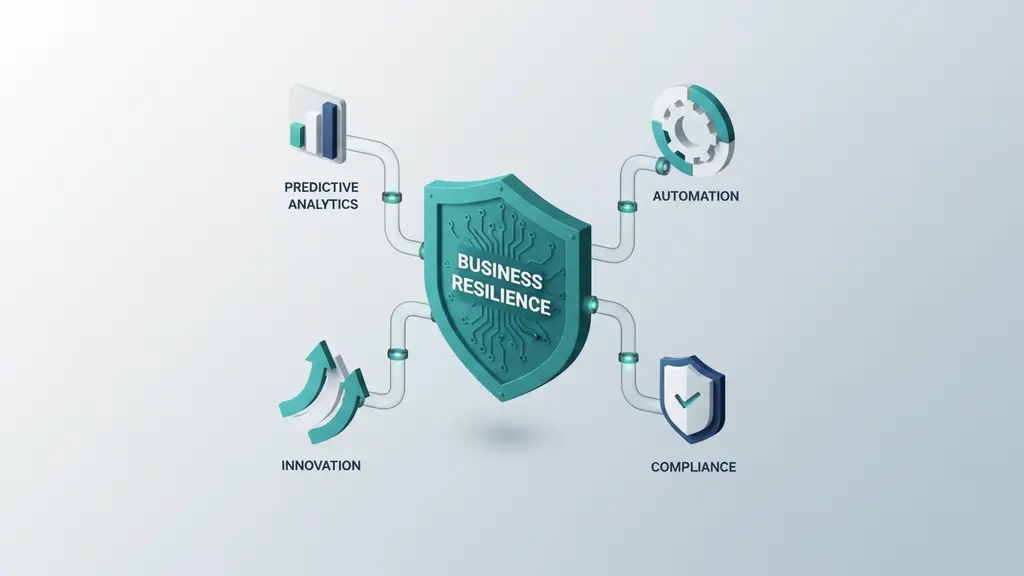
Custom AI development directly strengthens your business’s ability to withstand shocks and adapt to market shifts. Here’s how tailored AI solutions deliver resilience, value, and adaptability:
- Automate Unique Processes and Tasks
Streamline complex or industry-specific workflows that off-the-shelf tools can’t address. - Enable Predictive Analytics for Informed Decision-Making
Leverage your unique business data to forecast demand, spot risks, and seize opportunities. - Modernize Legacy Systems
Integrate AI with older platforms for enhanced efficiency and reduced technical debt. - Provide Industry-Specific Solutions
Tailor AI to verticals like retail (personalization), manufacturing (predictive maintenance), or SMBs (cash flow automation). - Drive Continuous Innovation and Improvement
Iterate quickly with custom models tailored to new business requirements. - Ensure Ethical AI, Risk Mitigation, and Compliance
Build AI systems aligned to your policies and industry regulations, with auditability and bias checks. - Transform Change Management and Employee Upskilling
Facilitate smoother adoption of AI through tailored training, support, and user-centric design.
By targeting these areas, organizations position themselves for growth—even in volatile times.
Custom AI Development to Future-Proof Business Strategy: Step-by-Step
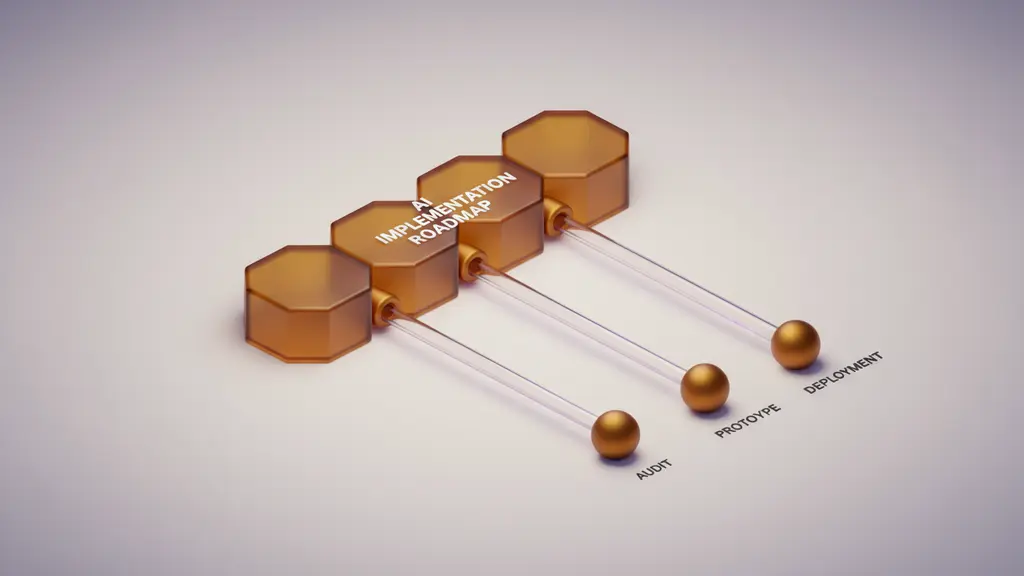
Adopting custom AI to future-proof your business follows a logical, repeatable process. Each step sets your team up for tangible results and long-term scalability.
Executive Roadmap to Successful Custom AI Integration
- Conduct an AI-Readiness Audit & Identify Use Cases
Assess current workflows, tech stack, and organizational readiness.
Prioritize business problems that AI could address. - Align Stakeholders & Gather Requirements
Secure executive sponsorship and build cross-functional teams.
Clearly define business objectives, success metrics, and constraints. - Select the Right AI Partner or Internal Team
Evaluate providers on technical expertise, domain experience, and cultural fit.
Ask for references and assess risk factors like vendor lock-in. - Solution Design & Prototyping
Develop initial concepts as low-risk pilots or proof-of-concepts.
Validate feasibility against technical and business requirements. - Data Collection, Cleaning, & Integration
Identify necessary data sources and ensure high data quality.
Integrate data with your AI models securely. - Pilot, Measure, and Refine
Deploy the solution on a small scale.
Gather feedback, measure outcomes, and iterate for improvement. - Full Deployment, Scaling, & Ongoing Optimization
Roll out the solution across relevant business areas.
Monitor performance, compliance, and user satisfaction; continue improving. - Employee Training, Change Management, and Upskilling
Provide hands-on training and support.
Encourage a culture of learning around AI. - Monitor for Compliance and Future Evolution
Continuously check that systems remain secure and compliant.
Plan regular reviews to adapt to new trends and regulations.
This structured approach minimizes risk and lays a foundation for sustainable value.
Custom AI vs. Off-the-Shelf AI: ROI, Flexibility, Security—Which is Best?
Choosing between custom AI and off-the-shelf solutions hinges on your business goals, complexity, and appetite for innovation. Here’s a side-by-side comparison to guide decision-making:
| Criteria | Custom AI Development | Off-the-Shelf AI |
|---|---|---|
| Fit & Flexibility | Tailored to your workflows, scalable and easily updated as business evolves | Fixed features, limited customization |
| Implementation Time | Longer (months); depends on design, integration | Short (weeks); ready-made |
| Upfront Investment | Higher initial cost; ROI grows with usage | Lower initial cost, potential hidden costs over time |
| Ongoing ROI | High—unique competitive advantage, efficiency gains | Moderate—limited to generic benefits |
| Security & Compliance | Controlled, compliant, auditable | Relies on vendor policies, less transparent |
| Vendor Risk | Lower risk of lock-in if developed/owned | Possible lock-in; data portability concerns |
| Best For | Unique workflows, regulated sectors, innovation-driven teams | Standard processes, fast deployment needs |
Decision Guide:
- Choose custom AI when your needs are complex, compliance-critical, or a strategic differentiator.
- Opt for off-the-shelf AI for simple, standard tasks or if resources are limited.
Avoiding Common Mistakes in Custom AI Integration
Avoiding pitfalls in custom AI projects is essential for achieving both ROI and employee confidence. Here are the most frequent mistakes and how to sidestep them:
- Underestimating Data Complexity
Fix: Conduct a thorough data audit and invest in data cleaning before starting. - Not Tied to Real Business Problems
Fix: Align every AI project to validated business goals and KPIs. - Lack of Executive or Team Buy-In
Fix: Build early stakeholder engagement; communicate vision and wins. - Neglecting User/Employee Training
Fix: Allocate resources for change management and ongoing upskilling. - Ignoring Scale or Adaptability
Fix: Plan your AI architecture with future growth and change in mind. - Overlooking Compliance and Security
Fix: Involve IT/security from day one; ensure regular compliance audits. - Risk of Vendor Lock-In or Short-Term Thinking
Fix: Prioritize open standards and long-term partnership reviews.
Awareness and proactive planning turn these risks into manageable challenges.
Real-World Case Studies: How Custom AI Future-Proofed Leading Companies
Custom AI solutions have enabled organizations across industries to become more resilient, efficient, and competitive. Here are select examples:
| Company | Industry | Use Case | Results | Lessons Learned |
|---|---|---|---|---|
| SMB Retailer | Retail | Automated inventory predictions | Cut stock-outs by 30% | Small changes, big impact |
| Global Manufacturer | Manufacturing | Predictive maintenance with digital twins | Reduced machine downtime by 20% | Data fuels savings |
| Financial Firm | Financial | Regulatory compliance with custom NLP | Cut compliance audit time by 50% | Faster, safer audits |
| SaaS Enterprise | Tech/Software | Customer support process automation | 25% reduction in resolution times | AI amplifies service teams |
- SMB Retailer: An independent chain integrated a custom AI model to forecast demand and optimize stock levels. Result: 30% fewer out-of-stock incidents and a noticeable sales lift within months.
- Global Manufacturer: Using digital twins and predictive analytics, this enterprise cut unexpected equipment failures, saving substantial maintenance costs and production time.
- Financial Firm: Deployed natural language processing to automate compliance checks, halving the effort and significantly lowering legal risk.
Common success factors: executive commitment, robust data preparation, and a phased implementation with measurable KPIs.
Frequently Asked Questions: Custom AI for Future-Proofing
What is custom AI development and how does it work?
Custom AI development is the process of designing artificial intelligence systems that are tailored to a company’s specific data, workflows, and objectives. It begins with identifying business needs, continues through model design and integration, and results in a unique solution optimized for your organization.
How can custom AI solutions help future-proof my business?
Custom AI adapts to your evolving processes, supports continuous innovation, and addresses regulatory requirements. This flexibility ensures your business remains agile, competitive, and resilient amid market and technology changes.
What is the process for integrating AI into existing business workflows?
Integration starts with an audit of current workflows and systems. Cross-functional teams then clarify requirements, followed by solution prototyping, rigorous data preparation, pilot testing, feedback iterations, and finally, organization-wide deployment.
What are the typical cost and timeline factors?
Costs depend on solution complexity, data readiness, and required integrations. While custom AI projects may require higher initial investment and several months for full implementation, ROI typically comes from efficiency gains, automation, and risk mitigation.
Can small businesses benefit from custom AI?
Yes. SMBs can leverage custom AI for targeted automation, improved forecasting, or customer experience enhancements—often delivering measurable results with manageable investments.
How do I ensure security and compliance in custom AI systems?
Work with partners who prioritize secure architecture, maintain compliance with standards like GDPR or ISO, and build audit trails into the AI workflow. Regular reviews and updates are essential.
What are common risks and how to avoid them?
Common risks include poor data quality, lack of executive alignment, and insufficient user training. These can be avoided by thorough planning, change management, and continuous measurement.
What trends will drive AI-powered business resilience?
Key trends include the adoption of generative AI, rise of digital twins for simulation, evolving industry regulations, and a focus on human-AI collaboration for adaptive problem-solving.
Conclusion & Next Steps: From Exploration to Execution
Taking decisive action on custom AI development has become essential for businesses that want to remain competitive, resilient, and ready for change. Tailored AI solutions enable organizations to improve efficiency, reduce risk, and unlock new sources of value in ways generic tools cannot achieve.
The organizations that succeed with AI are those that approach it strategically by focusing on real business problems, investing in the right talent and data foundations, and building systems that can evolve as markets and technologies change. With the right planning and execution, custom AI becomes a long term capability that supports sustainable growth and operational strength.
Custom AI is not just a technology investment but a business transformation lever. Companies that act thoughtfully today are better positioned to adapt faster, compete smarter, and thrive in an increasingly dynamic digital environment.
Key Takeaways
- Custom AI aligns technology with your unique business needs, enabling true future-proofing.
- Future-proofing requires agility, resilience, and ongoing innovation—qualities that generic AI often fails to deliver.
- A clear, stepwise integration framework minimizes risk and maximizes ROI.
- Real-world examples show tangible benefits for SMBs and enterprises alike.
- Begin with an AI-readiness audit and focus on stakeholder alignment, data quality, and change management for success.
This page was last edited on 2 February 2026, at 5:59 pm

Start a conversation with our team to solve complex challenges and move forward with confidence.