
Disruptive software development trends are rapidly reshaping how digital products are built, deployed, and secured.
In 2026–2027, business and technology leaders face a market where generative AI, low-code tools, and advanced automation are overturning established practices and creating both risk and opportunity.
Disruption in software development refers to changes that fundamentally alter the landscape—making older approaches obsolete and opening new competitive paths. These trends are no longer distant forecasts: generative AI powers code generation, cloud-native platforms accelerate scale, and automation reduces delivery times. Yet, with innovation comes new risks—skill shortages, security gaps, and shifting team structures.
This guide does more than list buzzwords. It offers expert forecasts on the most disruptive trends through 2026—and, crucially, it delivers actionable steps to help organizations adapt and compete. You’ll get strategic outlooks, skills you need to future-proof your teams, and checklists you can use immediately.
Why Act Now?
- The pace of software disruption is accelerating.
- Missing these shifts puts organizations at risk for rising tech debt, loss of talent, and declining competitive edge.
- Early adoption or adaptation can unlock outsized returns and industry leadership.
What Are the Most Disruptive Software Development Trends in 2026–2027?
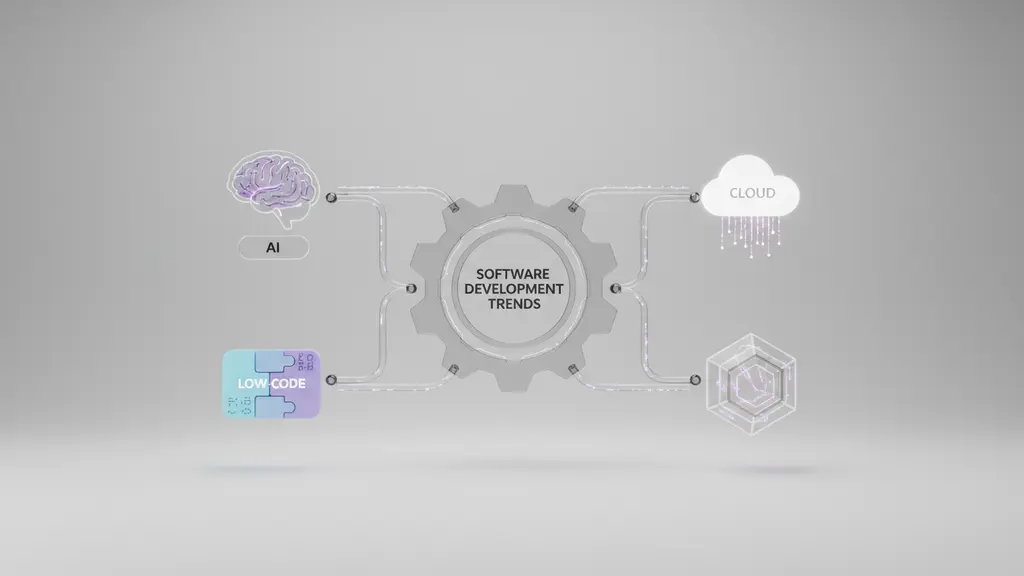
The most disruptive software development trends for 2026–2027 include advances in generative AI, low-code platforms, cloud-native and edge technologies, blockchain applications, automation in operations, cybersecurity innovation, and vertical/industry-specific solutions.
| Trend | Description |
| Generative AI & Autonomous Agents | AI-driven code, testing, and agentic automation |
| Low-Code/No-Code Platforms | App creation by non-developers, streamlined workflows |
| Cloud-Native & Edge Computing | Flexible, scalable, real-time application architectures |
| Blockchain & Web3 | Decentralized, secure, and transparent business models |
| AIOps & DevOps Automation | Intelligent automation of IT operations and delivery |
| Cybersecurity & Ethical AI | Advanced, automated defense and responsible AI |
| Vertical SaaS/Quantum/Green IT | Specialized, sustainable, and high-impact tech focus |
Each of these trends qualifies as disruptive because they significantly change who can build software, how fast it’s delivered, and how value is captured. Automation, workforce transformation, and speed-to-market are cross-cutting elements, raising the bar for innovation and resilience.
Generative AI and Autonomous Agents: Redefining Software Creation
Generative AI and autonomous agents are transforming software creation by automating code generation, debugging, and quality assurance—accelerating delivery while changing team skill needs.
Key Changes:
- AI-assisted code tools (e.g., GitHub Copilot) now write functionally correct code, suggest tests, and accelerate documentation.
- Agentic AI systems can automate end-to-end workflows—from design to deployment.
- AI-powered DevOps tools optimize release cycles and incident response.
Business Impact:
- Productivity gains free up developers for higher-value tasks.
- Demand is rising for “AI fluency”—the ability to engineer prompts, validate output, and collaborate with AI “co-workers.”
- Skill expectations are moving from rote coding to architectural thinking and system design.
Ethical & Quality Considerations:
- Generative AI introduces risks like bias in code, unpredictable outputs, and loss of transparency.
- Leading teams integrate explainability (XAI), code reviews, and continuous monitoring to mitigate these issues.
Examples:
- Automated test generation for web apps, reducing release cycle time.
- AI agents in infrastructure management, handling scaling decisions autonomously.
What’s Next:
Expect further integration of AI in all aspects of SDLC (Software Development Lifecycle), including agent-based application maintenance and self-healing systems.
Low-Code and No-Code Platforms: Expanding Who Can Build Software
Low-code and no-code platforms are democratizing software development by enabling business users (“citizen developers”) to create apps and automate workflows without deep technical skills.
What’s Driving Adoption:
- Pressure to accelerate digital transformation and fill developer talent gaps.
- User-friendly platforms allow rapid prototyping, process automation, and niche solution development.
Industries Most Affected:
- Financial services: Automating onboarding workflows.
- Healthcare: Building patient intake dashboards.
- Retail: Customizing supply chain and inventory tools.
Implications for Traditional Developers/IT:
- IT roles evolve to focus on governance, API design, and integration.
- Developers shift toward platform orchestration and complex engineering challenges.
Pros and Cons of Low-Code/No-Code Platforms:
- Pros:
- Faster time-to-market
- Empowers business innovation
- Reduces reliance on specialized coding skills
- Cons:
- Potential for “shadow IT” and governance issues
- Privacy/security risks if not properly managed
- Long-term maintainability concerns
What’s Next:
Expect low-code platforms to incorporate more AI-driven features and tighter IT oversight, blending empowerment with control.
Cloud-Native Development and Edge Computing: Building for Scalability & Speed
Cloud-native development and edge computing let organizations deploy applications that scale instantly and respond in real time, unlocking new digital services and operating efficiencies.
Cloud-Native Principles and Trends:
- Microservices, containers (e.g., Kubernetes), and serverless architectures are now mainstream, enabling resilient and flexible systems.
- Multi-cloud strategies are growing, offering better vendor resilience and cost optimization.
Edge Computing & IoT:
- Applications run closer to users and devices—reducing latency for real-time workloads (e.g., smart manufacturing, connected vehicles).
- Integration with AI at the edge enables intelligent data processing even in bandwidth-constrained environments.
Cloud-Native vs. Legacy Development:
| Attribute | Cloud-Native | Legacy |
| Scalability | Instant/on-demand | Fixed/manual |
| Resilience | Self-healing | Single point of failure |
| Deployment Speed | Minutes | Days/weeks |
| Cost Model | Usage-based | CapEx/Upfront |
What’s Next:
Cloud-native and edge paradigms will converge further, with AI and event-driven architectures delivering “smart” and context-aware services at scale.
Blockchain and Web3: Enabling Trust and Decentralization in Apps
Blockchain and Web3 technologies are introducing new models for transparency, security, and decentralized control across many sectors, moving beyond cryptocurrency into real business applications.
Horizontal and Vertical Disruption:
- Horizontal: Infrastructure for secure, auditable transactions and data sharing.
- Vertical: Real-world use in finance (DeFi), supply chain (traceability), and government (digital identity).
Decentralized Software Models:
- DApps (decentralized applications) reduce reliance on central servers.
- Smart contracts can automate agreements and processes transparently.
Challenges:
- High energy consumption for traditional blockchains (though some, like Proof-of-Stake, are improving).
- Scalability limits, regulatory uncertainty, and talent shortages.
Sector Usage Table:
| Sector | Example Use Case |
| Finance | DeFi lending, asset tokenization |
| Supply Chain | Provenance, anti-counterfeit tracking |
| Government | Digital identity, transparent procurement |
What’s Next:
Watch for enterprise adoption of private blockchains and increased integration with legacy IT, especially as regulatory clarity improves.
AIOps, DevOps Automation, and Microservices: Faster, Smarter Delivery
AIOps and DevOps automation help software teams deploy, monitor, and maintain applications with greater speed and reliability, leveraging AI to manage operational complexity.
What Is AIOps:
AIOps (Artificial Intelligence for IT Operations) extends DevOps by using AI/ML to automate event correlation, alert prioritization, incident management, and predictive maintenance.
Key Benefits:
- Faster, automated detection and resolution of issues.
- Streamlined CI/CD pipelines and toolchain orchestration.
- Demand is growing for skills in observability tools (e.g., Grafana, Datadog) and microservices design.
AIOps vs. DevOps — Feature Comparison:
| Feature | DevOps | AIOps |
| Automation | Manual/scripts | AI/ML-driven |
| Root Cause Analysis | Human-driven | Automated |
| Scalability | Team-limited | Handles massive data/alerts |
| Feedback Cycle | Scheduled | Real-time/adaptive |
Risk:
Excess automation without oversight can cause silent failures; maintaining the human-in-the-loop remains essential.
What’s Next:
Expect AIOps to evolve toward predictive, “self-driving” operations—reducing downtime and enabling proactive scaling.
Cybersecurity and Ethical AI: Securing Innovation
With accelerated innovation comes heightened threat exposure and a growing focus on the responsible design of intelligent systems. Secure-by-design and ethical AI practices are now critical.
Emerging Threat Vectors:
- AI-driven attacks and automated code vulnerabilities.
- Complex, distributed app architectures introduce new risks, including supply chain compromises.
Security/Compliance Evolutions:
- Shift to “secure-by-default” and code-level security automation.
- AI explainability (XAI) is gaining traction, especially where algorithms influence critical decisions.
Regulatory/Best Practice Overview:
Growing regulatory requirements around data privacy, algorithmic transparency, and digital sovereignty—driven by rules such as GDPR, CCPA, and upcoming AI acts worldwide.
Security Checklist for Teams:
- Integrate static/dynamic code analysis in CI/CD.
- Adopt zero-trust architectures.
- Ensure model transparency and fairness for AI-driven features.
- Regularly update dependencies/supply chain inventory.
- Train teams on secure design and compliance standards.
What’s Next:
Look for expanding investment in explainable AI, automated security monitoring, and machine-speed remediation across endpoints and clouds.
Industry-Specific and Emerging Trends: Vertical SaaS, Quantum, Green IT
Beyond general trends, 2026–2027 will see deeper disruption through sector-specific solutions, quantum technology experimentation, and increased focus on sustainability.
Vertical SaaS:
- Solutions tailored for specific industries (e.g., property management, healthcare, legal tech) are growing rapidly.
- These platforms embed regulatory logic, best practices, and AI tuning unique to each sector.
Quantum Computing:
- Not yet mainstream, but pilots in finance (portfolio optimization), pharma (molecular modeling), and logistics (route optimization) are underway.
- Quantum is expected to impact cryptography, simulation, and data-intensive computation initially.
Green IT:
- Sustainability is now a “must-have,” not a “nice-to-have.”
- Teams are adopting resource-efficient cloud architectures and carbon-aware deployment practices.
Timeline Callout:
- 2026: Widespread adoption of industry-specific SaaS for compliance-heavy sectors.
- 2027+: First business value from quantum co-processors; Green IT becomes central to IT procurement.
What’s Next:
Monitor industry and geographic nuances; the most disruptive trend in one market may lag in another.
How Are Disruptive Trends Changing Developer Skills and Team Structures?

Disruptive trends are fundamentally changing the skills software teams need and how organizations structure their engineering talent.
Critical New Skill Areas:
- AI fluency: Prompt engineering, training/validating AI models, agentic collaboration.
- Platform orchestration: Managing cloud, edge, and hybrid deployments.
- Automation & DevOps: Scripted/config-driven ops, AIOps toolchains.
Citizen Developers:
The “citizen developer” movement is shifting simple app creation to business users, while developers focus on platforms, integrations, and governance. This trend is changing hiring and career development, with greater emphasis on soft skills and interdisciplinary expertise.
Organizational Shifts:
- Rise of cross-functional squads combining developers, data scientists, product managers, and security engineers.
- More distributed, hybrid, and AI-augmented teams—requiring new collaboration and management practices.
Skills Checklist:
- Generative AI prompt engineering
- Low-code platform administration
- Cloud-native architecture design
- Observability and SRE fundamentals
- Secure/ethical software practice
What’s Next:
Teams excelling in continuous learning, adaptability, and collaboration will outperform in the face of rapid disruption.
How Do Disruptive Software Trends Impact Business, Investment, and ROI?

Disruptive software trends are upending traditional business models, M&A strategies, and investment priorities—reshaping the ROI landscape for technology organizations.
Impact on Business Models:
- New SaaS, microservices, and platform models unlock recurring revenue and customer expansion.
- Startups leverage AI/low-code to deliver products faster, reducing entry barriers.
Investment & M&A:
- Increased activity around emerging tech firms specializing in AI, cloud-native, and vertical SaaS.
- Organizations slow to adapt face loss of market share, higher tech debt, or even acquisition by more agile competitors (a common theme in Gartner and McKinsey studies).
ROI Impact Table:
| Trend | ROI Opportunity | Risk for Laggards |
| Generative AI | Reduce development costs | Missed innovation cycles |
| Low-Code/No-Code | Faster solution delivery | Outpaced by “business builders” |
| Cloud-Native | Lower infrastructure spending | Scalability/cost challenges |
| Cybersecurity AI | Minimize breach impact | Regulatory, brand, and financial loss |
Competitive Advantage:
First-movers capture outsized benefits, while laggards face rising opportunity costs.
Vertical View:
Heavily regulated and data-rich sectors (finance, healthcare, government) see the most impactful ROI from adopting secure-by-design and automation trends.
What Actionable Steps Can Companies Take to Adopt Disruptive Trends?
Adopting disruptive trends requires a systematic, risk-managed approach. Organizations can use this five-step framework to ensure success.
5-Step Trend Adoption Playbook
- Assess Readiness
- Evaluate current team skills, technology stack, and change appetite.
- Skills Uplift & Talent Strategy
- Upskill teams in AI fluency, automation, and new platforms; recruit for hybrid and cross-functional roles.
- Tooling & Vendor Selection
- Benchmark and pilot best-fit tools/platforms (e.g., AIOps suites, low-code builders).
- Pilot & Validate
- Launch limited-scope pilots; measure impact, user feedback, and risks before scaling.
- Scale & Embed
- Integrate successful pilots into standard workflows; monitor for continuous improvement.
Readiness Checklist:
- Conduct digital maturity and disruption readiness assessment
- Inventory and prioritize high-impact use cases
- Align executive sponsorship and budget
- Set up change management and training plans
Tips on Partner/Vendor Selection:
- Prioritize firms with proven expertise in targeted disruptive trends.
- Insist on clear roadmap, security track record, and post-pilot support.
What’s Next:
Schedule regular technology/skills audits; update roadmaps annually to stay aligned with evolving market disruption.
What Are the Risks, Pitfalls, and Long-Term Considerations?
While embracing disruptive trends brings opportunity, it also introduces risks—ranging from hidden tech debt to regulatory and organizational pitfalls.
Common Risks & Pitfalls:
- Technical Debt: Rushed adoption can cause fragmented architectures and legacy integration challenges.
- Vendor Lock-In: Over-reliance on proprietary cloud or platform tools may limit flexibility.
- Compliance Traps: Emerging tech often outpaces regulations, causing privacy or data localization missteps.
- Change Fatigue: Frequent transformations can strain teams and lead to resistance or burnout.
Long-Term Bet Assessment:
Not all “disruptions” succeed; monitor pilot results, industry case studies, and regulatory signals. Some trends—like quantum computing—carry longer horizon risks and rewards.
Risk Matrix:
| Risk | Mitigation Strategy |
| Tech Debt | Regular architecture reviews |
| Security Gaps | Ongoing security/compliance audits |
| Team Resistance | Open communication, continuous training |
| Regulatory Shifts | Stay engaged with policy/standards |
What’s Next:
Develop a living risks register, update mitigation plans regularly, and benchmark against peers.
Top 5 Future-Proofing Moves
- Invest in foundational AI and automation literacy across your workforce.
- Evolve security and ethics practices alongside technical innovation.
- Build modular, cloud-native architectures for greater flexibility.
- Prioritize cross-functional and hybrid talent models.
- Continuously reassess business models in light of vertical and sustainability trends.
Mistakes to Avoid:
- Betting solely on one disruptive trend while neglecting holistic skills.
- Underestimating the change management needed for cultural shift.
- Failing to integrate regulatory and security foresight early.
What’s Next:
Make future-proofing a standing agenda item in annual planning—and embed “learning agility” as a core organizational value.
Frequently Asked Questions (FAQ)
What are the most disruptive software development trends in 2025?
The most disruptive trends are generative AI and autonomous agents, low-code/no-code platforms, cloud-native and edge computing, blockchain/Web3, AIOps/DevOps automation, advanced cybersecurity/ethical AI, and specialized vertical SaaS and quantum/green IT initiatives.
How is AI changing the way software is developed?
AI automates code generation, testing, and deployment, enabling teams to build software faster and focus on system design and innovation rather than repetitive tasks. It also introduces new skills requirements and challenges around explainability and quality assurance.
Will low-code and no-code tools replace traditional developers?
Low-code and no-code tools expand who can build applications, but they complement rather than replace traditional developers. Software engineers will focus more on system architecture, integration, and governance, while business users can address simpler needs.
What risks do disruptive software trends pose to businesses?
Risks include increased tech debt, vendor lock-in, evolving threat landscapes, compliance challenges, and change fatigue within teams. Careful planning, ongoing training, and security best practices can mitigate these risks.
How can companies adapt to rapid changes in software development?
Companies should assess readiness, invest in skills upskilling, pilot new technologies, scale successful initiatives, and maintain a culture of continuous learning and adaptation.
What skills will be crucial for software engineers in the future?
Critical skills include AI fluency, cloud-native design, automation, security and compliance knowledge, and cross-functional teamwork. Adaptability and continuous learning will be key differentiators.
How does AIOps differ from traditional DevOps?
AIOps builds on DevOps by adding AI/ML-driven automation, root cause analysis, and real-time alert handling, enabling IT operations to scale and respond more intelligently to complex system events.
What role does blockchain play in software disruption?
Blockchain and Web3 enable secure, transparent, and decentralized applications, transforming industries like finance, supply chain, and government through new business models and trust frameworks.
Are AI-powered coding tools secure and reliable?
AI-powered tools can accelerate development, but they require vigilant oversight to catch potential errors, vulnerabilities, and biases. Regular code review and security integration are essential for safe adoption.
How does disruptive innovation impact software industry investments?
Disruptive trends shift investment toward emerging tech sectors, first-mover projects, and M&A activity. Agile companies reap the highest returns, while laggards risk falling behind or being acquired.
Conclusion
The next two years will see disruptive software development trends accelerate, challenging leaders to rethink strategies, invest wisely, and future-proof their teams.
From generative AI to cloud-native, from vertical SaaS to ethics and sustainability, the organizations that act now will seize competitive advantage—while those who wait risk irrelevance.
Now is the moment to assess your disruption readiness, pilot new technologies, and upskill your teams. Download our trend and readiness checklist or subscribe for expert insights that will keep your business—and your people—ahead of the curve.
Key Takeaways
- Disruptive software trends for 2026–2027 include AI, low-code, cloud-native, and cybersecurity innovations.
- Generative AI and automation are redefining developer roles and required skills.
- Business and investment strategies must evolve to capture ROI and avoid risk.
- Systematic adoption frameworks and continuous learning are essential to adapt.
- Security, ethics, and sustainability are as critical as technical advancement.
This page was last edited on 9 July 2026, at 11:09 am

Start a conversation with our team to solve complex challenges and move forward with confidence.