

- Main Cost Factors in AI Implementation
- Cost of Starting an AI Project
- Cost of Maintaining AI Systems
- Hidden Costs of Enterprise AI Implementation
- Cost Differences Between In-House AI Development and External Providers
- Cost-Effective Ways to Test AI Before Full Deployment
- Conclusion
- FAQs About the Cost of AI for Business
Last year I scoped an AI rollout for a mid-size ops team. The dev quote came in at $40,000. By month six, actual spend hit $140,000. Data cleanup alone ate half the budget. That gap between quoted and real cost of AI implementation is the norm, not the exception, and it’s why most companies get AI budgeting wrong from day one.
AI is marketed as a fast way to cut costs and boost efficiency. In practice, the real expense begins after development, not before. The true cost of AI implementation goes far beyond building a model. Data preparation, cloud infrastructure, skilled talent, system integration, compliance, and ongoing maintenance quickly add up. For many companies, these hidden and long-term costs outweigh the original development budget. Without careful planning, AI initiatives stall, overspend, or fail to deliver meaningful ROI.
This article breaks down what the cost of implementing AI actually looks like: where budgets go, which expenses get missed, and how to test AI cheaply before committing fully. Real numbers, real failure points, not theory.
TL;DR
- AI costs go far beyond building a model; data, infrastructure, people, and long-term operations drive most spending
- Data preparation is often the largest expense, frequently taking 30–50% of the total AI budget
- Starting an AI project can cost anywhere from $5,000 to $250,000+, depending on scope and scale
- AI systems require ongoing maintenance, typically 15–30% of the original build cost per year
- Enterprise AI projects carry hidden costs such as scaling issues, compliance work, and security overhead
- In-house AI development offers control but comes with high upfront and staffing costs
- External providers reduce early risk but can introduce long-term dependency and recurring fees
- Cost-effective AI adoption starts with small tests and proof-of-concept projects
- Gradual scaling and clear exit options help prevent overspending
- AI is not a one-time expense; long-term cost planning determines success or failure
- 80.3% of enterprise AI projects fail to deliver promised business value (RAND 2025, confirmed by Gartner, April 2026).

Main Cost Factors in AI Implementation
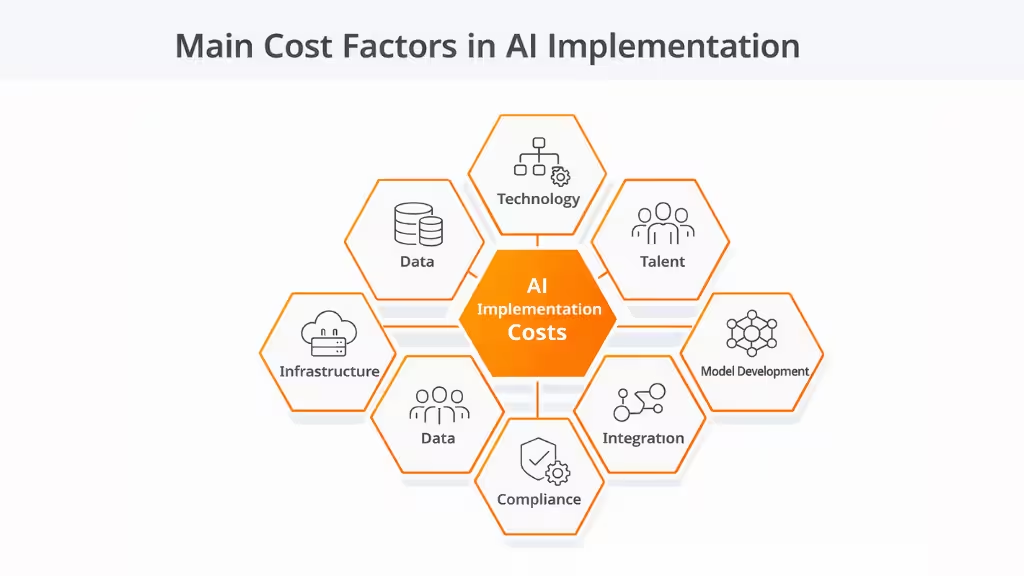
AI implementation costs are shaped by everything that supports the model, not just the model itself. Data readiness, infrastructure, people, and long-term operations account for most real-world spending once AI moves beyond pilot stages.
These are the core components where most AI implementation costs originate and scale over time:
- Data Collection, Preparation, and Management
- Computing Infrastructure and Processing Power
- Talent Acquisition and Development
- AI Model Development and Training
- Integration with Existing Systems and Processes
- Regulatory Compliance and Ethical Requirements
- Ongoing Maintenance, Monitoring, and Optimization
1. Data Collection, Preparation, and Management
- Estimated Cost Range: $10,000 – $40,000 (small projects); $100,000+ (enterprise)
- Examples: Data labeling for a customer support chatbot dataset, cleaning fragmented CRM records before model training, building a data pipeline for sensor/IoT input
Data is the largest and most underestimated cost area in AI projects. Most organizations start with data that is fragmented, inconsistent, or incomplete. Before training can begin, data must be sourced, cleaned, standardized, labeled, and secured. In many projects, this phase consumes 30–50% of the total AI budget. Small initiatives often spend $10,000–$40,000, while enterprise programs can exceed $100,000 purely on data readiness.
Gartner predicts that through 2026, organizations will abandon 60% of AI projects not backed by AI-ready data and 63% of organizations admit they lack, or aren’t sure they have, the right data management practices for AI (Gartner, 2026).
2. Computing Infrastructure and Processing Power
- Estimated Cost Range: A few thousand/month (entry-level); $10,000 – $50,000+/month (production)
- Examples: GPU instances for model training, cloud storage for training datasets, real-time inference hosting for a live recommendation engine
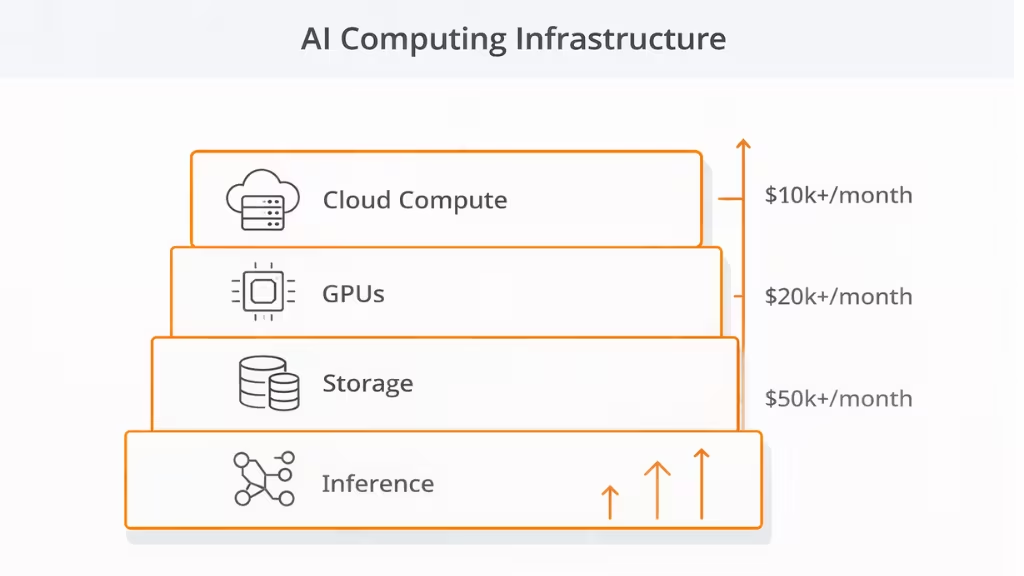
AI systems depend on scalable computing resources during both development and production. Costs come from cloud compute, GPU usage, storage, and data transfer. While early testing environments may remain modest, production systems introduce continuous inference and scaling costs. Entry-level workloads often start at a few thousand dollars per month, but production deployments commonly reach $10,000–$50,000+ per month, increasing as usage grows.
3. Talent Acquisition and Development
- Estimated Cost Range: $120,000 – $180,000/year per role, excluding benefits
- Examples: Hiring a machine learning engineer to build the core model, an MLOps specialist to manage deployment pipelines, a data engineer to maintain data infrastructure
AI implementation requires specialized skills that remain expensive and in short supply. Machine learning engineers, data engineers, and MLOps specialists are essential for building and sustaining AI systems. Experienced professionals typically earn $120,000–$180,000 per year, excluding benefits. Even with external partners, internal teams are needed to oversee quality, security, and long-term ownership.
4. AI Model Development and Training
- Estimated Cost Range: Under $20,000 (simple adaptation); $30,000 – $100,000 (fine-tuned); $200,000+ (fully custom)
- Examples: Fine-tuning an existing LLM on internal support tickets, adapting a pre-built image classifier, building a fully custom fraud-detection model from scratch
Model development costs depend heavily on the level of customization. Simple adaptations of existing models can stay below $20,000, while fine-tuned solutions often range from $30,000 to $100,000. Fully custom enterprise models frequently exceed $200,000. Training is not a one-time activity, as models must be retrained to handle data drift and evolving requirements.
5. Integration with Existing Systems and Processes
- Estimated Cost Range: $20,000 – $80,000 (mid-size); $150,000+ (enterprise)
- Examples: Connecting an AI model to Salesforce or an ERP system, redesigning a support workflow around an AI triage tool, integrating a recommendation engine into an existing e-commerce platform
AI delivers value only when embedded into real workflows. Integration work includes connecting AI systems to CRMs, ERPs, and internal platforms, as well as redesigning processes around AI outputs. These efforts are complex and time-consuming. Mid-sized implementations often spend $20,000–$80,000 on integration, while large enterprises may exceed $150,000.

6. Regulatory Compliance and Ethical Requirements
- Estimated Cost Range: Adds 10% – 20% to total AI budget
- Examples: GDPR/CCPA compliance documentation, third-party bias audits for a hiring algorithm, ongoing monitoring for a healthcare diagnostic AI
As AI adoption expands, compliance obligations grow. Data privacy regulations, audit requirements, and ethical safeguards introduce ongoing costs. These include documentation, monitoring, and third-party reviews. For many organizations, compliance-related expenses add 10–20% to overall AI budgets and persist throughout the system lifecycle.
7. Ongoing Maintenance, Monitoring, and Optimization
- Estimated Cost Range: 15% – 30% of original build cost, annually
- Examples: Quarterly retraining to correct model drift, security patching for an inference API, performance monitoring dashboards for a production model
After deployment, AI systems require continuous attention. Performance monitoring, retraining, infrastructure tuning, and security updates are ongoing responsibilities. Annual maintenance typically represents 15–30% of the original development cost, making long-term ownership the dominant expense over time.
The table below outlines the primary cost areas involved in AI implementation, showing what typically drives each expense and how costs scale in practice. These figures reflect real-world ranges seen across small projects and enterprise deployments, helping set realistic expectations before budgeting or planning begins.
Cost Factors in AI Implementation Summary
| Cost Area | What Drives the Cost | Realistic Cost Range |
|---|---|---|
| Data preparation and management | Data sourcing, cleaning, labeling, storage, and security | 30–50% of total budget. Small projects: $10k–$40k. Enterprise: $100k+ |
| Infrastructure and compute | Cloud compute, GPUs, storage, training, and inference | From a few thousand per month to $10k–$50k+ per month |
| Talent and skills | AI engineers, data engineers, MLOps, security | $120k–$180k per year per role |
| Model development and training | Model customization, training, retraining | <$20k (simple) to $200k+ (custom enterprise) |
| System integration | Connecting AI to existing platforms and workflows | $20k–$80k mid-size, $150k+ enterprise |
| Compliance and ethics | Privacy, audits, governance, bias controls | Adds 10–20% to total cost |
| Ongoing maintenance | Monitoring, optimization, retraining, security | 15–30% of the build cost per year |
Cost of Starting an AI Project
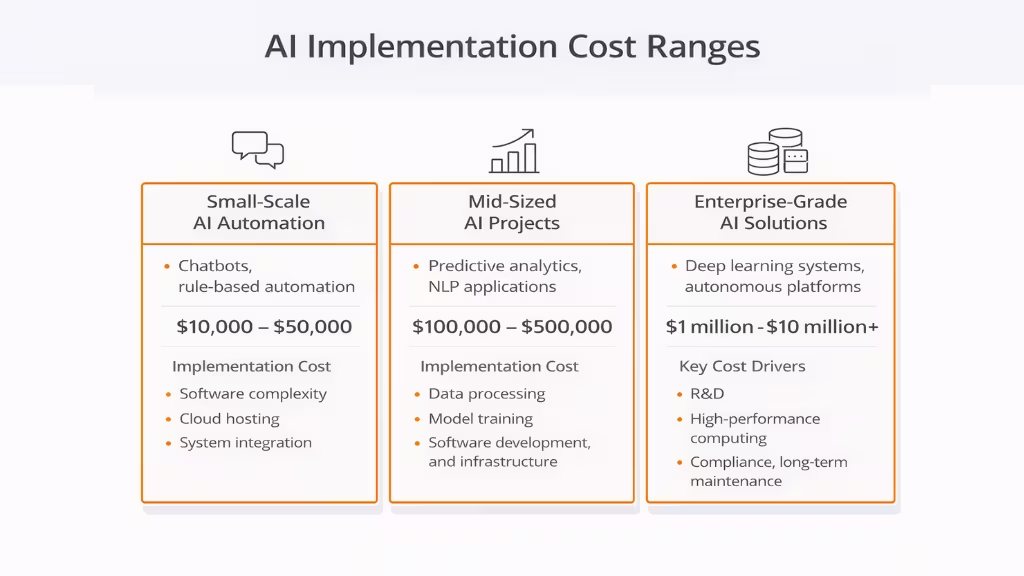
Given the cost factors outlined earlier, the total cost of AI implementation varies widely depending on project scope, technical complexity, and deployment scale. There is no standard price point for AI, but real-world implementations tend to fall into three broad categories.
1. Small-Scale AI Automation Projects
Basic chatbots or rule-based automation are generally the most accessible entry point. These systems rely on limited data, prebuilt models, and constrained usage. Costs typically range from $10,000 to $50,000, influenced by software complexity, cloud hosting needs, and the level of system integration required. While these projects are relatively affordable, they often provide narrow functionality and limited scalability.
2. Mid-sized AI Projects
Including predictive analytics and natural language processing applications involves higher complexity and deeper data requirements. These initiatives require structured datasets, model training or fine-tuning, software development, and reliable infrastructure. Implementation costs commonly fall between $100,000 and $500,000, reflecting the need for engineering effort, data processing, and production-ready deployment. At this level, AI begins to support core business decisions rather than isolated tasks.
3. Enterprise-Grade AI Solutions
Such as deep learning systems or autonomous decision platforms, represent the highest level of investment. These projects demand extensive research and development, high-performance computing resources, advanced security controls, and strict compliance measures. Total implementation costs often start at $1 million and can exceed $10 million, especially for large-scale or mission-critical systems. For enterprises, these initiatives are long-term strategic investments rather than standalone technology projects.
Beyond initial implementation, AI systems generate ongoing operational expenses. Cloud storage, API usage, periodic model retraining, infrastructure scaling, and security updates introduce recurring costs that accumulate over time. These long-term expenses frequently rival or exceed the original build cost, making cost planning and efficiency critical from the start.
Ongoing operational costs, including cloud storage, API usage, model retraining, infrastructure scaling, and security updates, continue after deployment and can significantly increase total lifetime spend.
Cost of Maintaining AI Systems
Maintaining AI systems is where long-term costs become visible. After deployment, AI requires continuous oversight to remain accurate, secure, and aligned with business needs. In many cases, maintenance expenses exceed initial development costs over time.
Model Monitoring and Performance Management
Once in production, AI models must be monitored for accuracy, bias, and performance drift. Changes in user behavior, data quality, or market conditions can degrade results without warning. Ongoing monitoring tools, alerting systems, and regular evaluations are required to keep outputs reliable. These activities create recurring operational costs that did not exist during development.
Retraining and Model Updates
AI models are not static. As new data becomes available or patterns shift, models must be retrained or fine-tuned. Retraining involves compute costs, engineering time, and validation efforts to ensure performance does not regress. For many organizations, retraining cycles occur quarterly or continuously, depending on use case sensitivity.
Infrastructure and Usage Scaling
As AI adoption grows, infrastructure usage increases. Higher request volumes, real-time inference needs, and expanded user access drive up cloud compute and storage costs. What starts as a manageable monthly expense can scale quickly, especially for customer-facing or data-intensive applications.
Security, Compliance, and Risk Management
Maintaining AI systems includes ongoing security reviews, access control updates, and compliance audits. Regulatory expectations evolve, requiring documentation updates and additional safeguards. These costs persist throughout the system lifecycle and are especially significant in regulated industries.
Operational Support and Engineering Oversight
AI systems require continuous involvement from engineers and operations teams. This includes troubleshooting, performance optimization, dependency updates, and incident response. Even when third-party platforms are used, internal oversight remains necessary to manage risk and reliability.
Typical Annual Maintenance Costs
Across most implementations, annual AI maintenance costs typically equal 15–30% of the original build cost. For example, a system that costs $100,000 to develop may require $15,000–$30,000 per year to maintain. At enterprise scale, annual maintenance can reach six figures, driven by infrastructure, staffing, and governance requirements.
Hidden Costs of Enterprise AI Implementation
Enterprise AI projects often look manageable at the planning stage. The real costs appear later, once systems are deployed, scaled, and used across the organization. These hidden expenses rarely sit in a single budget line, which makes them harder to control.
| Hidden Cost Category | Typical Impact | When It Hits |
|---|---|---|
| Upfront infrastructure & setup | $15,000 – $35,000/month during build | Before deployment |
| One-time development team cost | $270,000 – $340,000+ (mid-size project) | Before launch |
| Ongoing infrastructure | $25,000 – $35,000/month at production scale | After launch, recurring |
| Ongoing team management | $24,000 – $32,000/month | Continuous, post-launch |
| Full in-house team (annual) | $400,000+/year, salary only | Continuous |
| Data-related rework | Weeks of engineering time per cleanup cycle | Recurring as data scales |
| Ethical and legal compliance | 5% – 10% added to total cost | Ongoing, grows with regulation |
Upfront Costs
Initial enterprise AI costs go beyond model development. Early spending includes data audits, infrastructure setup, security reviews, and integration planning. Many of these costs are underestimated because they don’t directly involve “building AI,” yet they are required before deployment can begin.
Infrastructure alone is a significant piece of this. A mid-complexity AI build — GPU instances for training, CPU instances for serving, active + archival storage, networking, and support tooling like load balancing and monitoring — commonly runs $15,000–$35,000 per month just during the build phase, before the system is handling real traffic.
On top of infrastructure, there’s the one-time cost of assembling the team that builds the thing. For a mid-size project run over several months, combined data scientist, ML engineer, and DevOps time typically totals $270,000–$340,000 as a one-time development cost — separate from whatever you’re paying in ongoing salaries once the system is live.

Ongoing Costs
After launch, AI systems generate continuous expenses. Cloud usage, inference processing, monitoring tools, and system updates add recurring monthly costs. As usage increases, these expenses rise steadily rather than leveling off.
At production scale, infrastructure costs typically jump to $25,000–$35,000/month once serving and inference are running continuously rather than just training on a schedule. Layered on top of that, ongoing management — engineers and DevOps staff keeping the system tuned, monitored, and patched — adds another $24,000–$32,000/month. Testing, validation, and maintenance work together typically add 10–15% on top of the original build cost as a separate, recurring line.
Staffing and Training
Enterprise AI systems require constant human involvement. Engineers monitor performance, operations teams handle issues, and business users need training to work with AI outputs. Hiring or retaining skilled staff and running ongoing training programs creates long-term cost that often exceeds initial estimates.
A full in-house team spanning data science, ML engineering, and QA can run $400,000+/year in salary alone, before benefits or overhead:
| Role | Typical Cost Impact | Notes |
|---|---|---|
| Data Scientist | $120,000 – $180,000/year | Core to model building and analysis |
| Machine Learning Engineer | $130,000 – $200,000/year | Highest-cost technical role |
| AI Software Developer | $110,000 – $170,000/year | Integrates AI into existing systems |
| Project Manager | $100,000 – $160,000/year | Often underbudgeted or skipped early |
| QA Specialist | $90,000 – $140,000/year | Frequently the first role cut, at real risk to quality |
EU-based hires for the same roles typically run 30–45% lower, which is why dedicated-team or offshore arrangements are common cost-mitigation moves once a company sees these numbers.
Data-Related Costs
Data issues are one of the most common hidden expenses. Enterprise data is often inconsistent across systems. When AI begins operating at scale, gaps and errors surface, forcing teams to re-clean, re-label, and redesign data pipelines.
These costs repeat over time as new data sources are added. Most businesses start a project without enough clean, usable training data on hand, and a majority uncover errors or bias once they dig into their datasets — cleanup on a dataset of meaningful size routinely takes weeks of dedicated engineering time, not a quick pass.
Ethical and Legal Costs
AI systems must meet growing ethical and legal expectations. Bias testing, transparency documentation, privacy controls, and audit readiness introduce permanent overhead. As regulations evolve, compliance work expands rather than disappears, especially in regulated industries.
This typically adds another 5–10% to total AI cost, driven by frameworks like GDPR, CCPA, the EU AI Act, and the NIST AI Risk Management Framework — a list that keeps growing as more jurisdictions introduce AI-specific rules.
These expenses do not arrive all at once. They accumulate gradually across departments, vendors, and operational teams. Over several years, they often surpass the original AI development cost, even when the project is considered successful.
AI Implementation Cost by Industry
Enterprise AI implementation cost varies more by industry than by company size — regulatory load, data complexity, and integration depth differ a lot from sector to sector. Here’s roughly where full custom builds land today:
| Industry | Common AI Use Cases | Typical Cost Range |
|---|---|---|
| Manufacturing | Predictive maintenance, quality control, supply chain optimization | $400,000 – $800,000+ |
| Transportation & Logistics | Route optimization, autonomous vehicles, fleet management | $500,000 – $700,000+ |
| Finance | Fraud detection, risk assessment, algorithmic trading | $300,000 – $800,000+ |
| Automotive | Autonomous driving, predictive maintenance, in-car assistants | $600,000 – $900,000+ |
| Energy & Utilities | Smart grids, demand forecasting, energy management | $400,000 – $700,000+ |
| Healthcare | Predictive analytics, diagnostic tools, personalized medicine | $300,000 – $600,000+ |
| Real Estate | Property valuation, demand forecasting, virtual assistants | $250,000 – $600,000+ |
| Telecommunications | Network optimization, service automation, churn prediction | $300,000 – $500,000+ |
| Retail | Recommendation engines, inventory management, segmentation | $200,000 – $500,000+ |
| Education | Personalized learning platforms, performance analysis | $150,000 – $800,000+ |
A couple of patterns worth noting: manufacturing and transportation sit highest, largely because they involve physical-world integration (sensors, hardware, safety validation) on top of the software build. Education has the widest spread of any category — a simple learning-recommendation tool and a full adaptive-learning platform sit at opposite ends of that range, so the label alone tells you less than in other verticals.
If your business AI implementation expenses are landing well outside your industry’s range, that’s usually a signal to check scope creep before assuming the vendor quote is wrong.
Cost Differences Between In-House AI Development and External Providers
Choosing between building AI internally or working with external experts has a direct impact on cost, speed, and long-term risk. The difference is not just in pricing, but in how costs appear and grow over time.
In-House AI vs. External AI Providers: Cost Comparison
| Cost Area | In-House AI Development | External AI Providers |
|---|---|---|
| Upfront cost | High due to hiring, infrastructure, and setup | Lower, usually project- or subscription-based |
| Staffing expenses | Full-time AI engineers and specialists ($120k–$180k per role/year) | Included in service fees |
| Time to start | Slow due to hiring and onboarding | Faster due to ready teams and tools |
| Infrastructure cost | Fully owned and managed internally | Often included or usage-based |
| Ongoing maintenance | Fully handled by internal teams | Shared or managed by provider |
| Long-term cost | Can be lower at large scale over time | Can increase due to recurring fees |
| Flexibility and control | High control and customization | Limited by vendor tools and contracts |
| Risk of vendor lock-in | Low | Medium to high, depending on provider |
Pricing Models for AI Development
How you’re billed shapes your AI implementation cost as much as what gets built. Four models dominate the market, and picking the wrong one is a common way business AI implementation expenses spiral past budget.
1. Fixed-Price Model
Scope, deliverables, timeline, and total cost of adopting AI in business are agreed before work starts. Best suited for well-defined projects: an AI chatbot for a bank with specific intents and conversation flows mapped out in advance, a bookstore recommendation tool using basic filtering, short-term predictive maintenance builds, or an image recognition system with a clear accuracy target.
The upside is budget certainty — you know the exact cost of AI adoption upfront, and the vendor absorbs the risk of overruns. The downside: little room to change scope mid-build, vendors often inflate quotes to cover unknowns (raising your AI integration cost before work even starts), and even minor changes get complicated to manage within a locked scope.
2. Time and Material (T&M) Model
You pay for actual hours and resources used, at pre-agreed rates. Fits projects with evolving or unclear scope — a healthcare virtual assistant that adds symptom-checking or medication reminders as user feedback comes in, a computer vision system for a novel manufacturing process, a multi-phase retail analytics platform, or anything with high requirement uncertainty like autonomous drone systems.
T&M lets you adjust scope and budget as you go, and avoids locking into inaccurate upfront estimates. The tradeoff: enterprise AI implementation cost can climb past projection if no one’s tracking hours closely, and timelines can stretch without strict oversight.
3. Dedicated Team Model
A team works exclusively on your project, billed at fixed monthly rates or by hours worked. Suited to complex, custom builds needing sustained expertise — a bespoke predictive maintenance system integrated with proprietary machinery, an evolving e-commerce customer-insights platform, a medical research collaboration requiring ongoing clinical input, or infrastructure built to scale to millions of users.
You get focused expertise and consistent full-time support, which speeds iteration. But this is typically the highest small business AI costs option relative to project size — retaining a dedicated team is expensive for smaller companies, and success depends heavily on that team’s availability and performance.
4. Outcome-Based Pricing
Payment ties directly to hitting a predefined, measurable target rather than time or resources spent. Works for projects with clear success metrics: a recommendation engine judged on watch-time lift, a supply chain platform judged on inventory cost reduction, a fraud detection system judged on catch rate and false-positive rate, or an agriculture model judged on yield increase.
This aligns vendor incentives directly with your results and can be the most cost-effective model when outcomes are well-defined. The risk: disputes arise if metrics aren’t specified precisely, and your final cost of AI adoption stays uncertain until the outcome is actually hit.
Comparison Table
| Model | Best For | Pros | Cons |
|---|---|---|---|
| Fixed-Price | Well-defined scope, short-term builds | Predictable budget; vendor absorbs overrun risk | No flexibility mid-project; quotes often inflated for risk buffer |
| Time & Material | Evolving or unclear requirements | Flexible scope; budget adjusts as project develops | Costs can escalate without oversight; timeline creep |
| Dedicated Team | Complex, long-term, high-collaboration projects | Focused expertise; consistent full-time support | Expensive for smaller companies; depends on team availability |
| Outcome-Based | Projects with clear, measurable success metrics | Vendor incentives aligned with results; cost-effective if outcomes are met | Hard to define outcomes cleanly; final cost uncertain until goal hit |
Quick pick: tight budget, clear scope → fixed-price. Requirements likely to shift → T&M. Long-term strategic build needing deep focus → Dedicated Team. Results you can measure precisely → outcome-based.
Cost-Effective Ways to Test AI Before Full Deployment
Testing AI does not need a big budget. The safest way to start is to move step by step. This helps avoid spending money on systems that do not work or are not needed.
1. Start small. Do not try to build a full AI system at the beginning. Test whether the idea works before scaling it.
2. Use what already exists. Many AI tools and frameworks are already available and well supported. Using them saves time and money compared to building everything from scratch.
3. Build in small pieces. Simple and flexible design makes it easier to change or stop without losing large investments. This also reduces the cost of fixing mistakes later.
4. Work in short cycles. Test, review results, and adjust quickly. This prevents long development phases that fail late and cost more.
5. Outsource narrow tasks. Some work, like data labeling, is cheaper and faster when done by specialized providers instead of internal teams.
6. Use ready-made AI software when possible. Third-party AI tools can help test ideas faster and with fewer resources.
How to decide what to do
- If you only need to know whether AI can work, create a small proof of concept.
- If the budget is tight, avoid custom development and use existing tools.
- If speed matters, test in short cycles and adjust quickly.
- If your team is small, outsource specific tasks instead of hiring.
- If the future is unclear, keep systems simple and easy to change.
If you’re exploring AI adoption for your organization, you may also want to read:
👉How to Create an Effective AI Strategy
👉Best AI Software Development Companies to Work With in 2026
👉AI Outsourcing: How to Get It Right in 2026
👉How to Choose the Right AI Development Company for 2026 and Beyond
Examples of Successfully Deployed AI Projects
Case studies are useful for one reason: they turn abstract cost ranges into something a business can actually compare itself against. Here’s what five companies spent AI on, and what came back.
1. Siemens: predictive maintenance across factories
Siemens built Senseye, an AI system that flags equipment failures before they happen instead of after. The upside for plant managers is direct — unplanned shutdowns dropped by half, and maintenance spend fell by as much as 40% (Siemens). This is the model for manufacturers: the AI isn’t customer-facing, it’s a cost-avoidance play, and it pays back through fewer emergency repairs rather than new revenue.
2. Walmart: AI in supply chain and procurement
Walmart layered AI into supplier negotiations and inventory forecasting, moving from Google’s BERT to GPT-4 as its models matured. The chatbot-driven negotiation work alone trimmed supplier costs by 1.5%, and broader supply chain automation cut unit costs by 20% (AI Expert Network). At Walmart’s scale, a 20% unit-cost reduction is enormous — but the entry point was incremental, not a single big-bang rollout.
3. H&M: AI shopping assistant
H&M’s virtual shopping assistant handles product questions and recommendations across web and mobile. Roughly 70% of customer queries now get resolved without a human agent, chatbot-assisted sessions convert 25% more often, and live-agent workload dropped 40% (Creole Studios). This is the clearest case in the group for a self-funding project — support cost reduction and conversion lift both hit the P&L directly.
4. Netflix: recommendation engine
Netflix’s recommendation system isn’t a bolt-on feature — it’s core to how the platform functions for 195+ million subscribers. About 80% of what people watch comes from these recommendations, the system is estimated to save Netflix $1 billion a year in reduced churn (The Motley Fool), and 75–80% of total revenue is tied to personalization (Rebuy Engine). Netflix is the outlier here — this required years of investment and proprietary data most companies don’t have. It’s a ceiling, not a realistic first-year target.
5. Roofle: AI-powered quoting tool (SMB scale)
Not every case study needs to be an enterprise. Coherent Solutions built Roofle’s Roof Quote Pro, an AI tool that generates roofing quotes in about 40 seconds instead of a manual site visit. Within 8 months, the platform passed 500 subscribers with a 40% demo-to-close rate, and conversion rates rose 12% (Coherent Solutions). This is the more realistic comparison for a small or mid-size business budgeting a first AI project — a few months to measurable return, not a multi-year enterprise build.
Reading these together: the pattern isn’t “AI always pays off” — it’s that the projects with the clearest ROI had a narrow, well-defined task (quote generation, query resolution, failure prediction) rather than an open-ended mandate. That’s worth keeping in mind before scoping your own build.
Conclusion
AI becomes expensive when decisions are unclear. Costs increase when teams rush into development, underestimate data work, or treat AI as a one-time project instead of an ongoing system.
When AI is approached step by step, with early testing and a controlled scope, costs stay predictable. The biggest gains come from using AI where it actually changes outcomes, not where it simply sounds useful.
The real question is not whether AI costs money. It is whether the business is prepared to manage that cost over time. Organizations that plan for data, operations, and long-term ownership tend to see value. Those who don’t usually see overruns.
AI rewards discipline. Without it, even small projects become expensive.
FAQs About the Cost of AI for Business
How much does it cost to implement AI in a business?
AI implementation costs typically range from $5,000 for small pilot projects to $250,000 or more for enterprise deployments, depending on complexity, data readiness, and scale.
Is AI expensive to implement?
AI can be expensive if poorly planned. Costs rise quickly when data preparation, infrastructure, and long-term maintenance are underestimated.
What are the costs associated with AI implementation?
AI costs include data preparation, infrastructure, skilled talent, model development, system integration, compliance, and ongoing maintenance.
How much does AI cost per year?
Annual AI costs often equal 15–30% of the initial build cost, covering infrastructure usage, monitoring, retraining, and support.
What is the ROI of AI implementation?
ROI depends on use case and execution. AI delivers returns through productivity gains, better decisions, and automation when aligned with real business needs.
What are the hidden costs of AI?
Hidden costs include data rework, infrastructure scaling, security updates, compliance requirements, and internal training.
Is AI expensive to maintain?
Yes. AI systems require continuous monitoring, retraining, and infrastructure management, making maintenance a high long-term cost.
How long does it take to see ROI from AI?
Many businesses take months to several years to see ROI, depending on deployment scale and adoption speed.
What factors affect the cost of AI?
Key factors include data quality, model complexity, infrastructure usage, integration requirements, and regulatory obligations.
Is AI worth the investment for businesses?
AI is worth the investment when applied to clear business problems and managed with realistic cost expectations and long-term planning
This page was last edited on 13 July 2026, at 1:17 pm

Start a conversation with our team to solve complex challenges and move forward with confidence.