
Choosing the right AI development company means checking real technical depth, security, data ownership, industry experience, and post-launch support. A strong partner should focus on measurable ROI, start with a clear pilot, and help build AI automation that actually scales beyond demos.
AI is no longer a side experiment. Organizations poured well over $250 billion into artificial intelligence last year alone, and by 2028, roughly a third of enterprise software is expected to include agentic AI capabilities, up from almost nothing just a few years ago. Yet most companies still struggle to turn that investment into results — research shows the vast majority of AI pilots never move the needle on profit.
The gap between AI hype and AI ROI usually comes down to one decision: who you choose to build it with. Whether you’re searching for an AI software development company to modernize your core product or an AI agent development company to automate complex workflows, the vendor you pick will shape whether your AI initiative becomes a competitive advantage or an expensive shelf-ware project.
We know choosing the right AI development company can feel tricky. Many vendors promise “AI-powered” results, but not every team can deliver real implementation. That’s why we created this guide to show you what to check, which red flags to avoid, and what questions to ask before choosing an AI partner.
Why Choosing the Right AI Development Partner Matters
Unlike traditional software, AI systems sit directly inside your business processes. An AI agent or generative AI development pipeline touches customer data, internal knowledge, financial workflows, and decision-making in ways a typical web app never does. That means implementation quality has a direct, measurable impact on business outcomes — not just uptime.
A few realities worth knowing before you start evaluating vendors:
- Most companies have already deployed AI in at least one business function, yet the overwhelming majority have not seen a meaningful impact on their bottom line.
- Enterprises working with specialized AI development companies and structured partnerships succeed roughly twice as often as teams that attempt AI builds entirely in-house.
- AI capability is advancing faster than most annual planning cycles can absorb, which means the businesses moving early — and moving with the right partner — are compounding an advantage that’s difficult to close later.
In other words, this isn’t a decision to outsource to procurement alone. It’s a strategic call that determines whether your enterprise AI solutions actually reach production and deliver value, or stall out as disconnected pilots.
Before You Start: Define What You Actually Need
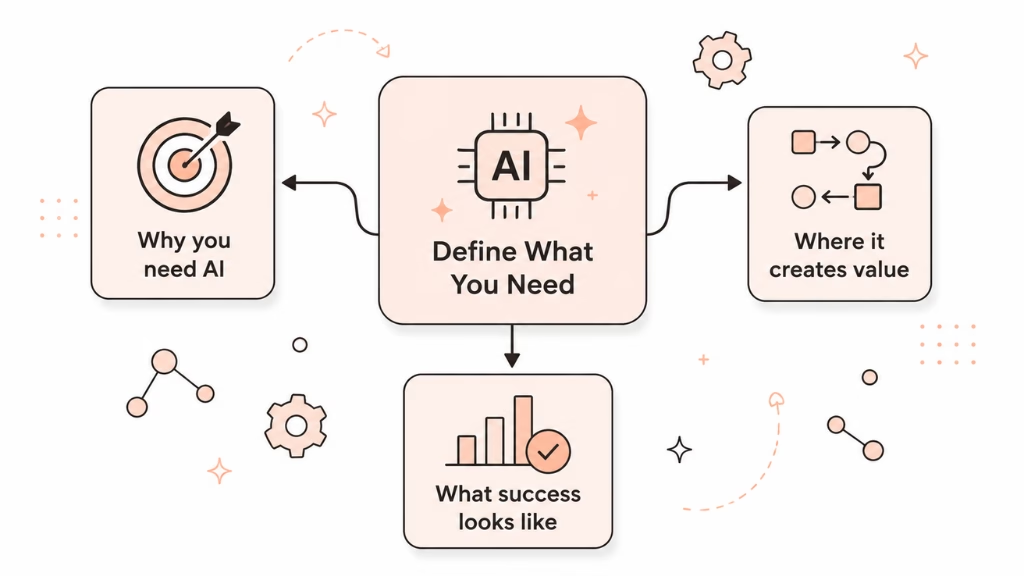
Before requesting proposals, get internal clarity on three things: why you need AI, where it can create the most value, and what outcome defines success. Skipping this step is the single most common reason companies end up comparing vendors on price instead of fit.
Some organizations need AI workflow automation to eliminate manual, repetitive processes. Others want generative AI development to reshape customer experience or agentic AI systems that can reason, plan, and execute multi-step tasks with minimal supervision. Many need a mix of all three.
If you’re not sure where to start, a strong AI consulting services partner should be able to help you map opportunities — but only if they take the time to actually understand your business first, rather than pitching a generic solution on the first call.
Key Criteria for Evaluating an AI Development Company
1. Technical Depth in Modern AI, Not Just “AI-Adjacent” Work
Look past marketing language and confirm the team has hands-on experience with the technologies your project actually requires: large language models (LLMs), retrieval-augmented generation (RAG), multi-agent architectures, workflow orchestration, and enterprise system integration. A genuine AI agent development company should be able to speak fluently about model selection trade-offs, not just demo a chatbot.
2. End-to-End Delivery Capability
A reliable AI implementation partner supports the full lifecycle: discovery and strategy, proof-of-concept, solution design, deployment, integration, and — critically — ongoing monitoring and optimization after launch. AI systems degrade or drift over time, so any partner who disappears after go-live isn’t offering true AI software development services, just a one-off build.
3. Industry and Domain Experience
AI challenges differ enormously by sector. Healthcare AI agents must navigate compliance and patient data regulations; financial services need audit trails and explainability; retail needs demand forecasting and personalization at scale.
A partner with relevant industry experience already understands your regulatory environment, your operational bottlenecks, and the workflows unique to your business — which shortens the learning curve dramatically.
4. Security, Governance, and Data Ownership
AI agents and models frequently touch sensitive business and customer data. Before signing anything, get clear, written answers to:
- Who owns the model, its outputs, and any data used in training?
- Where is data processed and stored, and can it move across your CRM, data warehouse, or ticketing systems securely?
- Can the vendor use your data to improve its own models without your explicit consent?
- What access controls, encryption, and compliance frameworks (SOC 2, HIPAA, GDPR, etc.) are in place?
Any hesitation or vagueness here is a serious warning sign, not a detail to sort out later.
5. Custom AI Software Development vs. Off-the-Shelf Tools
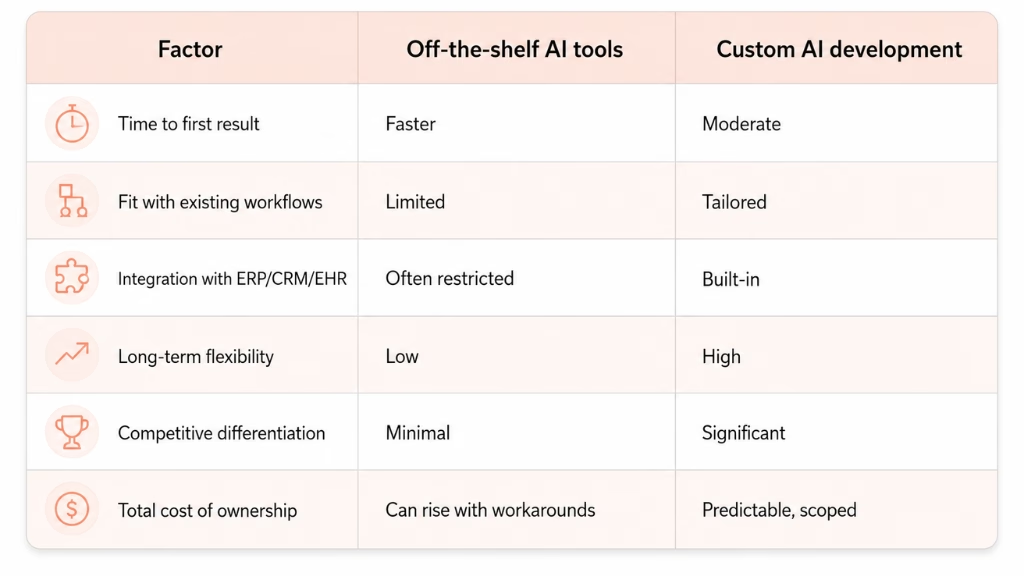
Generic, prebuilt AI tools can get you moving fast, but they rarely align with the nuance of your actual workflows, data structures, and compliance requirements.
Custom AI software development — and custom AI agent development specifically — is typically the better long-term investment because it’s built around your processes instead of forcing your processes to fit someone else’s product.
The trade-offs generally look like this:
6. Culture of Collaboration
The strongest AI automation company relationships function less like a vendor handing over a deliverable and more like an extension of your own team. You want a partner who challenges assumptions, asks hard questions before writing code, and treats the engagement as a shared outcome rather than a fixed-scope transaction.
7. Value, Not Just Cost
The cheapest quote is often the most expensive choice over 18 months if the solution doesn’t scale, integrate cleanly, or get adopted by end users. Evaluate total value: technical quality, collaboration, long-term support, and the vendor’s ability to tie their work back to measurable business outcomes — not just the hourly rate.
Green Flags vs. Red Flags
| Signal | Strong AI development partner | Weak vendor |
|---|---|---|
| First conversation | Starts with your business problem and expected ROI | Leads with a flashy model demo |
| Scope | Proposes a small, measurable pilot first | Pushes a large build immediately |
| Failure handling | Discusses hallucinations, evaluation, monitoring, fallback logic | Only talks about accuracy and capability |
| Team access | Introduces the actual engineers and technical lead | Senior staff sell, juniors deliver |
| Outcomes | Ties deliverables to a measurable metric before signing | Can’t connect the build to a business result |
| Data & IP | Clear, written terms on ownership and data use | Vague or evasive on ownership |
| Post-launch | Offers monitoring, optimization, and support plans | Disappears after deployment |
Questions to Ask Before You Sign
- What outcome will we measure, and by when?
- Who is the named technical lead, and will they actually write the code?
- How do you handle model failure, low-confidence outputs, and escalation to humans?
- Who owns the model, the outputs, and any data used for training or fine-tuning?
- How do you support enterprise digital transformation beyond this single project — can this scale into multi-agent systems or enterprise-wide deployment later?
- What does the engagement model look like: fixed-scope build, staff augmentation, or a discovery-to-MVP arrangement?
Choosing a Partner Based on What You Need
A new AI-powered product feature requires rigorous validation and, often, regulatory awareness — prioritize partners with proven accuracy under real-world conditions.
Customer service and support automation benefits from partners who design carefully for the exception cases, not just the happy path. Ask how the system escalates uncertain requests to a human.
Internal operations and business process automation rewards vendors who can move fast, replace fragmented tools, and tie their work to a clear operational metric like hours saved or error rate reduced.
Knowledge management and analytics projects need a partner comfortable with messy, large-scale data who can embed insights directly into your existing tools rather than building a disconnected demo.
Real-World Case Studies
Reading vendor claims is one thing; seeing what happens when an AI agent development company or in-house AI team ships something into production is another. Two well-documented examples show both the upside of getting AI implementation right — and what happens when scope and governance lag behind ambition.
Case Study 1: JPMorgan’s COiN — Custom AI for Contract Review
JPMorgan Chase built a custom AI system called COiN (Contract Intelligence) to automate the review of commercial loan agreements, running on a private cloud machine learning platform developed in-house. Before COiN, interpreting these contracts took lawyers and loan officers roughly 360,000 hours of work every year.
After deployment, the system could review the same volume of documents in seconds and also helped cut down loan-servicing errors tied to human misinterpretation of contract terms.
It’s a strong example of custom AI software development succeeding where a generic off-the-shelf tool likely couldn’t: the workflow was specific, high-volume, and repetitive enough to justify a purpose-built solution.
Case Study 2: Klarna’s AI Customer Service Agent — Scaling Fast, Then Rebalancing
Klarna launched an AI customer service assistant, built with OpenAI, across 23 markets in over 35 languages. In its first month, the assistant handled 2.3 million conversations — about two-thirds of Klarna’s total customer service chats — doing work the company estimated was equivalent to roughly 700 full-time agents, while cutting average resolution time from 11 minutes down to under 2.
The deployment is frequently cited as one of the most ambitious enterprise AI agent rollouts to date — but it’s also an instructive lesson in scope. By 2025, Klarna began reintroducing human agents for complex, emotionally sensitive, and high-stakes cases where the AI’s answers didn’t hold up as well as they did on routine queries.
The takeaway for anyone evaluating an AI implementation partner: agentic AI excels at high-volume, well-defined interactions, but a durable enterprise AI automation strategy still needs a clear, well-designed escalation path to humans for edge cases.
Both cases reinforce the criteria covered above: the strongest results come from a well-scoped use case, a partner who plans for failure modes and escalation, and a willingness to measure and adjust after launch rather than treating deployment as the finish line.
Where Your Company Is Based Matters, Too
Location and delivery model influence cost, time zone overlap, and talent depth. Many enterprises now work with an AI agent development company or other established outsourcing hubs to access deep engineering talent, competitive pricing, and mature enterprise software development capabilities without sacrificing quality — provided the vendor demonstrates the technical and security rigor outlined above.
What matters most isn’t geography itself, but whether the partner can prove enterprise-grade delivery regardless of where their teams sit.
Bringing It All Together
Choosing the right AI development company — whether you call it an AI software development company, an AI agent development company, or simply an AI implementation partner — is a strategic decision, not a procurement checkbox. The organizations that get real value from AI treat vendor selection the same way they’d treat a key hire: they look for proven technical depth, industry fluency, transparent data governance, and a genuine commitment to outcomes over demos.
Get the fundamentals right — clear goals, a rigorous evaluation process, a small measurable pilot, and a written agreement on data and ownership — and AI stops being a risky experiment. It becomes a durable part of how your business operates, scales, and competes.
Frequently Asked Questions
What’s the difference between an AI development company and an AI consultancy?
A consultancy typically advises on strategy and feasibility. An AI development company also builds, deploys, and supports the working software. The strongest partners do both, starting with consulting and carrying through to production.
How long does a custom AI agent project usually take?
A validated proof-of-concept can often be delivered in weeks; a full production build typically takes a few months, depending on integration complexity and data readiness.
Should we build an AI team in-house or hire an AI development company?
For most organizations starting out, a specialized vendor reaches production more reliably and faster. In-house teams make more sense once AI becomes core to your product and you can consistently attract and retain the right talent.
How do we protect our data when working with an AI vendor?
Put it in writing: who owns the model and outputs, where data is processed, and an explicit restriction on using your data to train the vendor’s other products without consent.
What industries benefit most from enterprise AI automation right now?
Customer service, finance and accounting, HR, supply chain, and IT operations are seeing the fastest, most measurable returns from AI agents and AI workflow automation today.
This page was last edited on 9 July 2026, at 11:08 am

Start a conversation with our team to solve complex challenges and move forward with confidence.